Roof insulation for pitched and flat roofs are two different products with different rules
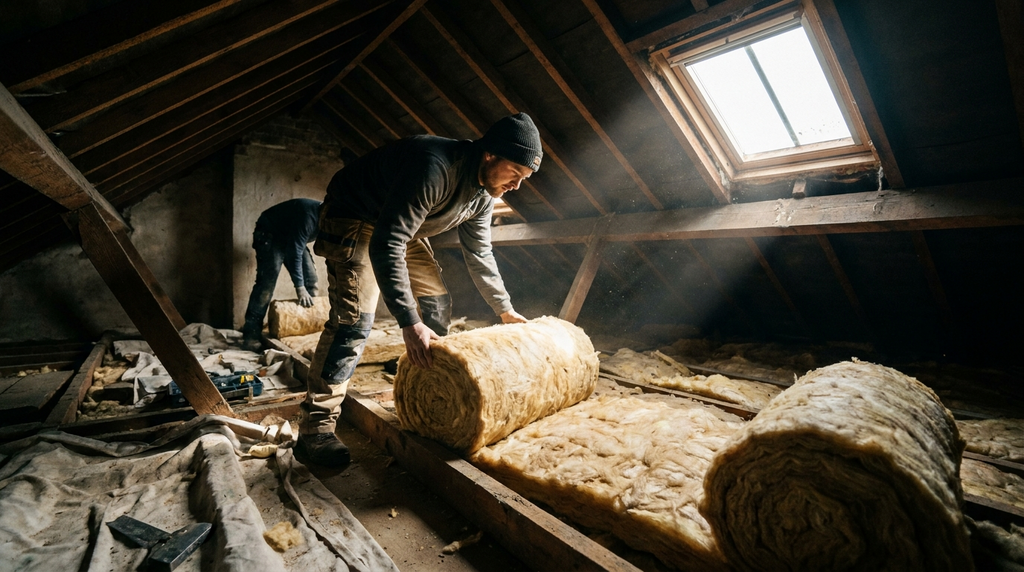
Pitched roof insulation and flat roof insulation are fundamentally different products that follow separate installation rules. Pitched roof insulation is typically installed between and over rafters, using materials like mineral wool, PIR boards, or sheep’s wool. Flat roof insulation is laid on top of the roof deck (warm roof) or between joists (cold roof), with rigid PIR or EPS as the common choice.
The building regulations set different minimum U-values for each type. A U-value measures how quickly heat passes through a material; lower numbers mean better insulation. Under Part L of the Building Regulations, updated for 2026, the minimum U-value for pitched roofs is 0.16 W/m²K and for flat roofs is 0.18 W/m²K (Approved Document L, DESNZ, 2026). A pitched roof loses heat through the loft space, while a flat roof loses heat directly to the outside, so the insulation strategy differs fundamentally.
The U-value target for pitched roofs in 2026 is 0.16 W/m²K, and for flat roofs 0.18 W/m²K
These U-values are the current minimum under Part L of the Building Regulations, as of the 2026 update (Approved Document L, DESNZ, 2025 revision, effective 2026). For a pitched roof, achieving 0.16 W/m²K typically requires 120–150mm of PIR insulation between rafters plus 50–100mm over the rafters, or 250–300mm of mineral wool between and over joists. For a flat roof using the warm roof method, 0.18 W/m²K usually needs 120–150mm of PIR insulation above the deck, depending on the board’s lambda value (Energy Saving Trust, 2026). The U-value is the primary metric; any installer quoting a job should provide the calculated U-value, not just a thickness.
Warm roof and cold roof are the two construction methods for flat roof insulation
A warm roof places insulation on top of the roof deck, with the waterproof membrane above it, keeping the structure warm and condensation risk low. A cold roof places insulation between the joists, with a ventilated air gap below the deck, requiring ventilation to avoid condensation. The 2026 building regulations strongly favour warm roofs for new builds and major renovations, because cold roofs are harder to insulate to the 0.18 target without thick joists (Approved Document L, DESNZ, 2026). For retrofit, a cold roof may be simpler if the existing deck is sound, but the ventilation requirement (minimum 50mm air gap) reduces insulation depth.
The cost difference between pitched and flat roof insulation in 2026
Pitched roof insulation using DIY mineral wool roll costs £8–£15 per m² for materials, or £20–£40 per m² installed (Energy Saving Trust cost guide, 2026). Pitched roof insulation using PIR boards with professional installation costs £25–£45 per m² installed, depending on rafter depth and access. Flat roof insulation using the warm roof method with EPDM membrane and PIR costs £60–£100 per m² fully installed, including vapour control layer and waterproofing (NFRC member pricing data, 2026). Flat roof insulation using the cold roof method with PIR between joists costs £40–£70 per m² installed, but may require deeper joists or a raised deck. The key trade-off is that flat roof insulation costs roughly 2–3 times more per m² than pitched, but the pitched roof may need loft boarding or access upgrades.
Quick numbers key stats for roof insulation comparison
| Row | Column 1 | Column 2 | Column 3 |
|---|---|---|---|
| 1 | Roof type | Pitched | Flat |
| 2 | Target U-value (2026) | 0.16 W/m²K | 0.18 W/m²K |
| 3 | Typical insulation depth (PIR) | 150–200mm | 120–150mm |
| 4 | Typical cost per m² installed | £20–£45 | £40–£100 |
| 5 | Annual heating bill saving (typical semi-detached) | £180–£260 | £120–£200 |
| 6 | Payback period | 3–7 years | 5–12 years |
| 7 | Installer certification needed | MCS (if using renewable heating) | MCS (if using renewable heating) |
Sources for cost and savings: Energy Saving Trust “Home Insulation” report, 2026, DESNZ “Energy Bill Savings from Insulation”, 2026, Ofgem “ECO4 eligible measures”, 2026. Savings assume a gas-heated semi-detached house with 100m² roof area, pre-insulation U-value of 0.5 (pitched) or 0.7 (flat). compare insulation cost vs savings for UK homes
The direct answer for most UK homes in 2026, pitched roof insulation is cheaper and easier, but flat roof insulation achieves better airtightness
Pitched roof insulation is the lower-cost option for standard houses with lofts, and can be DIY-installed with mineral wool for the lowest spend. Flat roof insulation, especially warm roof, is more expensive but seals the roof deck completely, reducing heat loss through the structure and improving airtightness (Energy Saving Trust “Flat Roof Insulation” technical note, 2026). The choice depends on your existing roof type: you cannot convert a flat roof to pitched without major structural work, and retrofitting a warm roof on a flat roof may require a new deck. If you have a pitched roof with a usable loft, consider “loft room” insulation (between and over rafters) for the same U-value as a flat roof, but this is more expensive than standard loft insulation.
How to verify an installer and check eligibility for government schemes
All roof insulation work should be carried out by an MCS-certified installer if you intend to claim ECO4, the Great British Insulation Scheme, or any renewable heat incentive (MCS Register, 2026). For flat roof insulation, the installer should also hold TrustMark registration and, if the roof is part of a new extension, FENSA or NICEIC certification for the associated work (TrustMark website, 2026). Check the installer’s public liability insurance (minimum £2 million) and ask for a written quote that includes the calculated U-value and insulation specification. For ECO4 eligibility, the property must have an EPC rating of D or below and the insulation must be installed by an MCS-certified contractor (GOV.UK “ECO4: guidance for households”, 2026). The Great British Insulation Scheme closed on 31 March 2026. It funded insulation measures only and never covered windows or glazing. check if your home qualifies for free roof insulation grants
Frequently Asked Questions
The minimum U-value for pitched roof insulation under Part L 2026 is 0.16 W/m²K. This requires 120-150mm of PIR between rafters plus 50-100mm over rafters, per DESNZ Approved Document L.
Flat roof insulation must achieve a U-value of 0.18 W/m²K under 2026 Building Regulations. A warm roof typically needs 120-150mm of PIR above the deck, according to the Energy Saving Trust.
A warm roof is generally better for flat roofs as it insulates above the deck, keeping the structure warm and reducing condensation risk. A cold roof insulates between joists and costs less but has higher condensation risk, notes the Energy Saving Trust.
Roof insulation costs £1,500-£4,000 for a typical UK home in 2026. Pitched roof insulation averages £2,000-£4,000, while flat roof insulation costs £1,500-£3,500, depending on material and method, per the Energy Saving Trust.
Yes, but only if you have building experience. Flat roof insulation must meet 2026 U-values (0.18 W/m²K) and comply with Part L. A warm roof requires careful waterproofing; mistakes risk condensation and leaks, so professional installation is recommended by the Energy Saving Trust.