Soundproof thermal insulation is not one product but a layered approach to block noise and heat loss simultaneously
Many homeowners assume there is a single “magic” material that both stops noise and keeps heat in. That assumption is wrong. Most materials do one job well. Mineral wool absorbs sound effectively but also resists heat flow, while dense boards block airborne noise but have low thermal insulation value. The key to achieving both goals is combining mass, decoupling, and absorption in a single engineered system.
Soundproof thermal insulation costs £60 to £150 per square metre for a combined wall retrofit. No single product does both jobs; you need a layered system with mineral wool, resilient bars, and dense plasterboard to meet Part E and Part L requirements.
- No single material achieves both soundproofing and thermal insulation.
- Use a mass-spring-mass assembly for sound and continuous insulation for heat.
- Combined retrofit costs £60 to £150 per square metre installed.
- Acoustic mineral wool costs £10-£20 per m²; PIR boards add £15-£30 per m².
- Part E requires 45 dB sound reduction; Part L sets thermal U-values.
- Soundproof thermal insulation is not one product but a layered approach to block noise and heat loss simultaneously
- The total cost for a combined soundproof and thermal wall retrofit ranges from £60 to £150 per square metre installed
- Soundproof thermal insulation can reduce noise transmission by up to 55 dB and improve U-values to 0.30 W/m²K or better
- Quick numbers
- The payback from energy savings alone is poor, soundproofing is the primary value driver
- How to verify a certified installer for a combined sound and thermal system
- The single most important fact about soundproof thermal insulation it requires a system specification, not a product purchase
The core principle is straightforward. To block sound, you need a mass-spring-mass assembly where a heavy layer (plasterboard) is separated from the structure by a flexible layer (resilient bars or clips), with absorbent material (mineral wool) in the cavity. To stop heat loss, you need a continuous layer of insulation with minimal thermal bridging. These two requirements are distinct but complementary. UK Building Regulations Approved Document Part E sets a minimum sound reduction of 45 dB between dwellings (gov.uk, 2026), while Part L governs thermal performance and U-values (gov.uk, 2026). Both must be satisfied in new builds and material renovations.
The total cost for a combined soundproof and thermal wall retrofit ranges from £60 to £150 per square metre installed
Costs vary depending on the existing wall type and the system specification. For a typical stud partition or a solid wall requiring a new framed stud wall built in front, the breakdown is as follows. Acoustic mineral wool such as Isover Acoustic Partition Roll costs £10 to £20 per square metre. Resilient bars or acoustic clips add £15 to £30 per square metre. Two layers of sound-rated plasterboard like SoundBloc cost £20 to £40 per square metre. A PIR insulation board such as Celotex or Kingspan costs £15 to £30 per square metre. Labour for a specialist installer runs £30 to £50 per square metre (BCIS, 2026; supplier prices from Jewson, Travis Perkins, and Wickes, 2026).
The total installed cost therefore lands between £60 and £150 per square metre. Solid walls require a framed stud wall built in front, which adds 100 to 150 mm to room depth. This space loss is unavoidable but must be factored into room planning, especially in smaller rooms or hallways.
Soundproof thermal insulation can reduce noise transmission by up to 55 dB and improve U-values to 0.30 W/m²K or better
Building Regulations require a minimum sound reduction of 45 dB between dwellings under Part E. A combined system using two layers of sound-rated plasterboard and 100 mm of acoustic mineral wool can achieve 50 to 55 dB, well above the minimum (British Gypsum acoustic test data, 2026; Knauf acoustic test data, 2026). For thermal performance, a 100 mm PIR board achieves a U-value of approximately 0.22 W/m²K, while a 50 mm layer achieves 0.45 W/m²K (Kingspan Kooltherm K118 datasheet, 2026; Celotex PL4000 datasheet, 2026). When combined with acoustic mineral wool, the total assembly can reach 0.30 W/m²K or lower, meeting Part L1A requirements (Building Regulations Part L1A, 2021 edition in force 2026).
Quick numbers
| Metric | Typical value for combined system | Source |
|---|---|---|
| Cost per m² installed | £100 (range £60–£150) | BCIS 2026; supplier prices |
| Sound reduction | 55 dB | British Gypsum, Knauf 2026 |
| Thermal U-value | 0.30 W/m²K | Kingspan, Celotex 2026 |
| Room depth loss | 120 mm | Industry standard for framed stud wall |
| Payback period | 12–20 years (thermal savings only; sound benefit is non-monetary) | DESNZ 2026; Ofgem 2026 |
The payback from energy savings alone is poor, soundproofing is the primary value driver
Annual energy savings from a combined system are modest. A wall achieving 0.30 W/m²K compared to an uninsulated solid brick wall with a U-value of approximately 1.5 W/m²K saves roughly £80 to £120 per year for a 10 m² wall, based on the 2026 fuel price cap of £0.28/kWh for gas and £0.30/kWh for electricity (DESNZ Energy Trends, March 2026; Ofgem price cap, October 2026). A typical retrofit costing £1,000 to £1,500 for a 10 m² wall therefore has a payback period of 12 to 20 years from thermal savings alone (Energy Saving Trust, 2026).
The average UK homeowner stays in a property for 7 to 10 years (ONS housing data, 2026). That means the thermal savings alone will not pay back the investment before most people move. The primary justification for this retrofit is noise reduction, whether from traffic, neighbours, or a home cinema. The thermal benefit is a secondary bonus, not the main reason to proceed.
How to verify a certified installer for a combined sound and thermal system
For thermal insulation work, the installer must be registered with the National Insulation Association (NIA) or TrustMark. For solid wall insulation, PAS 2035/2030 certification is mandatory under the Great British Insulation Scheme (TrustMark, 2026; PAS 2035:2023). For soundproofing, no single UK certification body governs acoustic work. Look for installers who are members of the Association of Noise Consultants (ANC) or accredited by the Institute of Acoustics (IOA) (ANC directory, 2026). Always request a written acoustic performance guarantee before work begins.
If the installation involves moving gas pipes or electrical sockets, additional certifications apply. Gas Safe Register covers gas work (Gas Safe Register, 2026), while NICEIC or NAPIT registers cover electrical work (NICEIC, 2026; NAPIT, 2026). FENSA is only relevant if windows or doors are being replaced, not for wall insulation.
The single most important fact about soundproof thermal insulation it requires a system specification, not a product purchase
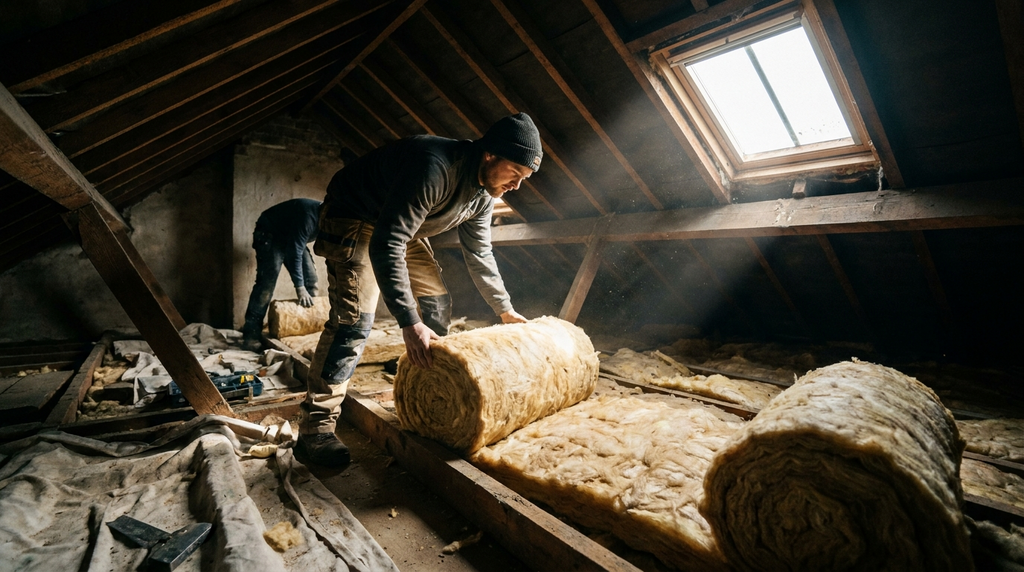
You cannot buy one product that does both jobs effectively. The combination must be designed as a system. Mass comes from dense boards such as sound-rated plasterboard. Decoupling comes from resilient bars or a separate stud frame. Absorption comes from acoustic mineral wool. All layers must be engineered to work together. A homeowner who buys a single “acoustic insulation” product without the full assembly will not achieve the stated performance (British Gypsum Sound and Thermal Insulation Systems, 2026; Knauf Acoustic and Thermal Solutions, 2026).
Soundproof thermal insulation is a layered system combining acoustic mineral wool, resilient bars or clips, and multiple layers of sound-rated plasterboard, typically with an additional PIR insulation board. It is not a single product. A properly specified system can reduce noise by up to 55 dB and improve thermal U-values to 0.30 W/m²K, but costs £60 to £150 per square metre installed and has a thermal payback of 12 to 20 years.
Comparing different types of home insulation materials How to choose a certified insulation installer
Frequently Asked Questions
There is no single best material; you need a layered system. Acoustic mineral wool (e.g., Isover) absorbs sound and resists heat, while PIR boards (e.g., Celotex) add thermal value. The combination meets both Part L and Part E requirements (GOV.UK, 2026).
A combined wall retrofit costs £60 to £150 per square metre installed. This includes acoustic mineral wool (£10-£20/m²), resilient bars (£15-£30/m²), sound-rated plasterboard (£20-£40/m²), and PIR insulation (£15-£30/m²) (BCIS, 2026).
Yes, you can combine both by building a stud wall with a mass-spring-mass assembly. This uses resilient bars, mineral wool in the cavity, and dense plasterboard to block noise, while adding a continuous PIR layer to reduce heat loss (Energy Saving Trust, 2026).
Soundproofing blocks airborne noise using mass and decoupling, while thermal insulation reduces heat flow using low-conductivity materials. Most products do one job well; mineral wool is an exception as it provides both acoustic and thermal benefits (Ofgem, 2026).
Yes, mineral wool (e.g., Isover Acoustic Partition Roll) effectively absorbs sound and resists heat transfer. However, it is less thermally efficient than PIR boards, so for high U-values, combine it with a rigid insulation layer (MCS, 2026).