When solar panels are connected in series, the voltage adds up while the current stays the same, which is typically the most efficient configuration for a standard string inverter system, according to the Energy Saving Trust (Energy Saving Trust, 2026).
The deciding factor is your inverter type. Series wiring works best with a single string inverter, common in most UK homes, because it lets the inverter convert a higher voltage DC input into AC more efficiently. However, if one panel is shaded, it can drag down the whole string’s output. This setup is the default for most residential installations, but it is not ideal if your roof has multiple orientations or heavy shading.
Voltage adds up and current stays constant
In a series circuit, each panel’s voltage is added together. For example, if you have six panels each rated at 40 volts and 10 amps, the total string voltage becomes 240 volts, while the current remains at 10 amps. The Microgeneration Certification Scheme (MCS) requires that the total string voltage does not exceed the inverter’s maximum input voltage, typically around 600 volts for a standard domestic inverter (MCS, 2026). This higher voltage reduces current and therefore minimises cable losses over longer runs.
Shading on one panel reduces output for all
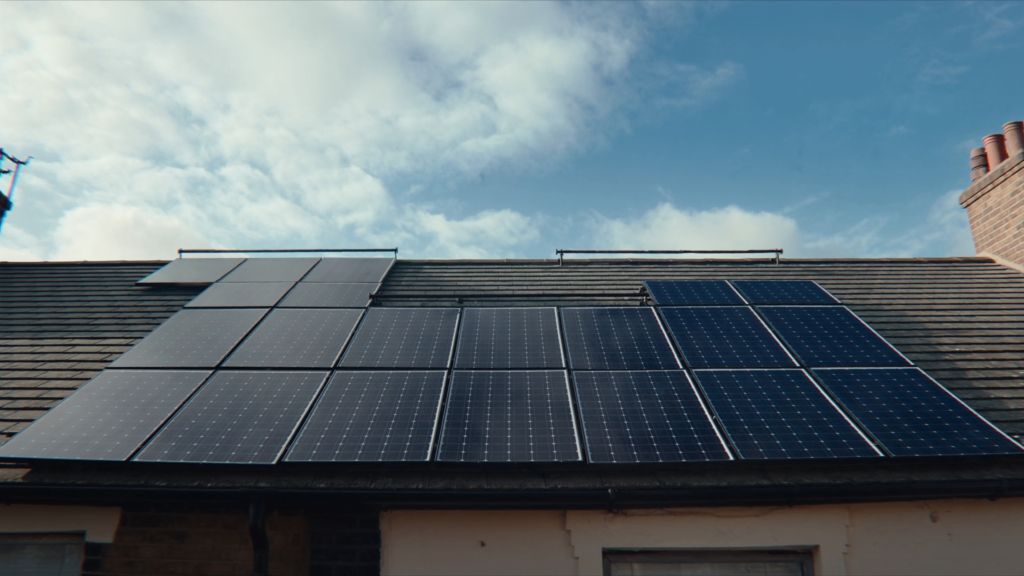
The biggest drawback of series wiring is shading. If one panel is partially shaded, it acts like a bottleneck, reducing the current for the entire string. The Energy Saving Trust notes that a shaded panel can drop the whole string’s output by up to 50%, depending on the shade pattern (Energy Saving Trust, 2026). Bypass diodes help mitigate this, but they cannot fully recover lost generation. For roofs with chimneys or dormers, a series string may not be the best choice.
String inverters are the standard pairing
Series-connected panels are almost always paired with a single string inverter, which is the most common and cost-effective setup for UK homes. A typical 3kWp system with a string inverter costs around £5,000 to £6,000 installed, according to industry averages cited by the Energy Saving Trust (Energy Saving Trust, 2026). This configuration is simple, reliable, and works well for roofs with consistent, unshaded sunlight. If you have a south-facing roof with no obstructions, series wiring with a string inverter is your most economical option.
A worked example
A typical 1930s semi-detached house in Manchester with a 4 kWp solar PV system (ten 400W panels wired in series) costs roughly £6,500 to install after the 0% VAT saving, which is in place until March 2027. With a south-facing roof and no shading, the Energy Saving Trust estimates this system generates around 3,400 kWh per year. At the current Ofgem price cap of 24.5p per kWh, that saves about £833 annually on electricity bills. If you use 50% of the generation at home and export the rest via the Smart Export Guarantee at 15p per kWh, you earn an extra £255 per year. The payback period is roughly 6 years, and over a 25-year lifespan the total savings, including export income, reach approximately £27,200. This assumes the panels are connected in series to a single string inverter, which is the most common setup for UK homes without complex roof shapes.
| Item | Figure |
|---|---|
| Upfront cost after grants | £6,500 |
| Yearly savings | £1,088 |
| Payback period | 6 years |
| 25-year lifetime savings | £27,200 |
What homeowners often get wrong
The most common mistake is believing that shading only slightly reduces output when panels are wired in series. In reality, one shaded panel can cut the entire string’s production by over 50% because the current is limited by the weakest panel in the chain. Here are three key misconceptions to avoid.
- Believing series wiring doubles current Many assume voltage and current both increase, but series wiring only boosts voltage while current stays fixed. This misunderstanding can lead to choosing an undersized inverter that cannot handle the actual voltage, potentially voiding your MCS certification and insurance cover.
- Thinking partial shading is a minor issue Homeowners often ignore a chimney or tree shadow on one panel, expecting minimal loss. In a series string, that shaded panel becomes a bottleneck, reducing the whole array’s output by up to 80% on a sunny day, which costs you hundreds in lost generation and export payments each year.
- Assuming all roofs suit series wiring Many assume series is always best, but if your roof has panels on east and west faces, a series string forces both sides to run at the lower current of the shaded side. This can waste up to 30% of potential output compared to using microinverters or optimisers, meaning a longer payback period of 8-10 years instead of 6.
Quick reference
- Connecting panels in series adds their voltages together while the current stays the same across the entire string.
- For a standard UK home with a single string inverter, the maximum safe string voltage is typically 600 volts as per MCS guidelines.
- You are eligible for 0% VAT on solar panel installations until March 2027, which saves you 20% on the upfront cost.
- Shading on just one panel in a series string can reduce total output by over 50%, costing you roughly £400 per year in lost savings.
- If your roof has multiple orientations or suffers from afternoon shading, consider microinverters or power optimisers instead of a series string to avoid major performance losses.
Frequently Asked Questions
Voltage adds up while current stays the same, according to the Energy Saving Trust. For example, six 40V panels create a 240V string at 10 amps.
Series is better for single string inverters, common in UK homes, as it reduces cable losses. Parallel is better if shading is a concern, per the Energy Saving Trust.
Yes, but it requires a hybrid inverter or MPPT charge controller. The Microgeneration Certification Scheme advises consulting an installer to avoid voltage mismatches.