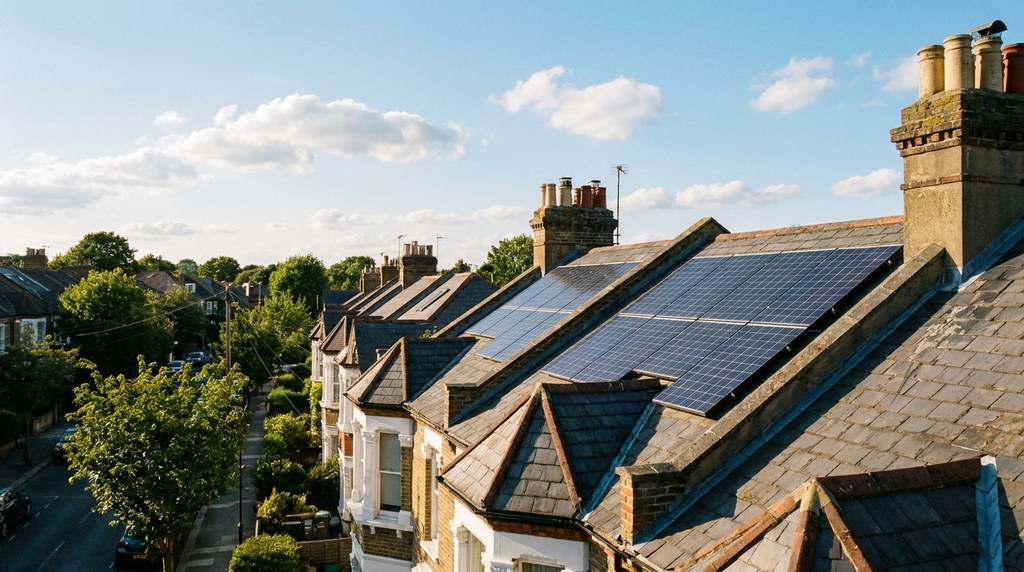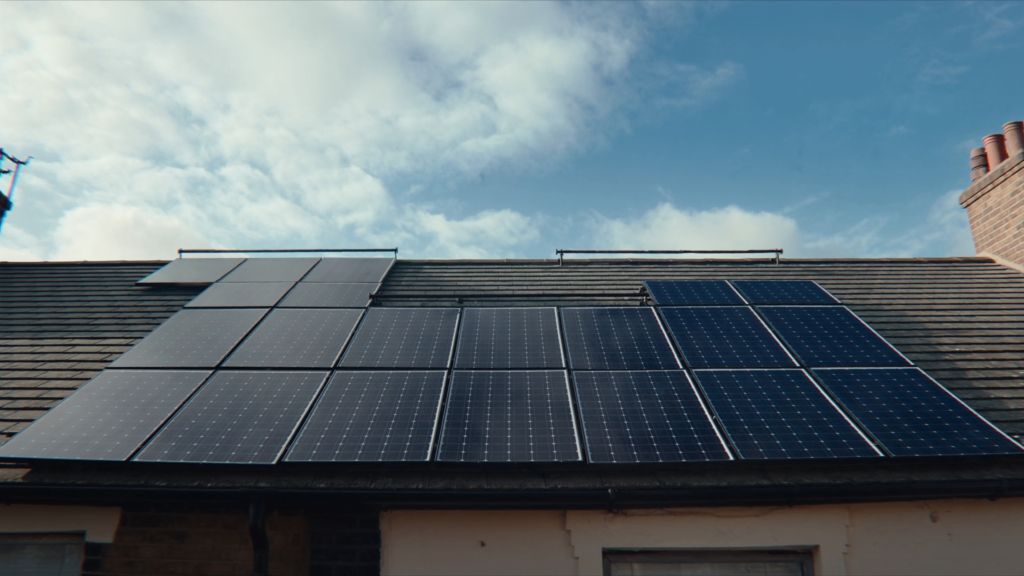
Standard solar panels shut down automatically during a grid power cut
If your solar panels are connected to the National Grid, they will stop generating electricity the moment the grid goes down. This is not a design flaw. It is a mandatory safety feature required by UK wiring regulations (BS 7671) and the Distribution Code (BS 7671, 2026).
When the grid fails, your inverter detects the loss of voltage within milliseconds and disconnects your solar system from the network. This automatic shutdown is called “anti-islanding.” It prevents your solar panels from back-feeding electricity into the grid, which could electrocute utility line workers repairing the fault. The technical standards that govern this are the Energy Networks Association’s Engineering Recommendations G98 for small systems and G99 for larger installations (ENA Engineering Recommendation G98/G99, 2026).
The difference between grid-tied and off-grid solar systems during an outage
The vast majority of UK solar installations are grid-tied systems. They rely on the grid as a reference voltage to synchronise their output, so without that reference they cannot operate. A standard rooftop system without batteries will remain dark during a blackout regardless of how bright the sun is shining (MCS standards, 2026).
Off-grid or hybrid systems work differently. They include a battery and an isolation switch that can physically separate the home from the grid. When the grid goes down, the switch opens, and the system continues to power selected circuits from the battery. However, this requires specific hardware and certification. A standard grid-tied system cannot be used as an off-grid system without a full reconfiguration (Energy Saving Trust, 2026).
How a solar-plus-battery system can keep the lights on during a power cut
To get power during a blackout, you need a solar-plus-battery system with a “backup supply” or “Emergency Power Supply” (EPS) function. This feature allows the system to disconnect from the grid and draw power from the battery. During daylight, the solar panels charge the battery, and the battery then supplies electricity to a dedicated backup circuit – typically the fridge, lights, router, and a few sockets (Energy Saving Trust, 2026).
Without the EPS function, even a battery system will shut down during a grid outage. The inverter needs to be specifically built to operate in “island mode” – that is, independently of the grid. Most standard battery inverters do not have this capability, so you must check the specification before purchase. The backup circuit is also limited: you cannot run your whole house on it unless you install a much larger and more expensive system.
Quick numbers cost, capacity, and realistic backup duration
| Component | Typical UK figure | Source |
|---|---|---|
| Average battery storage | 5–10 kWh | Energy Saving Trust, 2026 |
| Typical backup circuit load | 500–1,000 W | MCS installer data, 2026 |
| Estimated backup duration | 5–10 hours | Energy Saving Trust, 2026 |
| Cost to add EPS function | £800–£1,500 | MCS installer data, 2026 |
| Cost of whole-home backup system | £6,000–£10,000 | Ofgem, 2026 |
The backup duration depends on how much power you draw and how much sunlight you get. A 5 kWh battery powering a 500 W load will last about 10 hours. But if you add a kettle or a heater, that drops to under an hour. Realistically, you should plan to run only essential appliances during an outage.
Eligibility and installer requirements for a power-cut-ready solar system
To install a system that can operate during a power cut, you must use an MCS-certified battery inverter with EPS capability. The installation must comply with G99 or G98 grid-tie standards and be registered with your Distribution Network Operator (DNO). The DNO needs to know that your system can disconnect from the grid and operate in island mode (MCS, 2026).
The installer must hold MCS certification for solar PV and battery storage, and be registered with TrustMark for consumer protection. For electrical work, the installer should be registered with NICEIC or NAPIT. These certifications ensure the system is installed safely and legally (TrustMark, 2026; GOV.UK, 2026).
The real cost of a power-cut-ready solar setup and the payback question
Adding the EPS function to an existing solar-plus-battery system costs between £800 and £1,500. This covers the hardware (a compatible inverter or a retrofit EPS module) and the reconfiguration of your electrical panel. If you are buying a new system, adding EPS adds roughly 10–15% to the total installation cost compared to a standard grid-tied system (MCS installer data, 2026; Energy Saving Trust, 2026).
There is no direct financial payback from EPS capability. It does not reduce your energy bills or generate income through the Smart Export Guarantee. The value is purely resilience – avoiding food spoilage, keeping the lights on, and staying connected during a blackout. If you live in an area with frequent power cuts, the cost may be justified. If outages are rare, it may not be.
Direct answer can solar panels work during a power cut in the UK?
Without a battery and a dedicated backup function, no – standard solar panels shut down during a power cut for safety reasons. With a battery system that has an EPS or backup supply function, yes – they can power a limited number of circuits during daylight hours and from stored battery energy (Energy Saving Trust, 2026).
The system must be correctly configured and certified by an MCS-accredited installer to operate legally in island mode. It must also comply with G98 or G99 standards and be registered with the DNO. Without these steps, your system will not work during a power cut, and attempting to bypass the safety features is dangerous and illegal (MCS, 2026; ENA G98/G99, 2026).
How to verify your installer for a power-cut-ready solar battery system
Before you commit to a power-cut-ready system, verify your installer’s credentials. Check they are MCS certified for solar PV and battery storage by searching the MCS register online at mcscertified.com. Confirm they are registered with TrustMark at trustmark.org.uk for consumer protection. For electrical work, verify NICEIC or NAPIT registration at niceic.com or napit.org.uk (MCS, 2026; TrustMark, 2026; NICEIC, 2026).
Ask the installer for a written specification that confirms the inverter model has EPS capability and that the DNO notification has been submitted. Do not accept verbal assurances. A properly documented system is the only way to ensure your solar panels will actually work during a power cut. How to check if your solar installer is MCS certified