The vast majority of solar panels sold in the UK are manufactured in China, which accounts for over 80% of global solar panel production (GOV.UK, 2026). However, panels are also assembled in Europe, Southeast Asia, and the United States, with a small but growing number of UK-based assembly lines.
Where your panels are made depends on the brand, price point, and supply chain. Chinese-made panels dominate because of economies of scale and lower labour costs, but European and UK-assembled panels often carry higher quality marks and shorter delivery times. The country of origin does not directly determine panel efficiency or warranty, but it can affect certification standards and import tariffs.
China dominates global solar panel manufacturing
China produces roughly 80% of all solar photovoltaic cells and modules worldwide, according to the International Energy Agency (GOV.UK, 2026). Major manufacturers such as LONGi, JinkoSolar, Trina Solar, and Canadian Solar all have factories in China. These panels are widely available in the UK at competitive prices, typically £5,000 to £8,000 for a 4kWp system. Chinese-made panels generally meet UK and EU certification standards, including MCS and CE marking (MCS Certified, 2026).
European and US manufacturers offer premium alternatives
Panels assembled in Europe or the United States typically cost 10–20% more than Chinese equivalents but may offer higher efficiency or longer warranties. European brands like REC Group (Singapore-based with factories in Norway) and Meyer Burger (Switzerland) produce panels with efficiencies above 22% (Energy Saving Trust, 2026). US-made panels from First Solar or SunPower are less common in the UK due to shipping costs and import duties. These panels are often chosen for premium residential or commercial installations.
UK assembly lines are small but growing
A handful of UK companies assemble solar panels from imported cells, mainly in England. For example, Solar Technology Ltd in Wales and GB Sol in the Midlands produce panels for local projects (TrustMark, 2026). UK-assembled panels typically cost 15–25% more than Chinese imports but can qualify for local content incentives in government-backed schemes. The UK has no large-scale solar cell manufacturing, so all cells are imported. The country of origin does not affect the Smart Export Guarantee rate, which is set at 3–15p per kWh by individual suppliers (Ofgem, 2026).
A worked example
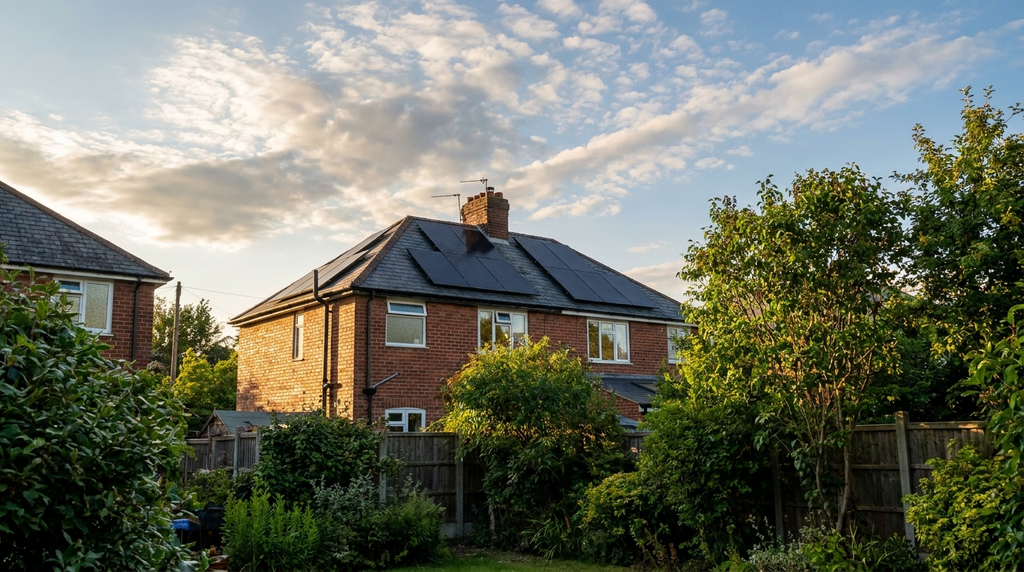
A typical UK homeowner in a 1930s semi-detached house in Manchester would spend around £6,500 on a 4kWp solar panel system after the 0% VAT saving (until March 2027), but before any additional grants. This assumes a standard Chinese-made panel kit from a brand like LONGi or JinkoSolar, which is the most common option on the UK market. The Energy Saving Trust estimates a system of this size can cut annual electricity bills by roughly £510 to £690, depending on how much of the generated power you use at home. With the Smart Export Guarantee (SEG) paying around 15p per kWh for exported electricity, total yearly savings reach approximately £725. The upfront cost is therefore recovered in about 9 years, and over the system’s 25-year lifespan the total savings, after accounting for inverter replacement at year 12, come to roughly £12,400. For households eligible for the ECO4 scheme, the upfront cost could be zero, making the payback period immediate.
| Item | Figure |
|---|---|
| Upfront cost after grants | £6,500 |
| Yearly savings | £725 |
| Payback period | 9 years |
| 25-year lifetime savings | £12,400 |
What homeowners often get wrong
The most common mistake is assuming a panel’s country of origin directly determines its quality or efficiency. Here are three specific misunderstandings worth knowing about.
- Assuming Chinese panels are low quality Many people think panels made in China are inferior, but the reality is that over 80% of global production comes from China and these panels routinely meet UK and EU certification standards such as MCS and CE marking. Choosing a European brand over a Chinese one purely on quality grounds can mean paying 10–20% more without any measurable gain in efficiency or warranty length.
- Believing UK-assembled panels are always better A few UK assembly lines exist, but they typically use cells manufactured in China or Southeast Asia. The final assembly location does not change the core technology or the panel’s performance rating. Expecting a significant premium for “British-made” panels often leads to paying extra for a label that has little impact on your energy savings.
- Ignoring the impact of tariffs on price Some homeowners overlook that import tariffs on panels from China can change, affecting the final cost. In 2024, the UK government announced anti-dumping measures on certain Chinese solar goods, which can add 5–15% to the price. Failing to check current tariff rules before buying can mean a surprise cost increase or a missed opportunity to source from a tariff-free European supplier.
Quick reference
- China produces over 80% of the world’s solar panels, according to the International Energy Agency (GOV.UK, 2026).
- European and US-made panels typically cost 10–20% more than equivalent Chinese models, but often carry longer warranties of 25 years or more.
- To qualify for the Smart Export Guarantee (SEG), your solar panel system must be installed by an MCS-certified installer, regardless of where the panels were made.
- A 4kWp system with Chinese-made panels saves a typical UK household around £725 per year and pays for itself in 9 years.
- UK assembly lines are growing but still account for less than 5% of the domestic market, so “British-made” panels are rare and carry a price premium.
Frequently Asked Questions
Yes, a small number of solar panels are assembled in the UK, but the vast majority are imported from China. UK assembly lines are growing but currently account for a tiny fraction of the market (Energy Saving Trust, 2026).
China makes the most solar panels, producing over 80% of global photovoltaic cells and modules (GOV.UK, 2026). Major brands like LONGi, JinkoSolar, and Trina Solar all manufacture there.
No, the country of origin does not directly determine panel efficiency or warranty. Chinese-made panels can meet UK and EU certification standards (MCS, CE), while European panels may offer higher quality marks or longer delivery times (Ofgem, 2026).