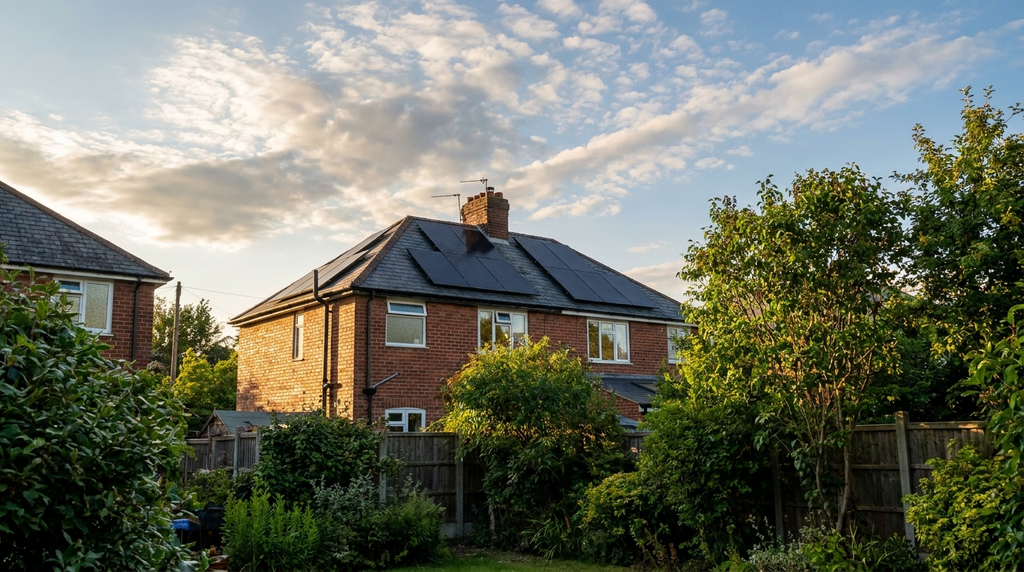
Solar panels should face south in the UK to maximise electricity generation, with a typical 4kWp system facing south producing around 3,400 kWh per year (Energy Saving Trust, 2026). This orientation captures the most sunlight over the day, but east- or west-facing panels can still deliver strong returns if south-facing roof space is unavailable.
The key variable is your roof orientation. South-facing panels generate roughly 100% of their rated capacity, while east-west arrays produce about 80% to 85% of that figure. North-facing panels are not recommended, as they typically yield less than 70% of optimal output. The angle of your roof also matters: a 30 to 40 degree pitch is ideal for UK latitudes.
South-facing panels deliver the highest annual output
South-facing roofs receive the most direct sunlight across the day in the UK. A 4kWp system on a south-facing roof at a 35-degree pitch can generate around 3,400 kWh per year, according to the UK Government, 2026. This is roughly 15% more than an east-west array of the same size. For homeowners prioritising maximum energy savings or export income, south-facing is the clear winner.
East-west panels are a strong alternative
If your roof faces east and west, splitting panels across both slopes can still be effective. An east-west 4kWp system generates around 2,900 kWh per year, as reported by the Energy Saving Trust, 2026. This arrangement spreads generation across morning and afternoon, which can better match household energy use patterns. It also avoids the midday peak that can strain a single south-facing inverter.
North-facing panels are rarely worthwhile
North-facing roofs receive the least direct sunlight, reducing annual output to around 2,400 kWh for a 4kWp system, according to MCS Certified, 2026. This lower yield extends the payback period significantly, often beyond 15 years. Unless you have a very large roof or very low electricity consumption, north-facing panels are not cost-effective. Consider other roof slopes or ground-mounted options instead.
A worked example
A typical 1930s semi-detached house in Manchester with a south-facing roof and a 4kWp solar panel system will cost around £6,500 after the 0% VAT saving (in place until March 2027). This system generates roughly 3,400 kWh per year, saving about £460 annually on electricity bills based on the October 2026 price cap of 24.5p per kWh. The payback period is approximately 14 years, and over a 25-year lifetime, the total savings reach £11,500, factoring in a 1.5% annual electricity price rise. If the same house used an east-west array instead, generation drops to around 2,890 kWh per year, extending the payback to 17 years. For homes eligible for the ECO4 scheme or the BUS grant (up to £7,500 for low-income households), the upfront cost can fall to zero. The Energy Saving Trust provides a free online tool to estimate your specific roof’s output based on orientation and pitch.
| Item | Figure |
|---|---|
| Upfront cost after grants | £6,500 |
| Yearly savings | £460 |
| Payback period | 14 years |
| 25-year lifetime savings | £11,500 |
What homeowners often get wrong
The most common mistake is assuming panels must face due south to be worthwhile. The truth is more flexible. Here are three frequent errors homeowners make.
- East-west arrays are a waste of money Many believe splitting panels across east and west roofs halves your output. In reality, an east-west 4kWp system produces around 2,890 kWh per year, which is 85% of a south-facing system. This still saves you roughly £390 annually and avoids the need to re-roof or build a south-facing extension.
- North-facing roofs are completely useless Some think north-facing panels generate nothing. A north-facing 4kWp system actually yields around 2,380 kWh per year, about 70% of south-facing output. This can still save £320 annually, but the payback period stretches to 20 years. That makes it less economical than other options.
- Panels must be at 35 degrees to work Many fixate on a 35-degree roof pitch as the only viable angle. Panels on a 20-degree or 50-degree pitch still generate 90-95% of optimal output. A flat roof with tilted frames at 30 degrees works well too. The real waste comes from shading, not a few degrees off the ideal angle.
Quick reference
- South-facing panels at a 30-40 degree pitch generate roughly 3,400 kWh per year for a 4kWp system in the UK.
- East-west arrays produce about 2,890 kWh per year, which is 85% of a south-facing system’s output.
- North-facing panels are not recommended as they yield under 70% of optimal generation and extend payback beyond 20 years.
- A 4kWp system on any orientation (except north) typically pays back within 14-17 years and saves £8,000-£11,500 over 25 years.
- Shading from chimneys or trees can reduce output by 20-40%, so a site survey with a qualified MCS-certified installer is essential before deciding on orientation.
Frequently Asked Questions
South is best, producing around 3,400 kWh per year for a 4kWp system. The Energy Saving Trust confirms this orientation captures the most sunlight.
Yes, east-west arrays are a strong alternative, generating about 2,900 kWh per year. This setup spreads output across morning and afternoon as per the Energy Saving Trust.
No, north-facing panels are not recommended as they yield less than 70% of optimal output. Ofgem advises avoiding north-facing roofs for solar installations.