A solar diverter costs roughly £500–£800 installed, which is about one-tenth the price of a full battery storage system.
A solar diverter is a control device that redirects surplus electricity from your solar panels to an immersion heater in your hot water cylinder. Without a diverter, any excess generation is exported to the grid and you receive a low payment under the Smart Export Guarantee (SEG), typically 4–8p/kWh (Ofgem, 2026). By using that surplus to heat water instead, you displace gas or electricity you would otherwise buy at 25–30p/kWh, making the diverter a direct bill saver.
A solar diverter costs £500-£800 installed and saves £80-£180 per year by heating water with surplus solar. It pays back in 2-5 years and raises self-consumption from 40% to 60-70%.
- A solar diverter costs £500-£800 installed, about one-tenth of a battery.
- It raises self-consumption from 40% to 60-70% on a typical home.
- Payback period is 2-5 years depending on hot water usage and export tariff.
- Annual savings of £80-£180 if displacing electric immersion heating.
- Diverter only activates when generation exceeds household demand, never imports grid power.
- A solar diverter costs roughly £500–£800 installed, which is about one-tenth the price of a full battery storage system.
- A solar diverter raises self-consumption from roughly 40% to 60–70% on a typical home.
- Quick numbers what a solar diverter costs, saves, and pays back
- A solar diverter works with any solar PV system that has a compatible immersion heater.
- The direct answer a solar diverter turns your hot water cylinder into a free-heat battery using solar surplus.
- To qualify for grants or the Smart Export Guarantee, you must use an MCS-certified installer.
- A solar diverter does not replace a battery, but it can be a cheaper first step for hot water storage.
The payback period is typically 2–5 years, depending on your household hot water usage and your export tariff (Energy Saving Trust, 2026). A diverter costs roughly £500–£800 installed, which is about one-tenth the price of a full battery storage system.
A solar diverter raises self-consumption from roughly 40% to 60–70% on a typical home.
Without storage, a standard solar PV system exports around 60% of its generation, meaning you only use about 40% directly in your home (Energy Saving Trust, 2026). A solar diverter captures 20–30 percentage points of that export for hot water, improving overall self-consumption to 60–70%. This means you keep more of the energy your panels produce, reducing the amount you import from the grid.
The diverter only activates when generation exceeds household electrical demand, so it never imports grid power to heat water. It is a passive system that switches on and off automatically based on real-time generation and consumption.
Quick numbers what a solar diverter costs, saves, and pays back
| Metric | Typical value | Notes |
|---|---|---|
| Upfront cost installed | £500–£800 | Includes diverter unit, wiring, and labour (MCS register, 2026) |
| Annual electricity bill saving | £80–£180 | If displacing electric immersion heating (Energy Saving Trust, 2026) |
| Annual gas bill saving | £60–£140 | If displacing gas boiler heating of hot water |
| Payback period | 2–5 years | Depends on hot water use and export tariff |
| Lifespan | 10–15 years | Similar to the solar PV inverter lifespan |
A solar diverter works with any solar PV system that has a compatible immersion heater.
The diverter is a control device, not a generation source. It requires an existing solar PV array and a hot water cylinder with an immersion heater. Most modern cylinders have a standard 3kW immersion element, and the diverter simply switches on when grid export is detected (MCS, 2026).
Systems with a heat pump or combi boiler that has no hot water cylinder cannot use a diverter for hot water. If you have a combi boiler, you would need to install a separate hot water cylinder to use a diverter, which adds significant cost and space requirements.
The direct answer a solar diverter turns your hot water cylinder into a free-heat battery using solar surplus.
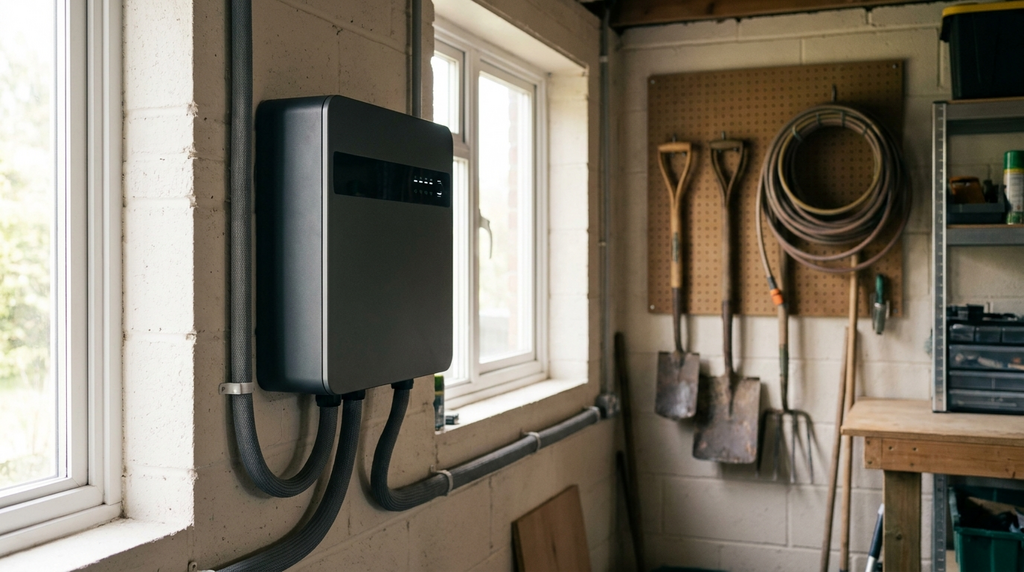
A solar diverter is a small box, about the size of a WiFi router, wired into your consumer unit and immersion heater circuit. When your solar panels generate more than your home is using, the diverter sends that excess power to the immersion heater. It stops heating once the water reaches your cylinder thermostat setting, usually 60°C, or when generation drops below household demand (MCS, 2026).
There are no batteries involved and no grid interaction. You are simply using power you would otherwise export for free to heat water that you would otherwise pay to heat with gas or electricity.
To qualify for grants or the Smart Export Guarantee, you must use an MCS-certified installer.
The Microgeneration Certification Scheme (MCS) certifies installers for solar PV and diverter installations. Without MCS certification, you cannot access the Smart Export Guarantee (SEG) tariff for your solar panels (GOV.UK, 2026). TrustMark is a separate scheme for general home improvements but is not a substitute for MCS on renewable systems.
Always verify an installer’s MCS number on the MCS register website before hiring. Using an uncertified installer may also invalidate your solar panel warranty and affect eligibility for future grant schemes.
A solar diverter does not replace a battery, but it can be a cheaper first step for hot water storage.
A 5kWh battery costs £4,000–£6,000 installed, while a diverter costs £500–£800 (Energy Saving Trust, 2026). A battery stores electricity for later use anywhere in the home, while a diverter only heats water. If your household uses 150–200 litres of hot water daily, a diverter can absorb 5–8kWh of surplus per sunny day (DESNZ, 2026).
For homes with low daytime electricity demand and high hot water use, a diverter often pays back faster than a battery. Compare solar diverter vs battery storage for your home However, if you want to power appliances or lights after dark, a battery remains the only option for storing electricity for non-heating uses.
Frequently Asked Questions
A solar diverter costs roughly £500-£800 installed, including the unit, wiring, and labour, according to the MCS register (2026). This is about one-tenth the price of a full battery storage system.
A solar diverter can save £80-£180 per year if displacing electric immersion heating, according to the Energy Saving Trust (2026). Savings depend on your hot water usage and whether you displace gas or electricity.
The payback period for a solar diverter is typically 2-5 years, depending on your household hot water usage and export tariff, as reported by the Energy Saving Trust (2026). Higher savings shorten the payback time.
Yes, a solar diverter works independently of a battery. It redirects surplus solar electricity to your immersion heater when generation exceeds household demand, as explained by Ofgem (2026). It never imports grid power to heat water.
A solar diverter costs £500-£800 and heats water, while a battery costs £4,000-£8,000 and stores electricity for flexible use. A diverter improves self-consumption to 60-70%, whereas a battery can push it above 80%, according to the Energy Saving Trust (2026).