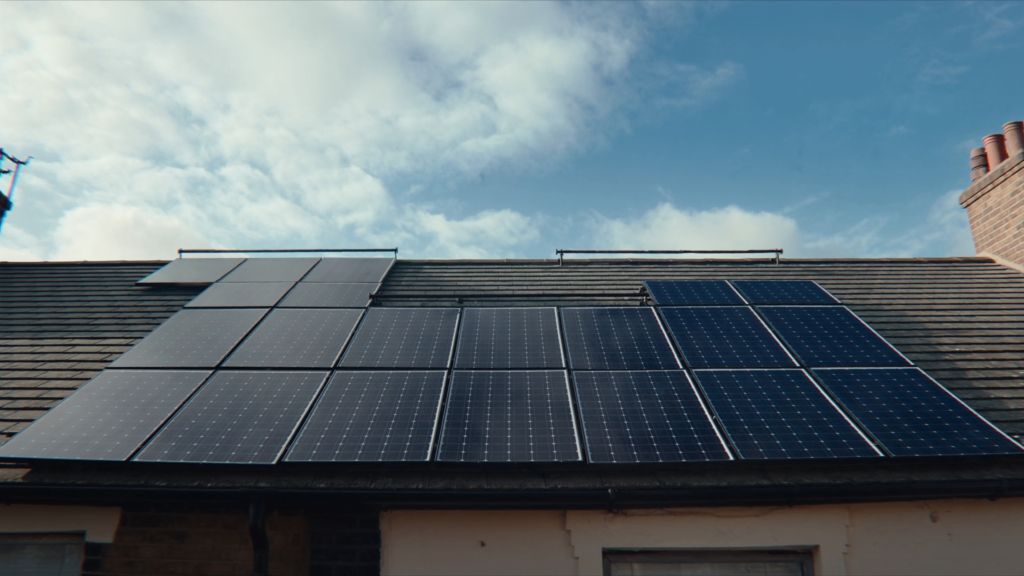
As UK summer temperatures climb, homeowners with solar panels often wonder whether a heatwave reduces their system’s output or even damages the panels themselves. The short answer is that solar panels do lose some efficiency in high heat, but the effect is smaller than many fear and well within safe operating limits.
The output drop from a typical UK heatwave is 8–12% below a panel’s nameplate rating, and the panels are built to withstand far higher temperatures than a British summer can produce.
A solar panel loses 0.3% to 0.5% of its rated output for every 1°C above 25°C, this is the temperature coefficient
Every solar panel sold in the UK must display a temperature coefficient on its datasheet, typically between -0.3%/°C and -0.5%/°C. This figure tells you how much power the panel loses for each degree Celsius its surface temperature rises above 25°C, the standard test condition (STC) used by manufacturers (MCS 010 standard).
In a UK heatwave with ambient temperatures of 30–35°C, the panel surface can reach 60–70°C due to solar heating. Using a typical -0.35%/°C coefficient, a 400W panel at 65°C surface temperature loses roughly 140W, still producing about 260W. This is not “overheating” in the sense of failure; it is a predictable, reversible efficiency loss that reverses as the panel cools.
The temperature coefficient is a standard part of every module’s technical specification and is verified by MCS certification (DESNZ solar PV performance data).
The efficiency loss in a UK heatwave is smaller than many homeowners expect
UK heatwaves rarely exceed 35°C ambient for sustained periods, so the temperature coefficient penalty is modest. At 35°C ambient with a 65°C panel surface, a 400W panel with a -0.35%/°C coefficient loses roughly 140W, still producing 260W. The bigger factor in summer is high irradiance (sunlight intensity), which partly offsets the temperature loss (Energy Saving Trust, 2026).
Because summer days are longer and the sun is higher, the total energy generated in a heatwave still exceeds a typical winter day by a wide margin. The temperature coefficient is a percentage loss, not a fixed number, so the absolute power drop is smaller on a 400W panel than on a larger system. Homeowners should not expect a dramatic, noticeable dip in daily generation during a heatwave.
Quick numbers, typical output change during a heatwave
| Ambient temperature | Panel surface temperature | Output vs. 25°C baseline (400W panel, -0.35%/°C) |
|---|---|---|
| 25°C | 45°C | 100% (400W) |
| 30°C | 55°C | ~95% (380W) |
| 35°C | 65°C | ~86% (344W) |
| 40°C (rare in UK) | 75°C | ~79% (316W) |
These figures are based on temperature coefficient data from MCS-registered module datasheets (e.g., Longi, Jinko, Trina). All panels sold in the UK must publish this coefficient (MCS 010 standard). Actual output depends on irradiance, orientation, and shading, but the table gives a reliable estimate for typical conditions.
Solar panels do not “overheat” in the sense of damaging themselves, they are designed for far higher temperatures
Solar panels are tested to withstand 85°C for the “hot spot” test under IEC 61215 and 200°C for bypass diodes under IEC 61730 (DESNZ “Solar PV safety” guidance). A UK heatwave surface temperature of 65–70°C is well within safe operating limits.
Heat-related failures such as delamination or cracked cells are almost always caused by manufacturing defects, not ambient heat alone. The IEC standards require panels to survive repeated thermal cycling and high-temperature exposure without damage. If a panel fails during a heatwave, the likely cause is a pre-existing fault, not the weather.
Homeowners should not worry about their panels physically overheating. The system is built to operate safely in far more extreme conditions than a British summer can produce.
The direct answer to “solar panels heatwave output”, output drops, but not catastrophically, and the system still generates substantial power
In a UK heatwave (30–35°C ambient), expect a 5–15% reduction from nameplate rating, not a complete shutdown. The system still produces more total energy in summer than in winter because daylight hours are longer (Energy Saving Trust, 2026).
The temperature coefficient is published on every module datasheet; you can calculate your own panel’s loss using the formula: loss (%) = coefficient × (panel surface temperature – 25°C). For a -0.35%/°C panel at 65°C, the loss is 14%. This is not a cause for concern, the system continues to deliver useful power throughout the heatwave.
How to check whether your installer used the correct temperature coefficient in your system design
The MCS certificate for your installation must list the module model and its STC rating. Find the temperature coefficient (printed on module datasheet or online) and compare it to the designer’s assumptions (MCS 010 installation standard).
If the design assumed no temperature loss (unlikely), the system may underperform in summer. A competent installer will have accounted for the coefficient in their yield calculation. If you suspect an error, contact the installer and ask for their design assumptions. The MCS installer audit guidance provides a framework for checking compliance (GOV.UK/MCS).
Use the MCS register to verify your installer’s certification and check whether the module model listed matches your actual panels.
How to verify your installer is MCS-certified and the system is eligible for the Smart Export Guarantee
The MCS certificate is the only document that proves eligibility for the Smart Export Guarantee (SEG) tariff (Ofgem SEG guidance, 2026). Without it, you cannot sell excess electricity back to the grid under SEG.
Check the MCS register (mcs.uk.com) by installer name or certificate number. The installer must also be registered with TrustMark for consumer protection (TrustMark website).
If your installer is not MCS-certified, your system may still work but you will not qualify for SEG payments. Always verify certification before installation, and keep the certificate safe for future proof of eligibility.