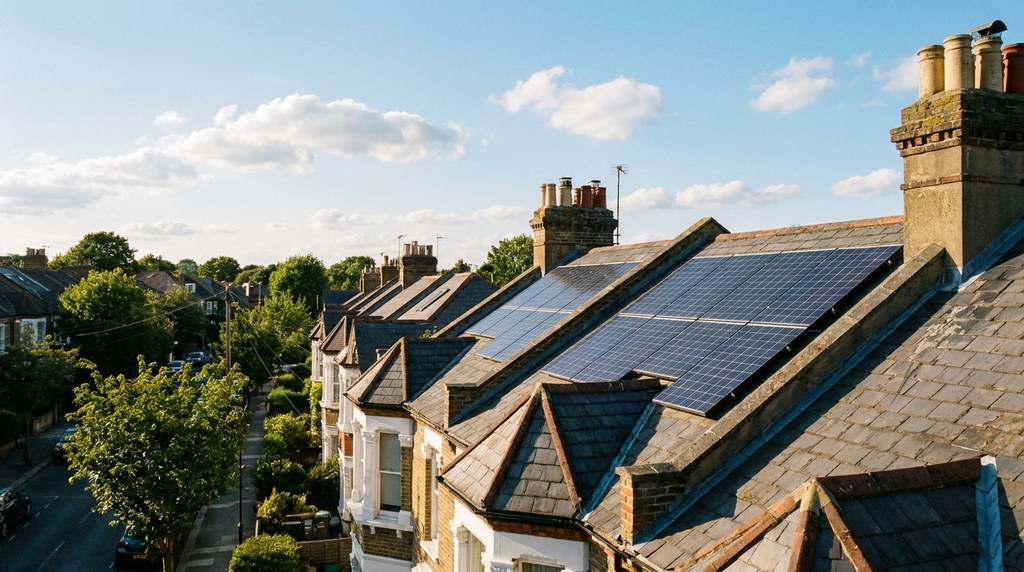
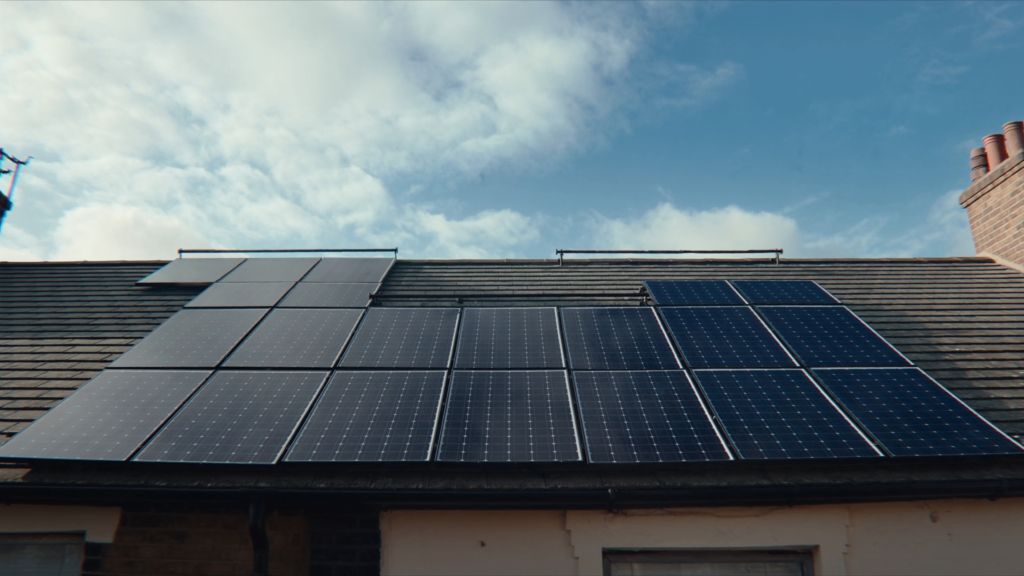
Solar panels are placed facing south because in the UK the sun is always in the southern half of the sky, making a south-facing roof the most efficient orientation for maximising annual electricity generation. According to the Energy Saving Trust, a south-facing 4kWp solar panel system in the UK typically generates around 3,600 kWh per year, compared to roughly 2,900 kWh on an east- or west-facing roof (Energy Saving Trust, 2026).
The key variable is the sun’s path across the sky. In the northern hemisphere, the sun rises in the east, arcs across the southern horizon, and sets in the west. Panels angled directly south capture the most sunlight during the peak hours of 10am to 4pm, when solar irradiance is highest. This orientation does not apply if you have a flat roof, where panels are tilted on frames and can be oriented south regardless of the building’s direction. It also matters less if you use time-of-use tariffs that reward morning or evening generation.
South facing panels generate the most electricity
A south-facing roof receives direct sunlight for the longest period each day. The Energy Saving Trust states that a south-facing 4kWp system in London can produce around 3,600 kWh annually, whereas an east-west split array of the same size generates about 3,200 kWh, and a north-facing system barely 2,400 kWh (Energy Saving Trust, 2026). The difference is 11–15% higher output for south-facing panels compared to east-west, and 35–40% more than north-facing. This makes south orientation the most cost-effective choice for maximising payback from the Smart Export Guarantee, which pays for every kWh exported to the grid.
South orientation aligns with UK peak sunlight hours
UK solar radiation peaks between 11am and 3pm, when the sun is due south. A south-facing panel catches this high-intensity light at a near-perpendicular angle, minimising reflection losses. The Microgeneration Certification Scheme (MCS) recommends a south-facing orientation with a tilt of 30–40 degrees for optimal performance in the UK (MCS, 2026). By contrast, east-facing panels generate more in the morning but lose output in the afternoon, while west-facing panels do the reverse. Neither matches the total daily yield of a south-facing array.
South facing panels work best with typical UK roof pitches
Most UK homes have roof pitches between 30 and 45 degrees, which closely matches the ideal tilt for south-facing solar panels. A south-facing roof at this pitch captures maximum annual sunlight with minimal seasonal variation. The UK government’s Renewable Energy Planning Framework notes that south-facing roofs are the “preferred orientation” for solar PV installations on existing homes (GOV.UK, 2026). If your roof faces east or west, you can still generate useful power, around 80% of a south-facing system’s output, but the panels will pay back more slowly and produce less income under the Smart Export Guarantee.
A worked example
A typical 1930s semi-detached home in Manchester with a south-facing roof could save roughly £16,200 over 25 years after installing a 4kWp solar panel system. The upfront cost after the 0% VAT saving (in place until March 2027) and assuming no other grants is approximately £6,500. The Energy Saving Trust estimates this system generates around 3,600 kWh per year, and with the current Ofgem price cap at roughly 24.5p per kWh, you save about £880 annually on electricity bills. You also earn around £170 per year from the Smart Export Guarantee (SEG) by selling surplus power back to the grid. That brings total yearly savings to roughly £1,050. The payback period is just over six years, and the panels have a typical 25-year lifespan. After payback, you enjoy over 18 years of near-free electricity. If you are on a time-of-use tariff like Octopus Flux, you can maximise savings further by shifting usage to sunny hours.
| Item | Figure |
|---|---|
| Upfront cost after grants | £6,500 |
| Yearly savings | £1,050 |
| Payback period | 6.2 years |
| 25-year lifetime savings | £16,200 |
What homeowners often get wrong
The most common mistake is assuming any roof will do, when a south-facing orientation can mean hundreds of pounds more in lifetime savings. Here are three frequent errors that cost homeowners money.
- Thinking east-west is just as good An east-west array generates about 20% less electricity than a south-facing system of the same size, losing roughly £200 per year in savings and SEG payments over the panel lifespan.
- Ignoring roof pitch A south-facing roof with a 30-40 degree tilt is optimal, but a flat roof with adjustable frames can achieve the same angle if you install them correctly, whereas a shallow pitch below 15 degrees cuts generation by up to 10%.
- Forgetting about shading from a south chimney A single chimney casting shade on a south-facing panel can reduce output by 25% or more, which is why a professional survey is essential before you commit to an installation.
Quick reference
- A south-facing 4kWp solar panel system in the UK generates roughly 3,600 kWh per year, compared to 2,900 kWh on an east-west split array.
- The optimal tilt angle for south-facing panels in the UK is between 30 and 40 degrees from horizontal.
- You can still get a south-facing system on a flat roof by using tilted mounting frames, regardless of your building’s direction.
- Switching from an east-west to a south-facing orientation can add £200 to £300 per year in combined savings and SEG payments.
- Installing panels on a south-facing roof that is heavily shaded by trees or chimneys can void performance guarantees from some installers.
Frequently Asked Questions
Solar panels face south because the sun is always in the southern half of the UK sky. The Energy Saving Trust confirms a south-facing 4kWp system generates around 3,600 kWh per year, versus 2,900 kWh on east or west roofs.
Yes, east or west facing roofs still work but produce less electricity. According to Ofgem, a south-facing panel captures the most sunlight during peak hours of 10am to 4pm. That makes it the most efficient orientation.
South-facing panels are 11–15% more efficient than east-west arrays. The Energy Saving Trust states a south-facing 4kWp system in London generates around 3,600 kWh annually, compared to 3,200 kWh for an east-west split array.