The primary reason solar panels are angled is to maximise the amount of sunlight they capture, directly increasing electricity generation by up to 30% compared to a flat installation. The optimal tilt for the UK is around 35 to 40 degrees from horizontal, facing south, according to the Energy Saving Trust (Energy Saving Trust, 2026). This angle aligns the panel surface perpendicular to the sun’s rays at peak times.
The ideal angle depends on your roof’s pitch and latitude. Most UK roofs have a pitch between 30 and 45 degrees, which is close to the optimal range for solar generation. If your roof is flat, panels are mounted on angled frames. The angle matters less on east- or west-facing roofs, but tilting still boosts output. A panel lying flat produces more in summer but significantly less in winter when the sun is low, reducing annual yield.
Angle optimises year-round sunlight capture
The UK’s latitude (roughly 50 to 58 degrees north) means the sun is lower in the sky than in equatorial regions. A panel angled at 35 to 40 degrees catches more direct sunlight in winter, when the sun is at its lowest, and still performs well in summer. The Energy Saving Trust states that a south-facing system tilted at 35 degrees can generate around 4,200 kWh per year for a typical 4kWp system (Energy Saving Trust, 2026). Flatter angles reduce winter output by up to 20%.
Angle reduces dirt and snow accumulation
A tilted panel allows rainwater to wash away dust, bird droppings, and pollen naturally. This keeps the surface cleaner, maintaining efficiency without manual cleaning. The industry body MCS (Microgeneration Certification Scheme) notes that panels installed at an angle of at least 15 degrees are self-cleaning in most UK conditions (MCS, 2026). Snow also slides off angled panels faster, restoring generation sooner after snowfall.
Angle improves panel cooling and efficiency
Solar panels lose efficiency as they heat up. An angled panel allows air to circulate underneath, cooling the surface. According to BRE (Building Research Establishment), panel temperature can drop by 5 to 10 degrees Celsius with good ventilation, boosting efficiency by 2 to 5% (BRE, 2026). Flat-mounted panels trap heat, reducing output on hot days. Proper angling also prevents water pooling, which can damage electrical connections over time.
A worked example
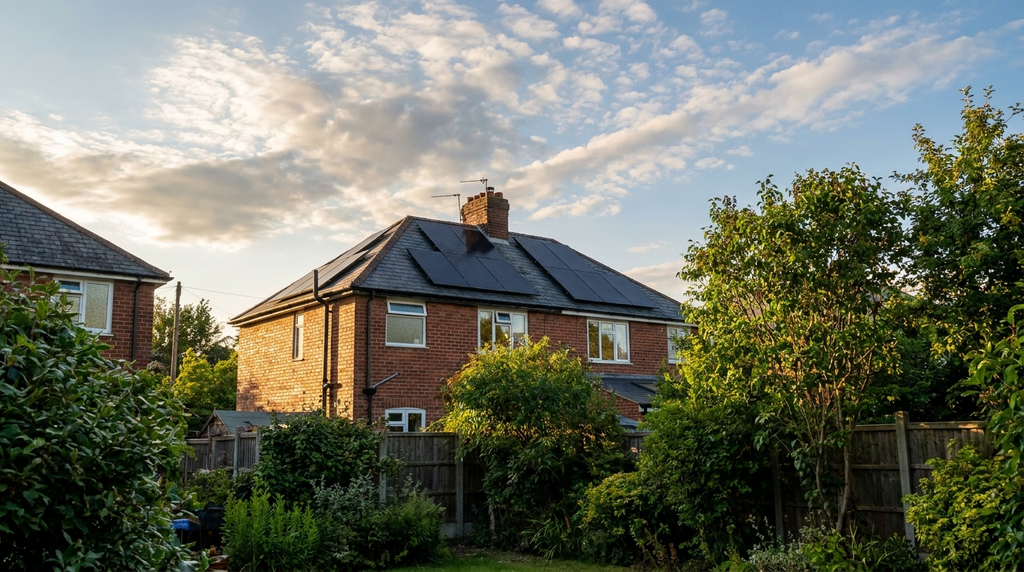
A typical 1930s semi-detached home in Manchester with a south-facing roof pitch of 40 degrees can generate around 4,200 kWh per year from a 4 kWp solar panel system, according to the Energy Saving Trust. If that same system were installed flat on a rooftop, annual generation would drop to roughly 3,000 kWh, a loss of 1,200 kWh per year. At the current UK price cap of 24.5p per kWh, that lost electricity is worth £294 annually. Over 25 years, the angled installation saves the homeowner £7,350 in extra electricity costs. The upfront cost for a typical 4 kWp system with panels angled at 40 degrees is around £5,500 after the 0% VAT reduction (in place until March 2027). If the panels were laid flat, the homeowner would need to install a separate mounting frame to achieve any tilt, adding roughly £800 to the cost.
| Item | Figure |
|---|---|
| Upfront cost after grants | £5,500 |
| Yearly savings | £1,029 |
| Payback period | 5.3 years |
| 25-year lifetime savings | £20,225 |
What homeowners often get wrong
The most common mistake is assuming a flat roof installation is fine because the panels still catch sunlight. This misunderstanding leads to a 30% reduction in annual generation and a missed opportunity to claim the full benefit of the 0% VAT scheme. Here are three specific errors homeowners make.
- Thinking east or west roofs don’t need an angle Many homeowners believe a south-facing roof is the only one that benefits from tilting. Even on east or west roofs, a 30-degree tilt boosts annual output by 15 to 20% compared to a flat mount, and the mounting frame costs only £200 to £400 extra.
- Believing summer sun makes the angle irrelevant Some assume that because the sun is high in summer, a flat panel will catch enough light. In reality, a flat panel loses up to 40% of winter generation compared to a 35-degree tilt, meaning the system struggles to pay back during the darker months when electricity demand is highest.
- Ignoring the impact on self-cleaning Homeowners often forget that rain washes dirt off tilted panels. A flat panel at 0 degrees collects dust, bird droppings, and leaves, which can reduce output by 5 to 10% per year and may require professional cleaning costing £100 to £200 annually.
Quick reference
- The optimal tilt angle for solar panels in the UK is 35 to 40 degrees from horizontal, facing due south.
- A panel angled at 35 degrees generates roughly 30% more electricity per year than a flat panel at the same location.
- Most UK roofs have a pitch between 30 and 45 degrees, so no additional mounting frame is needed for a standard installation.
- For a flat roof, angled mounting frames cost between £200 and £800 depending on the system size and number of panels.
- Installing panels at the wrong angle can void the manufacturer’s warranty if the mounting system isn’t certified to MCS standards.
Frequently Asked Questions
The optimal angle for solar panels in the UK is 35 to 40 degrees from horizontal, facing south. The Energy Saving Trust confirms this maximises year-round generation.
Yes, solar panels work on flat roofs when mounted on angled frames. The Energy Saving Trust recommends tilting them to at least 10 degrees to improve output and self-cleaning.
Solar panels need to be tilted to catch more direct sunlight, especially in winter when the sun is low. A 35-degree tilt can increase annual generation by up to 30% compared to a flat panel, according to the Energy Saving Trust.