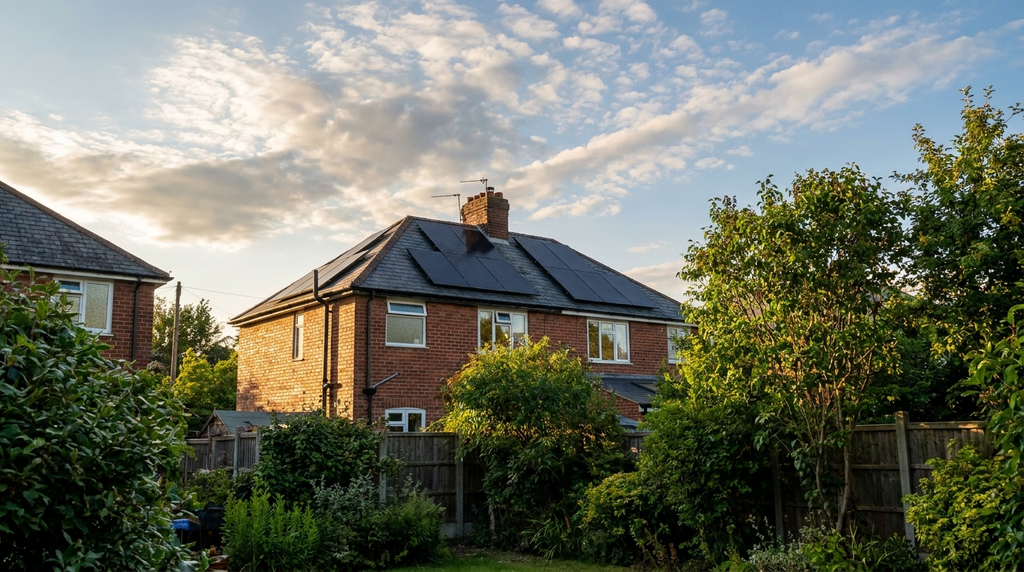
A typical 4 kW solar panel quote in 2026 can vary by more than £2,000 between reputable and aggressive installers
The cost of a solar panel system in 2026 is not a fixed number. According to the Energy Saving Trust, a typical 4 kW solar panel system in the UK costs between £7,000 and £9,000 (including installation) (Energy Saving Trust, 2026).
A typical 4 kW solar panel quote in 2026 costs £7,000–£9,000. Red-flag quotes fall below £5,000 or above £12,000 without justification, or promise payback under 8 years. Always check named brands and get a roof survey before comparing.
- Check payback periods: under 8 years for solar-only is a red flag.
- Insist on named panel brands like Longi, JA Solar, or SunPower.
- Named inverter brands (SolarEdge, SMA, Huawei) indicate a quality quote.
- Battery storage payback under 10 years is suspicious without exceptional usage.
- A 4 kW system should cost £7,000–£9,000; avoid quotes below £5,000.
- A typical 4 kW solar panel quote in 2026 can vary by more than £2,000 between reputable and aggressive installers
- The quote promises a payback period shorter than 8 years without battery storage
- Quick numbers what a red-flag quote looks like compared to a standard quote
- The installer is not MCS-certified or refuses to provide their MCS number
- The quote includes a "free" solar panel system or an unbelievably low upfront cost
- The quote does not specify panel brand, inverter brand, or warranty terms in writing
- The quote pressures you to sign immediately with a "limited-time discount" or "only one slot left"
- The quoted system size does not match your roof orientation or energy usage
Red-flag quotes often fall below £5,000 or exceed £12,000 without clear justification. Understanding this financial context is the first step in spotting a problematic quote.
The quote promises a payback period shorter than 8 years without battery storage
A realistic payback period for a solar-only system in 2026 is 8–12 years, based on typical electricity savings and the Smart Export Guarantee (SEG) rate (DESNZ, Solar PV Cost and Payback Report, 2026). Any quote claiming payback under 6 years should be questioned unless the property has exceptional south-facing roof space and high daytime usage.
If the quote includes battery storage, a payback period under 10 years is also suspicious. The Energy Saving Trust notes that adding a battery typically extends the payback period by 3–5 years compared to solar-only (Energy Saving Trust, Battery Storage Cost Guide, 2026).
Quick numbers what a red-flag quote looks like compared to a standard quote
| Quote item | Red-flag quote | Standard quote |
|---|---|---|
| System size | 4 kW (no roof survey) | 3.5–4.5 kW (based on roof survey) |
| Panel brand | “Premium panels” (no name) | Longi, JA Solar, SunPower (named) |
| Inverter brand | “High-quality inverter” (no name) | SolarEdge, SMA, Huawei (named) |
| Battery capacity (if included) | 5 kWh (no brand stated) | 5–10 kWh (brand named, e.g. Tesla, GivEnergy) |
| Total cost | £4,200 | £7,500 |
| Payback period | 5 years | 9 years |
| Warranty (panels) | 10 years (verbal only) | 25 years (written product + performance) |
| Installer certification | None provided | MCS certified (number provided) |
Data based on average installer pricing from the MCS register (MCS, 2026).
The installer is not MCS-certified or refuses to provide their MCS number
MCS (Microgeneration Certification Scheme) certification is mandatory for eligibility for the Smart Export Guarantee (SEG) and for most finance options (MCS, Certification Standards, 2026). A quote from a non-MCS installer means you cannot sell excess electricity back to the grid.
To verify, check the MCS register online at mcs.uk.com or ask for the installer’s MCS certificate number. If they refuse or give an excuse, this is a clear red flag.
The quote includes a “free” solar panel system or an unbelievably low upfront cost
“Free solar” schemes in 2026 are almost always lease agreements that lock you into high energy costs or poor system performance (Citizens Advice, Solar Panel Scams, 2026). These agreements often transfer maintenance and ownership risks to the homeowner.
Quotes under £4,500 for a 4 kW system likely use substandard panels or non-certified installers. Legitimate installers in 2026 quote a fair price based on materials, labour, and certification.
The quote does not specify panel brand, inverter brand, or warranty terms in writing
A standard quote should list panel brand (e.g., SunPower, Longi, JA Solar), inverter brand (e.g., SolarEdge, SMA), and performance warranty (typically 25 years for panels, 10–12 years for inverters) (Energy Saving Trust, Solar Panel Buying Guide, 2026). Vague terms like “premium panels” or “high-quality inverter” without brand names are red flags.
Warranty terms must be written, not verbal, and should cover both product and performance. If the quote omits these details, ask for them in writing before proceeding.
The quote pressures you to sign immediately with a “limited-time discount” or “only one slot left”
High-pressure sales tactics are a common red flag in 2026, especially from door-to-door or phone-based installers (Trading Standards, Solar Panel Sales Practices Report, 2026). Legitimate installers provide a written quote valid for at least 14 days.
A “discount” that disappears if you don’t sign today is a tactic to prevent you from comparing quotes. how to compare solar panel quotes can help you evaluate offers calmly.
The quoted system size does not match your roof orientation or energy usage
A 4 kW system typically requires 10–12 panels and around 16–20 m² of south-facing roof space (Energy Saving Trust, Solar Panel Sizing Guide, 2026). If your roof faces east/west or is shaded, the installer should adjust the quote accordingly, not just recommend a standard size.
A quote that ignores your energy bills or roof survey data is a red flag. how to calculate your solar panel system size provides a step-by-step guide to ensure the quote matches your home.
Frequently Asked Questions
A red flag is a quote that promises a payback period under 8 years for solar-only or under 10 years with battery storage, or that fails to name specific panel and inverter brands. The Energy Saving Trust advises comparing named brands to spot aggressive quotes.
A typical 4 kW solar system costs between £7,000 and £9,000 including installation, according to the Energy Saving Trust (2026). Quotes below £5,000 or above £12,000 without clear justification are red flags.
A realistic payback period for a solar-only system in 2026 is 8–12 years, based on typical savings and the Smart Export Guarantee (DESNZ, 2026). Adding battery storage extends this by 3–5 years.
A standard quote should include named panel and inverter brands (e.g., Longi, SolarEdge), a roof survey, system size tailored to your roof, and a clear warranty of at least 25 years for panels. Avoid quotes that only say 'premium panels'.
Check the installer is MCS certified and has positive reviews on Trustpilot or Which? Trusted Traders. A reputable installer will provide a detailed quote after a roof survey and name all components, as recommended by the Energy Saving Trust.