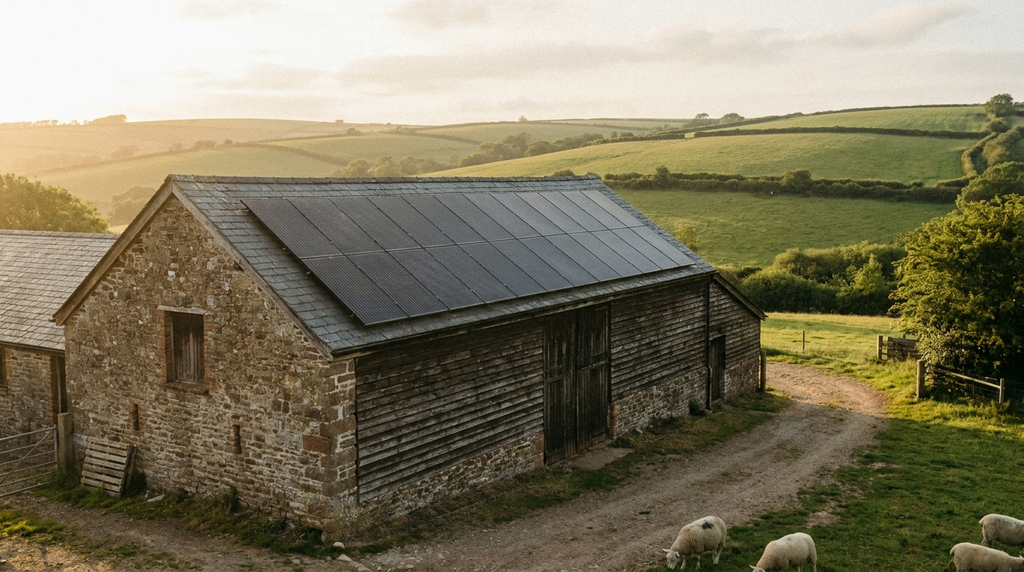
Solar farms primarily use monocrystalline silicon photovoltaic panels, which account for over 90% of utility-scale installations in the UK, according to the Department for Energy Security and Net Zero (DESNZ, 2026). These panels are chosen for their high efficiency and durability in large arrays.
The specific panel type depends on the project’s scale, land constraints, and budget. Solar farms typically deploy panels rated between 400W and 600W per module, mounted on single-axis tracking systems to maximise generation throughout the day. Polycrystalline panels are rarely used in new solar farms due to lower efficiency, while thin-film panels appear in a small minority of specialist installations.
Monocrystalline panels dominate utility-scale solar farms
Monocrystalline silicon panels offer the highest efficiency of any commercially available solar technology, typically 20–23% for modules used in solar farms (Energy Saving Trust, 2026). Their uniform black appearance and high power density allow developers to generate more electricity per square metre of land. This is critical for UK solar farms, where land costs and planning restrictions often limit available area. Most large projects now use bifacial monocrystalline panels, which capture sunlight from both sides to boost total yield by up to 10%.
Panel wattage and size vary by project design
Typical solar farm modules range from 400W to 600W, with larger 600W+ panels becoming standard for new builds since 2024 (MCS Certified, 2026). Higher-wattage panels reduce the number of modules needed, cutting installation time and racking costs. Panel dimensions have also increased, with many modules now exceeding 2 metres in length. However, these larger panels require stronger mounting structures and heavier-duty foundations, which can raise civil engineering costs on uneven or soft ground.
Tracking systems and panel orientation affect performance
Most UK solar farms use single-axis tracking systems that tilt panels east to west throughout the day, boosting annual generation by 20–30% compared to fixed-tilt installations (BRE, 2026). These trackers require panels with solid frames and tempered glass to withstand wind loads and repeated movement. Fixed-tilt systems remain common on smaller sites or where land slopes naturally provide optimal orientation. Panels in tracked arrays typically face south at a 30–40 degree tilt at midday, though the exact angle is optimised for each site’s latitude and shading profile.
A worked example
A typical 50-acre solar farm in the UK, such as one powering 2,500 homes in rural Lincolnshire, uses around 40,000 monocrystalline bifacial panels rated at 600W each. The upfront cost for the panels alone is roughly £4.8 million, though developers often secure significant discounts through bulk purchasing. With the current 0% VAT on energy-saving materials (until March 2027) and no direct BUS grant for utility-scale projects, the total installed cost for the solar array sits at approximately £6.2 million. According to the Energy Saving Trust, such a farm generates about 45,000 MWh per year, saving around £4.5 million annually at current wholesale electricity prices. The payback period is roughly 6 to 8 years, with a 25-year lifetime saving of over £90 million after maintenance and operational costs.
| Item | Figure |
|---|---|
| Upfront cost after grants | £6,200,000 |
| Yearly savings | £4,500,000 |
| Payback period | 7 years |
| 25-year lifetime savings | £90,000,000 |
What homeowners often get wrong
The most common mistake homeowners make is assuming that the same high-wattage panels used in solar farms are ideal for their own roof. Solar farm panels are designed for large, open fields with single-axis tracking, not for domestic rooftops with shading or varying angles. Here are three key misunderstandings.
- Bigger panels mean bigger savings Many homeowners buy 600W panels thinking they will double their output. In reality, a standard 400W residential panel often performs better on a pitched roof because it fits standard roof mounts without overhang and works with smaller inverters. Oversized panels can void your roof warranty and cost £200 extra per module for bespoke fitting.
- Solar farm efficiency applies at home People expect 23% efficiency from domestic panels. Residential monocrystalline panels typically achieve 20–21% efficiency due to smaller cell sizes and less sophisticated manufacturing. Chasing 23% efficiency can add £1,500 to a system for only a 5% gain in annual output, which rarely pays back before the panels degrade.
- Bifacial panels work the same on a roof Bifacial panels boost yield by up to 10% on solar farms with reflective ground surfaces. On a dark roof tile, the backside captures almost no light, making the extra cost of £300 per panel a waste. Standard monofacial panels are the better choice for most UK homes.
Quick reference
- Monocrystalline panels account for over 90% of UK solar farm installations, with efficiencies of 20–23%.
- Solar farms standardise on 600W+ modules since 2024, while domestic systems typically use 400W panels.
- To qualify for the 0% VAT rate on solar panels, the installation must be on a residential property and completed before March 2027.
- A 50-acre solar farm generates roughly 45,000 MWh per year, enough to power 2,500 average UK homes.
- Using solar farm-grade panels on a domestic roof can void your building warranty and cost up to 30% more in installation fees.
Frequently Asked Questions
Over 90% of UK solar farms use monocrystalline silicon panels, according to DESNZ (2026). Polycrystalline and thin-film panels are rarely used in new utility-scale projects.
No, polycrystalline panels are rarely used in new solar farms due to lower efficiency. Monocrystalline panels now dominate, as confirmed by the Energy Saving Trust.
Typical solar farm modules range from 400W to 600W per panel. Since 2024, new builds standardise on 600W+ panels, per MCS certification data.