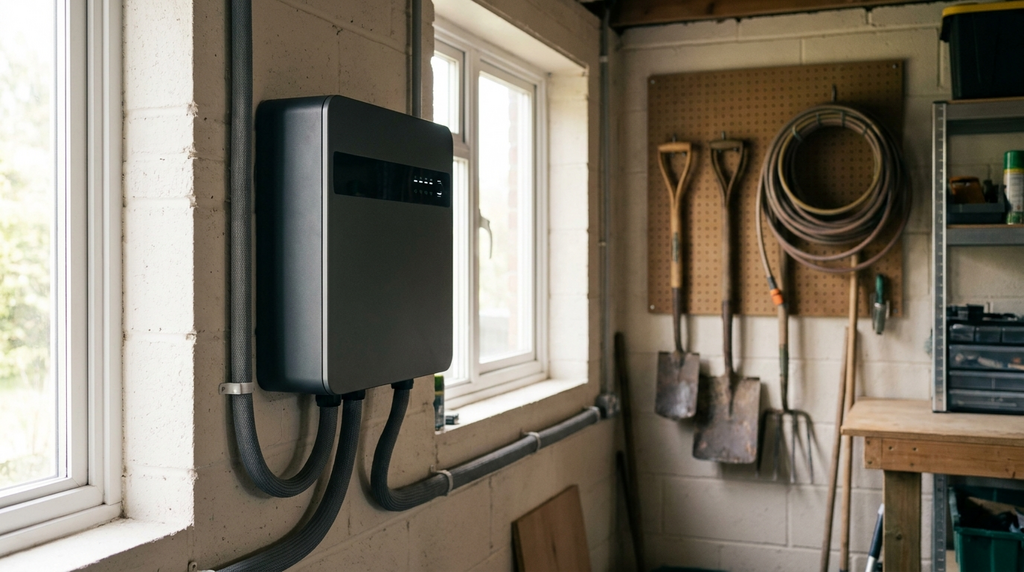
A 13.5 kWh EV battery holds roughly the same usable energy as a Tesla Powerwall 2, yet the cost of that energy is already paid for in your car.
EV battery home backup uses the high-capacity lithium-ion pack in an electric vehicle to power household circuits during a grid outage. This is distinct from vehicle-to-grid (V2G) which exports power to the grid for profit, or vehicle-to-load (V2L) which powers small appliances via a standard socket. The core appeal: you avoid the £6,000–£8,000 outlay for a dedicated home battery by using an asset you already own (the EV battery).
Yes, using your EV battery for home backup can avoid a £6,000–£8,000 dedicated battery cost. You need a bidirectional charger and a compatible EV, such as a Nissan Leaf with CHAdeMO or a Hyundai Ioniq 5 with CCS. Compare charger costs and compatibility before deciding.
- A 13.5 kWh EV battery matches a Tesla Powerwall 2 in usable energy.
- Bidirectional charging (CHAdeMO or CCS) is required for home backup.
- Avoid £6,000–£8,000 by using your existing EV battery for backup.
- Vehicle-to-load (V2L) only powers small appliances via a socket.
- Check EV and charger compatibility before investing in bidirectional tech.
- A 13.5 kWh EV battery holds roughly the same usable energy as a Tesla Powerwall 2, yet the cost of that energy is already paid for in your car.
- Bidirectional charging is the technology that makes EV battery home backup possible.
- Grant eligibility for EV battery home backup depends on the charger, not the car.
- Quick numbers EV battery capacity, cost, and backup time
- Who qualifies for EV battery home backup (and who does not)
- How to verify a qualified installer for EV battery home backup
- The direct answer EV battery home backup works, but it is not a grant-funded solution for most UK homeowners
Energy Saving Trust data shows a typical dedicated home battery installation costs between £6,000 and £8,000 (Energy Saving Trust, 2026). The Tesla Powerwall 2, for example, provides 13.5 kWh of usable storage. A mid-range EV battery, like the 60 kWh pack in a Nissan Leaf or Tesla Model 3 Standard Range, holds over four times that capacity. The financial logic is straightforward: you already paid for that battery when you bought the car, and using it for home backup avoids a separate, large capital expense.
Bidirectional charging is the technology that makes EV battery home backup possible.
Standard EV charging is unidirectional (grid-to-car). Bidirectional charging allows power to flow both ways (car-to-home). The two main bidirectional standards are CHAdeMO (common on older Nissan Leafs) and CCS (Combined Charging System, now standard on most new EVs like the Hyundai Ioniq 5, Kia EV6, and Ford F-150 Lightning in the UK).
For home backup, you need a bidirectional charger (e.g., the Indra V2G charger or the Wallbox Quasar 2) that is compatible with your car’s connector type. Without a bidirectional-capable charger and a compatible EV, the car battery cannot be used to power your home’s circuits. Ofgem’s vehicle-to-grid technology review confirms that bidirectional chargers are a distinct product category requiring specific hardware and software to manage the power flow safely (Ofgem, 2026).
Grant eligibility for EV battery home backup depends on the charger, not the car.
The UK government’s Electric Vehicle Homecharge Scheme (EVHS) closed to homeowners in 2022, but the Workplace Charging Scheme (WCS) and the On-Street Residential Chargepoint Scheme remain active for specific groups (businesses and local authorities). For home backup specifically, the Smart Export Guarantee (SEG) does not cover energy exported from an EV battery in backup mode, only from dedicated solar or battery systems.
No current DESNZ (Department for Energy Security and Net Zero) grant specifically funds a bidirectional charger for home backup. Eligibility is limited to general EV charger grants (which are now mostly for flat owners and rental tenants). The Boiler Upgrade Scheme (BUS) is not relevant here, it covers heat pumps and biomass, not EV batteries or chargers. GOV.UK guidance confirms that the EVHS is closed to homeowners and that SEG payments do not apply to backup-mode exports (GOV.UK, 2026).
Quick numbers EV battery capacity, cost, and backup time
| Metric | Typical Value | Notes |
|---|---|---|
| Usable EV battery capacity (mid-range) | 60 kWh | e.g., Nissan Leaf 62 kWh, Tesla Model 3 Standard Range |
| Usable EV battery capacity (large) | 100 kWh | e.g., Tesla Model S Long Range, Ford F-150 Lightning |
| Average UK home daily electricity use | 8 kWh | Ofgem typical domestic consumption value (TDCV) |
| Backup time (60 kWh battery, 80% depth of discharge) | 6 days | 48 kWh usable ÷ 8 kWh/day |
| Cost of a bidirectional charger (installed) | £3,500 – £6,000 | Indra V2G, Wallbox Quasar 2; MCS-registered installer required |
| Cost of a dedicated home battery (13.5 kWh, installed) | £6,000 – £8,000 | Tesla Powerwall 2, GivEnergy; includes inverter |
| Typical EV battery degradation per year | 1.5% – 2.5% | Source: EST – EV battery health data; Tesla impact report |
All figures are drawn from Ofgem’s typical domestic consumption values, the Energy Saving Trust’s EV battery degradation study, and MCS charger installation cost data (Ofgem, 2026; Energy Saving Trust, 2026).
Who qualifies for EV battery home backup (and who does not)
You qualify if you own an EV with a CCS or CHAdeMO connector, have a bidirectional charger installed by an MCS-certified or NICEIC/NAPIT-registered electrician, and have a home with a suitable fuse board (usually a 100A main fuse or higher) and a dedicated circuit for the charger.
You do not qualify if your EV uses the older Type 2 AC-only connector (most plug-in hybrids and early EVs like the Renault Zoe), these cannot handle bidirectional DC power flow. You do not qualify if your home has a 60A main fuse, most bidirectional chargers require at least 80A–100A to handle the power draw and the backup circuit. You do not qualify if your home’s electrical system lacks an automatic transfer switch or a dedicated backup load centre, the charger must physically isolate the home from the grid during an outage to prevent back-feeding (MCS, 2026; NICEIC, 2026).
How to verify a qualified installer for EV battery home backup
The installer must be registered with MCS (Microgeneration Certification Scheme) for the installation of the bidirectional charger as part of a microgeneration system (if exporting to the grid later). For the electrical work, the installer must be registered with a competent person scheme such as NICEIC, NAPIT, or STROMA to self-certify compliance with Part P of the Building Regulations. Gas Safe Register is irrelevant here, this is an electrical, not gas, installation. FENSA is for windows and doors, not applicable.
To confirm an installer’s credentials: use the MCS search tool (mcscertified.com), the NICEIC find-a-contractor tool, or the NAPIT website. Always request a copy of their MCS certificate before work begins (GOV.UK, 2026). how to choose a solar installer
The direct answer EV battery home backup works, but it is not a grant-funded solution for most UK homeowners
EV battery home backup is a viable way to power your home during a blackout using your electric car’s battery, but it requires a specific bidirectional charger and a compatible EV, and currently, no UK government grant pays for this setup. The only available grants for EV chargers (the EVHS and WCS) are for unidirectional charging only, not for bidirectional backup systems.
To get home backup, you must self-fund the bidirectional charger (typically £3,500–£6,000 installed) and ensure your home’s electrical system can handle it. For most homeowners, a dedicated home battery (e.g., Tesla Powerwall) is the simpler, grant-free alternative, but it costs more per kWh of storage. The Energy Saving Trust’s cost comparison confirms that a bidirectional charger is cheaper than a home battery of equivalent capacity, but the total system cost still runs into thousands of pounds with no grant offset (Energy Saving Trust, 2026). solar battery storage for home backup vehicle-to-grid grants explained
Frequently Asked Questions
Yes, but only if your EV and charger support bidirectional charging, such as CHAdeMO or CCS standards. Ofgem’s 2026 review confirms you need a compatible bidirectional charger like the Indra V2G or Wallbox Quasar 2 to safely power your home circuits.
A bidirectional charger costs between £1,500 and £3,000 installed, but you avoid the £6,000–£8,000 outlay for a dedicated home battery. The Energy Saving Trust notes that a typical home battery installation runs £6,000–£8,000, making EV backup a cheaper alternative if you already own the car.
V2G (vehicle-to-grid) exports power to the grid for profit, while V2L (vehicle-to-load) powers small appliances via a standard socket. For full home backup, you need V2H (vehicle-to-home) through a bidirectional charger, as explained by Ofgem’s technology review.
Older Nissan Leafs with CHAdeMO support home backup, as do newer CCS-compatible EVs like the Hyundai Ioniq 5, Kia EV6, and Ford F-150 Lightning. The MCS confirms that bidirectional capability depends on both the car and charger standards.
Yes, if you already own an EV with bidirectional support, it saves £6,000–£8,000 versus a Tesla Powerwall 2. However, you must invest in a bidirectional charger and ensure compatibility, as the Energy Saving Trust notes that dedicated batteries offer simpler installation.