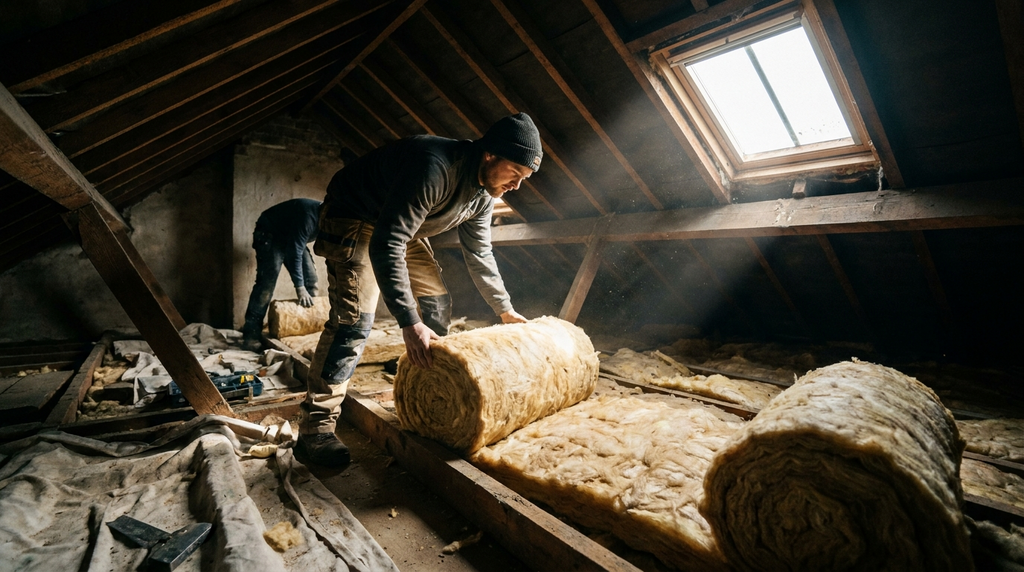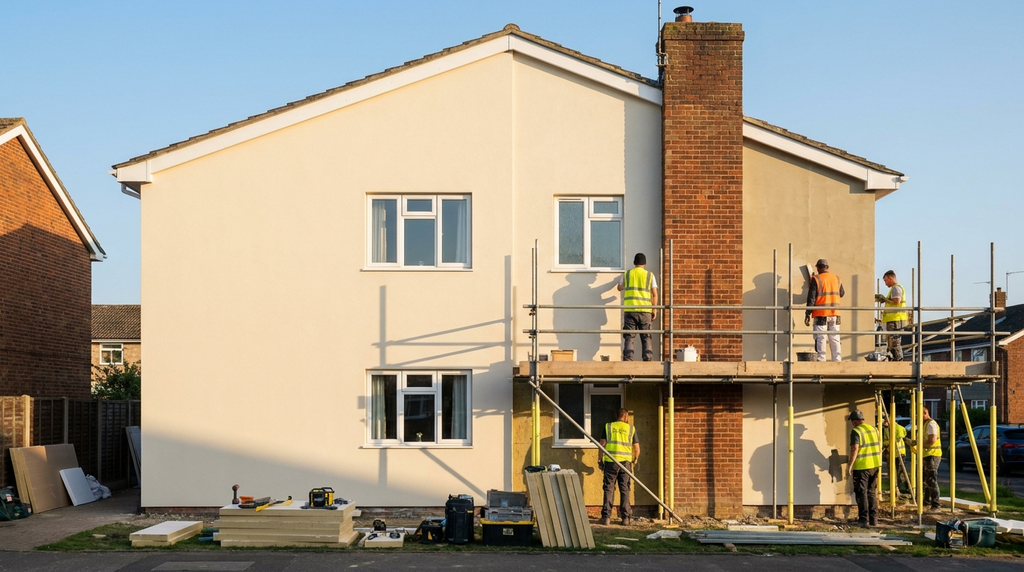
Uninsulated garage roofs lose heat at roughly 3 times the rate of an insulated wall
An uninsulated roof on an attached garage can account for up to 25% of total heat loss from the main house, according to the Energy Saving Trust (Energy Saving Trust, 2026). This article covers insulation methods for detached and attached garages with pitched or flat roofs. It does not cover garage conversions into habitable rooms, which require full Building Regulations approval under Approved Document L (GOV.UK, 2026).
Garage roof insulation costs £20-£35 per m² for PIR boards, or £8-£15 per m² for mineral wool. An uninsulated attached garage roof can account for up to 25% of house heat loss. The best method depends on roof type and space use.
- Uninsulated garage roof loses 3x more heat than an insulated wall.
- Pitched roofs: fit 100-150mm PIR boards between rafters for U-value 0.18-0.25.
- Flat roofs: choose warm roof method to avoid condensation issues.
- Material costs for PIR boards range £20-£35 per m² in 2026.
- Always include a vapour control layer and 50mm ventilation gap.
- Uninsulated garage roofs lose heat at roughly 3 times the rate of an insulated wall
- Pitched garage roofs rigid insulation boards between rafters
- Flat garage roofs warm roof vs cold roof insulation
- Quick numbers cost, U-value, and payback for each method
- Spray foam insulation for garage roofs when is it suitable?
- The direct answer which garage roof insulation method gives the best value for an attached garage in 2026?
- How to verify your garage roof insulation installer MCS, TrustMark, and building control
The choice of insulation method depends on three variables: roof type (pitched vs flat), whether the garage is attached or detached, and how the space is used (storage, parking, or occasional workshop). This article compares rigid board, mineral wool, and spray foam insulation for garage roofs, with cost, thermal performance, and installation requirements drawn from 2026 industry data.
Pitched garage roofs rigid insulation boards between rafters
For pitched garage roofs, the most common method is fitting cut-to-size PIR (polyisocyanurate) or phenolic rigid boards between the rafters. A 50mm air gap above the insulation is required for ventilation, per NHBC technical guidance on roof ventilation (NHBC, 2026). Typical U-values range from 0.18 to 0.25 W/m²K for 100–150mm PIR boards, based on Kingspan and Celotex product data sheets that cite Building Regulations Approved Document L (GOV.UK, 2026).
Material costs for PIR boards in 2026 are £20–£35 per m² at major builders’ merchants such as Travis Perkins and Jewson. This method maintains the existing roof covering and does not reduce headroom significantly if rafters are deep enough (typically 100mm or more). A vapour control layer must be fitted on the warm side (the interior face) to prevent condensation, and adequate eaves-to-ridge ventilation is essential. Without it, moisture can accumulate and rot the timber rafters over time.
Flat garage roofs warm roof vs cold roof insulation
Flat garage roofs use either a warm roof or cold roof system. A warm roof places insulation above the roof deck, with the waterproof membrane sitting on top. With 120mm PIR, U-values can reach 0.15 W/m²K, according to the Flat Roofing Alliance (Flat Roofing Alliance, 2026). A cold roof places insulation between or below the joists, with a ventilated air gap above; typical U-values are 0.20–0.25 W/m²K with 100mm mineral wool (Energy Saving Trust, 2026).
Costs in 2026: warm roof systems run £40–£60 per m² including a new waterproof layer, while cold roof materials alone cost £15–£25 per m² (National Federation of Roofing Contractors, 2026). Warm roofs eliminate condensation risk in the roof structure because the insulation is above the deck, but they raise the roof height, which may affect drainage or parapet walls. Cold roofs require cross-ventilation at eaves and ridge, which is often impossible on a detached garage without a loft space. If ventilation cannot be provided, a cold roof will trap moisture and fail prematurely.
Quick numbers cost, U-value, and payback for each method
| Method | Material cost per m² (2026) | Typical U-value (W/m²K) | Labour cost per m² (installed) | Estimated annual energy saving (attached garage) |
|---|---|---|---|---|
| PIR boards between rafters | £20–£35 | 0.18–0.25 | £15–£25 | £40–£80 |
| Warm roof flat (120mm PIR) | £40–£60 | 0.15–0.20 | £25–£40 | £50–£100 |
| Cold roof flat (100mm mineral wool) | £15–£25 | 0.20–0.25 | £10–£20 | £30–£60 |
| Mineral wool between rafters | £10–£15 | 0.30–0.35 | £10–£15 | £20–£40 |
| Spray foam (75–100mm) | £30–£50 | 0.20–0.28 | Included | £35–£70 |
Energy savings are calculated using the Energy Saving Trust heat loss calculator and 2026 average gas and electricity prices from DESNZ (DESNZ, 2026). Payback periods depend on whether the garage is heated and how the space is used. For an attached garage used as a workshop, payback is typically 3–7 years. For an unheated garage, payback extends to 10–15 years or more, as savings come mainly from reducing heat loss through the adjoining house wall.
Spray foam insulation for garage roofs when is it suitable?
Spray foam is closed-cell polyurethane foam applied directly to the underside of the roof deck, typically 50–100mm thick. Manufacturer technical data from Icynene and BASF gives U-values of 0.20–0.28 W/m²K for 75–100mm (MCS, 2026). Installed cost in 2026 is £30–£50 per m², based on quotes from MCS-registered spray foam installers.
Spray foam is best suited for irregularly shaped roofs or those with limited access where rigid boards cannot be cut to fit. However, the BRE (Building Research Establishment) has warned that spray foam can trap moisture if the roof covering is not fully watertight, leading to timber decay (BRE, 2026). NHBC guidance also notes that spray foam can make future roof repairs difficult and may void roof covering warranties (NHBC, 2026). For these reasons, spray foam is generally a lower-recommendation option unless the roof is in excellent condition and access is genuinely constrained.
The direct answer which garage roof insulation method gives the best value for an attached garage in 2026?
For an attached pitched garage roof, 100mm PIR rigid boards between rafters (with a vapour control layer) offers the best balance of cost (£20–£35/m²), U-value (0.22 W/m²K), and ease of DIY installation. Payback on heating bills is 3–5 years (Energy Saving Trust, 2026). For a flat garage roof, a warm roof system with 120mm PIR is the most effective, though more expensive (£40–£60/m²), because it eliminates condensation risk and meets modern Building Regulations if the garage is later converted.
Mineral wool between rafters is cheaper (£10–£15/m²) but less thermally efficient (U-value 0.30–0.35 W/m²K) and requires thicker layers to match PIR performance. Spray foam is only cost-effective for hard-to-access roofs or where headroom is critical, but carries higher long-term risk due to moisture trapping and repair complications.
How to verify your garage roof insulation installer MCS, TrustMark, and building control
For a garage roof insulation project in non-habitable space, no formal certification is legally required. However, TrustMark registration is recommended for quality assurance (GOV.UK, 2026). For spray foam insulation, the installer should be MCS-certified for spray foam products (MCS, 2026). For any insulation that affects the roof covering (e.g., warm roof on a flat garage), a FENSA or NFRC-approved contractor is advisable for the roofing work.
If the garage is attached and the insulation reduces the thermal envelope of the house, Building Regulations Part L may apply. Homeowners should check with their local building control before starting (GOV.UK, 2026). Always ask for written quotes, product datasheets, and a warranty (typically 10–25 years for rigid boards, 5–10 years for spray foam).
How to insulate an attached garage wall Flat roof insulation options for outbuildings
Frequently Asked Questions
PIR rigid board insulation costs £20-£35 per m² from merchants like Travis Perkins and Jewson in 2026. Mineral wool is cheaper at £8-£15 per m², while spray foam averages £30-£50 per m² installed, per industry data.
Yes, insulating an attached garage roof can reduce total house heat loss by up to 25%, according to the Energy Saving Trust. The typical payback period is 3-5 years depending on roof type and heating system.
PIR rigid insulation boards between rafters are the best option for pitched garage roofs, achieving U-values of 0.18-0.25 W/m²K. This method maintains headroom and uses existing roof covering, per NHBC technical guidance.
Garage roof insulation for non-habitable spaces does not require full Building Regulations approval. However, if converting the garage into a living room, Approved Document L applies, per GOV.UK 2026 guidance.
Yes, DIY installation is possible for flat garage roofs using rigid boards or mineral wool, but the warm roof method is recommended to avoid condensation. Ensure proper vapour control layer and ventilation, per NHBC standards.