The first sound is always the tyres
It’s a quiet Saturday morning, the kind where the only noise is a blackbird testing its repertoire from the neighbour’s laurel. Then comes the crunch, that unmistakable, gravelly shift as a visitor’s car turns into your drive. You hear it from the kitchen, and you know exactly who it is before they’ve even knocked. That sound, that moment of arrival, is the first thing your driveway does for you. And it’s the first thing you notice when you’re choosing between gravel block and resin: not the cost, not the drainage spec, but how it feels to live with it day after day.
The choice between these two surfaces is rarely about the numbers on a quote. It’s about the way the driveway settles into the garden over years, how it sounds in a downpour, and whether you want a threshold that announces every arrival or one that lets you slip home in silence.
Let your front door do the heavy lifting
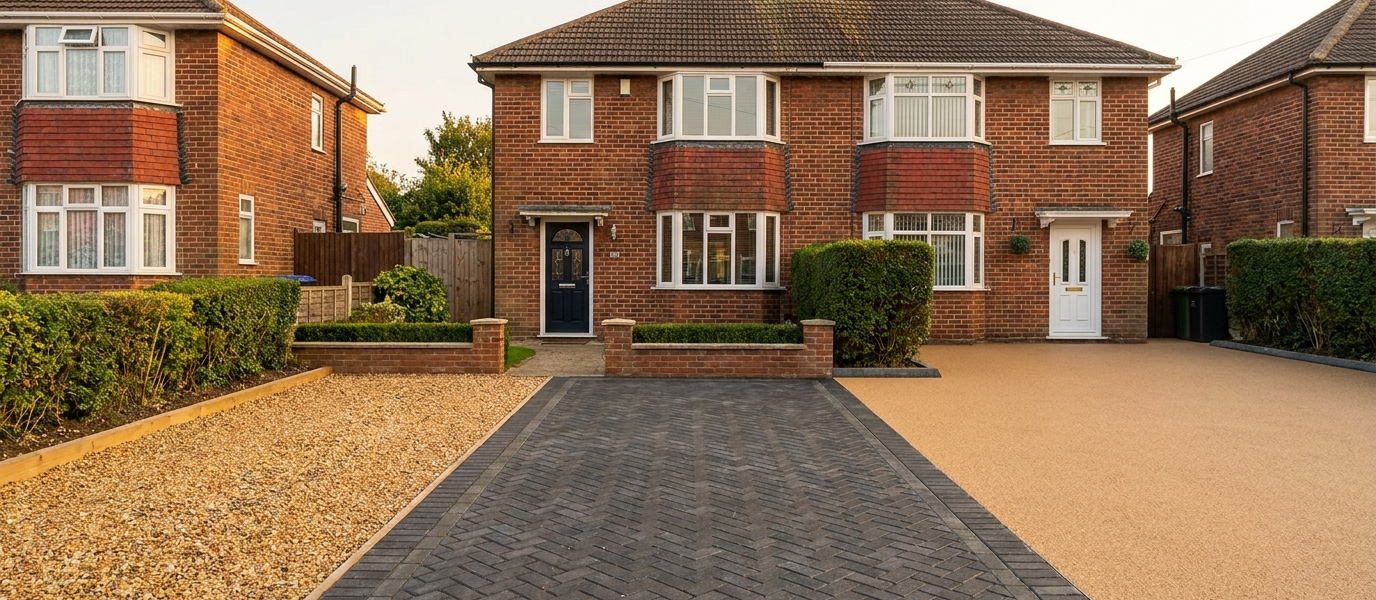
The driveway is the first room of the house. Walk it from the gate to the step, and you’ll feel the difference immediately. Gravel block, those concrete or clay pavers arranged in a grid, with gravel tucked into the gaps, gives you an irregular, textured surface. The blocks sit slightly uneven, the gravel shifts underfoot, and if you’re lucky, a little moss or grass softens the edges over time. It’s a surface that feels alive, responsive, almost conversational.
Resin, by contrast, is a smooth sweep. It’s poured on-site and smoothed into a single, continuous plane that catches the light like wet sand. After a shower, it mirrors the sky, turning your drive into a silver-grey ribbon that leads the eye straight to the front door. There’s no crunch, no give, just a clean line that says I’ve been thought about.
This matters more than you think. A driveway isn’t just a place to park, it’s the transition between public and private, between the street and your home. That transition changes how you feel coming back at the end of a long day. Gravel block slows you down, makes you notice the ground. Resin lifts your gaze, makes the house feel taller, lighter.
Pick a colour that softens with the seasons
Gravel block offers a natural palette, buff, grey, flint, that deepens when wet and fades gently in sun. A warm Cotswold gravel block will glow honey in the late afternoon, then turn to charcoal after a storm. It’s a surface that ages gracefully, the way a stone wall does, because it’s made of the same stuff.
Resin can be matched to almost any tone, a soft Farrow & Ball Drop Cloth grey, a deep slate, even a muted terracotta, but the finish stays constant. It doesn’t fade or deepen with weather; it holds its colour like a photograph. Which is fine, until autumn arrives. Leaves on gravel block disappear into the gaps, slowly breaking down and feeding the moss. Leaves on resin lie flat, demanding a broom every few days. If you live under a sycamore, you’ll notice this by November.
There’s also the light. Resin’s reflective quality can brighten a north-facing frontage, bouncing daylight back into the house through ground-floor windows. Gravel block, with its texture and shadow, absorbs harsh afternoon glare, softening the approach. One opens up; the other settles in.
Eight ways to soften a tall sash window
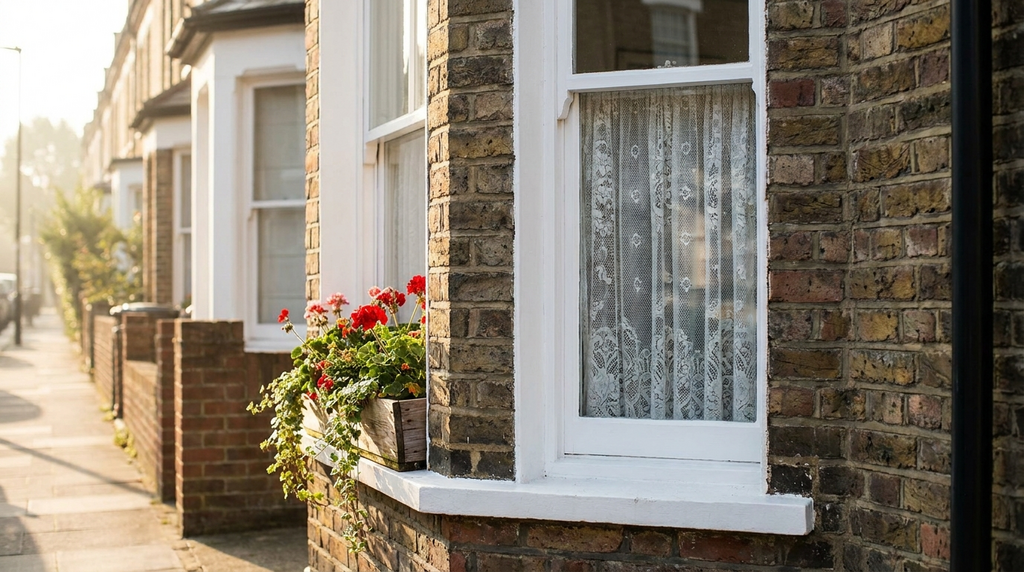
From the driveway, look up. Those tall sash windows, the kind that make a Victorian terrace or 1930s semi feel grand, need a grounding foreground. The driveway is that foreground. Here are eight ways to make the connection work:
- A gravel block border in a warm stone tone that echoes the window’s sandstone sill.
- A resin path laid in vertical bands that mirror the window’s clean lines.
- Planting at the base, lavender, box, or ornamental grasses, to break the hard edge where drive meets wall.
- A shallow rill or gutter detail that repeats the sash’s geometry, drawing the eye upward.
- Lighting cast upward from the drive surface, washing the brickwork and making the window feel suspended.
- A doormat in a complementary texture, coir or sisal, that bridges the gap between gravel block and polished step.
- A low wall or planter that repeats the window’s proportion, creating a visual rhythm across the facade.
- The driveway itself as a visual anchor: a dark resin sweep that makes the window seem taller by contrast.
Each of these is a small gesture, but together they turn the driveway from a practical surface into a design decision that lifts the whole house.
Why texture matters more than colour
Colour is what you see on the sample card. Texture is what you live with. Gravel block offers a tactile experience: the satisfying crunch underfoot, the uneven surface that drains instantly, the way it feels warm on bare feet in summer and cool in the shade of a car. It’s a surface that announces itself. You know you’ve arrived because the ground tells you so.
Resin is smooth, uniform, almost silent. It’s the driveway for people who don’t want their driveway to be a thing. In summer, it can be too hot for bare feet. In rain, it sheers off in a clean sheet. But it’s also the surface that lets a bike stand without scraping, that doesn’t catch a heel, that stays flat and predictable.
The gain for you, the homeowner, is this: choose texture first, and you choose how the driveway lives. Colour can be adjusted, topped up, even replaced. Texture is the character of the space. A gravel block drive feels like a garden path that grew up to park a car. A resin drive feels like a room without walls.
The decision is in the detail
Walk the edge. Gravel block needs a border to hold it in place, a timber edge, a stone lip, a planted strip that keeps the gravel from wandering into the lawn. That border is an opportunity. A weathered oak edge, left to silver, softens the transition between drive and garden. A stone kerb, clean and straight, gives the drive a formal finish.
Resin needs a kerb too, but a different kind, a clean, sharp edge that stops the pour from spreading. That kerb can be a low concrete lip, or it can be a strip of granite setts that echoes the house’s stonework. Either way, it’s the detail that makes the surface feel intentional.
Drainage is where the two diverge. Gravel block drains instantly, rain disappears into the gaps, feeding the ground beneath. Resin is permeable too, but only if the base is right. A poor sub-base and resin will sheet in a downpour, pooling at the edges. It’s a risk worth paying to avoid.
Maintenance follows a rhythm. Gravel block needs an occasional top-up, a bag of gravel every couple of years, and a bit of weeding where seeds find the gaps. Resin needs sealing every three to five years, a job that’s best done by a professional. Neither is onerous, but each has a pace. Gravel block asks for a little attention each spring. Resin asks for a bigger effort every few years. Choose the rhythm that suits your temperament.
What the driveway remembers
The first morning after installation, you’ll walk out to the car and notice the surface is pristine. No tyre marks, no footprints, no chalk from the children’s afternoon game. That won’t last. Gravel block holds the memory of every wheel turn, every heel dig, every dropped bike. The gravel shifts and settles, and the blocks wear at the edges, and within a year the drive looks like it belongs to the house, lived-in, imperfect, yours.
Resin stays clean. It doesn’t hold a footprint. It doesn’t show the chalk. It stays crisp and uniform, year after year, like a freshly painted wall. Some people love that. Others find it a little cold, a little too perfect.
The real comparison isn’t technical. It’s not about permeability or cost or UV stability. It’s about which material you want to live with, walk on, and watch age. Gravel block grows into the garden, softening with the seasons. Resin stays sharp, a clean line between house and street.
Stand at your front door, looking back down the drive. The surface you choose will be the first thing you see every time you come home, and the last thing you see every time you leave. It should feel like it belongs to the house, not just to the car.
driveway colour ideas