The guesswork we called a schedule
The timer schedule was never a schedule. It was a guess, an averaged-out assumption about when you’d be cold, when you’d be gone, when you’d want the house to feel like a house again. You punched in 7am to 9am and 5pm to 10pm, then spent the next three years overriding it because Tuesday was different from Thursday and the spare room never needed heating anyway. Smart thermostats don’t just replace that guess. They make the guess itself feel faintly ridiculous.
This is the quiet revolution happening in British homes right now. The shift from smart thermostats vs timers isn’t really about technology, it’s about whether your heating system treats you like a person or a punch card.
The difference between a schedule and a conversation
Timer schedules treat your home like a clockwork machine, on at 7am, off at 9am, on again at 5pm, regardless of if you’re there, asleep, or stood in a jumper wondering why the radiators are roaring. They don’t know you’ve taken the day off. They don’t know you’re working from the sofa today. They just know it’s 7am, so the boiler fires up.
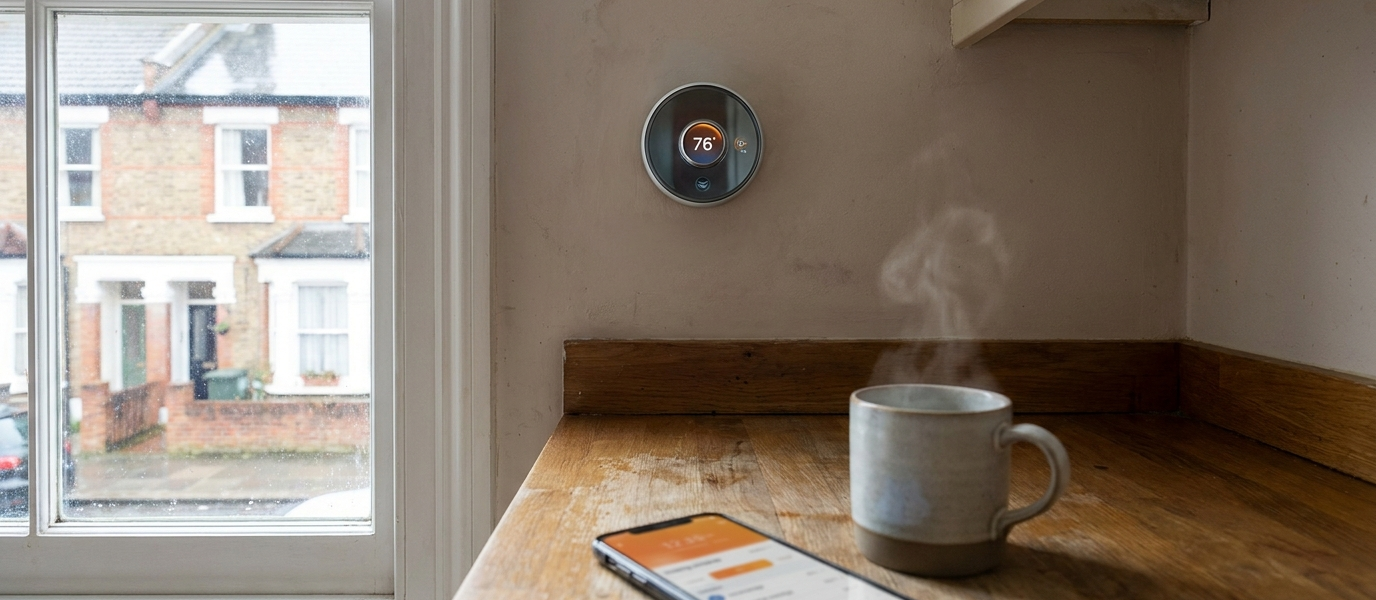
Smart thermostats learn your patterns, but they also respond to your actual presence. Geofencing, motion sensors, and adaptive algorithms mean the heating adjusts to what you’re doing, not what you planned to do. You might have told the old timer you’d be home by 6pm, but the smart system knows you’re still on the train and keeps the house cool until your phone pings the signal that you’re ten minutes away.
Why this matters: The shift is from controlling heat to being comfortable, and those two things are not the same.
Why the “set and forget” promise actually works now
Old programmable thermostats promised to remove the hassle of manual control, but they required precise programming and a reliable routine. Most people set them once and never touched them again, even when their life changed. The result was a house that felt either too hot or too cold, with the boiler cycling on and off like a metronome you couldn’t silence.
Modern smart thermostats, Hive, Nest, Tado, Drayton Wiser, use machine learning to build a heating profile from your manual adjustments. You don’t program it; you just live, and it watches. After a week of turning the heating down when you leave for work, it starts doing it for you. After a month, it knows that Wednesday is your early finish and warms the house accordingly.
The real gain isn’t convenience, it’s that the system stops wasting energy on empty rooms and half-warm mornings. That’s the difference between a guess and an intelligent response.
Geofencing your phone becomes the trigger
When you leave the house, the thermostat knows. When you’re ten minutes away, it starts warming the house to your preferred temperature. No more “I forgot to turn the heating down” guilt. No more coming back to a cold house because you assumed you’d be home by 6pm but got stuck in traffic.
The timer schedule assumed you’d never deviate. Geofencing assumes you’re human. It’s the single feature that makes the old system feel like a fossil, because your phone already knows where you are, so why shouldn’t your heating?
For homeowners with irregular hours, shift workers, freelancers, parents running between school runs and meetings, this alone is worth the switch. It’s not about programming. It’s about presence.
Zoning without the rewiring headache
A single timer schedule treats the whole house as one zone, the kitchen gets the same treatment as the spare bedroom. That’s fine if you live in a studio flat. For the rest of us, it means heating rooms nobody’s using.
Smart thermostats let you set different temperatures for different rooms, using smart radiator valves (TRVs) that talk to the main hub. You can have the living room warm by 7pm while the bedrooms stay cool. The timer schedule couldn’t do nuance. This one can.
And here’s the thing the old system never understood: you don’t need every room at 21°C. The bathroom wants to be warm when you shower. The bedroom wants to be cool when you sleep. The hallway just needs to not be freezing. Smart zoning gives you that without a plumber or a new boiler.
Eight ways a smart thermostat changes your heating habits
- You stop thinking about the heating as “on” or “off” and start thinking about it as “warm enough”.
- You stop overriding the schedule because the schedule stops being rigid.
- You notice when rooms are too hot or too cold and adjust one valve, not the whole system.
- You use the app more than the wall unit, and that changes how often you tweak the settings.
- You start to see patterns in your own behaviour you never noticed before.
- You stop worrying about the boiler cycling on and off unnecessarily.
- You save money without feeling like you’re “cutting back”.
- You realise the old timer was never really managing your home, it was managing your guilt.
The open-window detection no one asked for but everyone needs
Smart thermostats can detect a sudden drop in temperature, a window left open, and automatically turn the heating off in that room. A timer schedule would keep pumping heat into a room with a wide-open sash window, merrily warming the garden while you wonder why the boiler won’t shut up.
The smart system stops wasting heat before you’ve even noticed the draught. It’s a small feature, but it’s the kind of thing that makes you realise how much energy the old system quietly burned. In a Victorian terrace with draughty single glazing, this alone can save a noticeable chunk of your monthly bill.
What happens to the boiler when it stops being a timer
Timer schedules force boilers into short, intense bursts, on, off, on, off, which is less efficient than a steady, modulated output. Your boiler is essentially sprinting in intervals rather than jogging at a consistent pace. That’s hard on the components and hard on your gas bill.
Smart thermostats allow weather compensation and load modulation, so the boiler runs for longer but at a lower, more consistent output. The result: less wear on the boiler, lower gas consumption, and a house that stays at a stable temperature rather than swinging between “too hot” and “too cold”. It’s the difference between a car that lurches from stop to start and one that glides smoothly through traffic.
For anyone with a modern condensing boiler, this is where the real efficiency gains live. The old timer was actively working against your boiler’s design.
Why the timer schedule feels like a relic now
The timer schedule was designed for a world where everyone left the house at the same time and came back at the same time. That world no longer exists. Hybrid working, school-run chaos, freelance hours, the odd early finish, modern life doesn’t fit into a 7am-to-9am box.
Smart thermostats adapt to hybrid working, irregular hours, and the reality that “home” is no longer a predictable schedule. The death of the timer schedule isn’t a product upgrade. It’s a recognition that your home should fit your life, not the other way around.
The old system asked you to conform. The new one asks what you need. That’s not a small difference, it’s the difference between a house that manages you and a home that looks after itself.