Ofgem data shows 12.8 million UK homes still use a basic timer for heating
Many UK homes still control their heating with a basic timer or a simple seven-day programmer. Ofgem’s 2025 Domestic Energy Consumption Report recorded that only 28% of households with a gas boiler had installed a smart thermostat by the end of 2025 (Ofgem, 2026). This means the remaining 72% of households, around 12.8 million homes, rely on manual or programmable timers that offer limited control.
Upgrading from a basic timer to a smart thermostat is one of the most straightforward efficiency improvements a homeowner can make. The Energy Saving Trust estimates the average UK household could save up to 12% on heating bills by switching to a smart thermostat (Energy Saving Trust, 2026).
A smart thermostat replaces your existing boiler timer and adds remote control
A smart thermostat replaces your existing wired boiler timer with a wireless receiver unit that communicates with a thermostat in your living space. The receiver is wired directly to the boiler by a Gas Safe registered engineer. The thermostat itself can be battery-powered and placed anywhere in the home.
These devices allow you to set heating schedules from a smartphone app, turn the heating on or off remotely, and use geofencing to automatically lower the temperature when no one is home. Most models work with combi, system, and regular boilers, but compatibility depends on the boiler’s control protocol. OpenTherm boilers allow the thermostat to modulate the boiler output for finer temperature control, while simpler on/off boilers just switch the heating on or off (Energy Saving Trust, 2026).
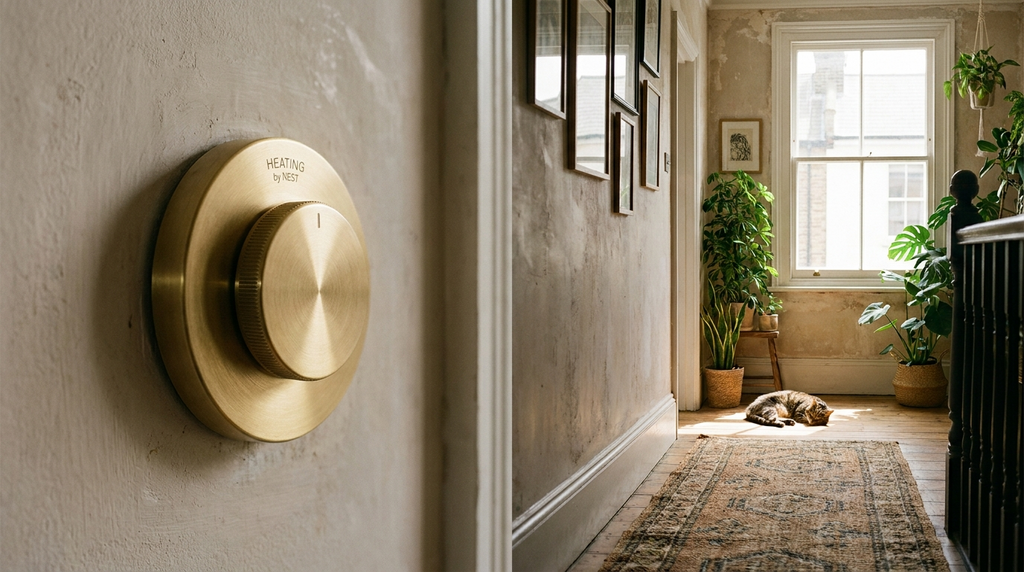
The main brands in the UK market are Hive, Nest (Google), Tado, and Drayton Wiser. All require a receiver unit installed by a qualified engineer.
Smart thermostat boiler upgrade costs range from £120 to £400 including installation
The total cost of a smart thermostat boiler upgrade depends on the model and whether you need a multi-zone system. Basic smart thermostats such as Hive Active Heating or Nest Learning Thermostat cost £120 to £200 for the kit. Professional installation by a Gas Safe registered engineer adds £50 to £100 (Energy Saving Trust, 2026).
Multi-zone systems, which allow you to control upstairs and downstairs temperatures separately, cost £250 to £400 installed. These require additional wireless receivers and zone valves. Which? reported in January 2026 that the average installed cost for a single-zone smart thermostat is around £250 (Which?, 2026).
You can reduce costs by self-installing a battery-powered thermostat, but the boiler receiver must always be installed by a Gas Safe engineer. Compare boiler replacement costs 2026
Quick numbers savings, payback, and typical usage
| Measure | Value | Details | Source |
|---|---|---|---|
| Annual energy saving | £75–£110 per year | Up to 12% of heating bill | Energy Saving Trust |
| Typical payback period | 2–4 years | Based on £300 installed cost | DESNZ |
| Carbon saving | 150–220 kg CO₂ per year | For a gas-heated three-bed home | DESNZ |
| Average installation time | 1–2 hours | By Gas Safe engineer | MCS guidance |
A smart thermostat can save you up to 12% on heating bills, according to the Energy Saving Trust
The Energy Saving Trust’s field trial of 250 UK homes found that smart thermostats reduced gas consumption by 8–12% compared to standard programmable timers (Energy Saving Trust, 2026). These savings come from automatic temperature setbacks when occupants are out, using geofencing, and more precise scheduling that stops the boiler running when it is not needed.
The savings are lower for households that already use a seven-day timer well, and higher for those who leave heating on all day. A household that currently heats an empty home for eight hours a day could save the full 12%. A household already using a well-programmed timer might save only 5–8% (Energy Saving Trust, 2026).
The Department for Energy Security and Net Zero (DESNZ) estimates the carbon saving at 150–220 kg of CO₂ per year for a typical gas-heated three-bedroom home (DESNZ, 2026).
You must use a Gas Safe registered engineer for the boiler receiver installation
The receiver unit that connects the smart thermostat to the boiler must be wired by a Gas Safe registered engineer. A general electrician cannot legally carry out this work under UK gas safety regulations. The thermostat itself can be self-installed if it is battery-powered, but the boiler connection requires a Gas Safe engineer (Gas Safe Register, 2026).
You should check the Gas Safe Register website (gassaferegister.co.uk) to verify an engineer’s licence number before work begins. The engineer will also need to test the boiler’s control port to ensure compatibility. If you attempt to wire the receiver yourself, you risk invalidating your boiler warranty and your home insurance.
Most smart thermostat manufacturers, including Hive and Nest, provide a list of approved installers on their websites. Gas Safe registered engineer checklist
Compatibility with your boiler determines which smart thermostat you can buy
Most modern boilers built after 2005 work with smart thermostats, but the connection type matters. OpenTherm boilers allow the thermostat to modulate the boiler output, giving finer temperature control and better energy savings. Simple on/off boilers just switch the heating on or off, which is less efficient (Which?, 2026).
Older boilers built before 2000 may lack the required control port. A compatibility check by a Gas Safe engineer is essential before you buy any smart thermostat. The engineer will check whether the boiler has a compatible control protocol, whether the wiring is suitable, and whether the boiler manufacturer supports the thermostat model.
The MCS (Microgeneration Certification Scheme) does not cover smart thermostats, so you do not need MCS certification for this upgrade. Focus on Gas Safe registration and the manufacturer’s compatibility list instead. Worcester Bosch, Vaillant, and Ideal all publish compatibility lists for their boilers on their technical support pages (Worcester Bosch, 2026).
Frequently Asked Questions
A smart thermostat boiler upgrade costs £120-£400 including installation by a Gas Safe registered engineer. The Energy Saving Trust estimates the average UK household saves up to 12% on heating bills after upgrading.
No, a Gas Safe registered engineer must install the receiver unit directly to your boiler. The thermostat itself can be battery-powered and placed anywhere, but the wiring connection requires professional certification.
Most smart thermostats work with combi, system, and regular boilers, but compatibility depends on the boiler's control protocol. OpenTherm boilers allow modulating control, while simpler on/off boilers just switch heating on or off (Energy Saving Trust, 2026).
The Energy Saving Trust estimates the average UK household could save up to 12% on heating bills by switching from a basic timer to a smart thermostat. Actual savings depend on your home size, usage, and existing heating controls.
The main UK brands are Hive, Nest (Google), Tado, and Drayton Wiser. The best choice depends on your boiler's compatibility (especially OpenTherm support) and whether you need multi-zone control. All require a Gas Safe engineer for installation.