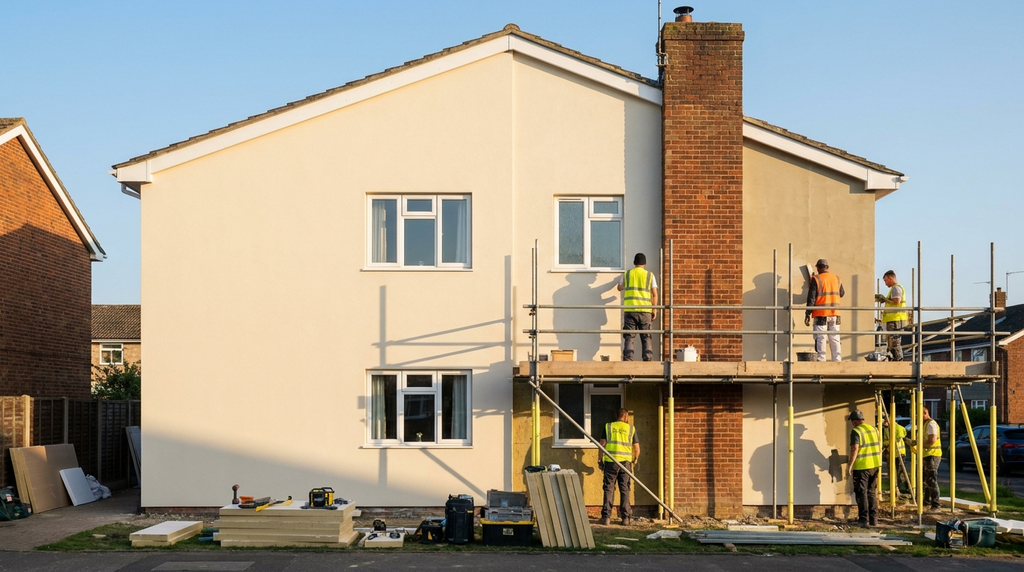
The cavity insulation install day typically takes two to four hours for an average semi-detached house
If you are planning to have cavity wall insulation fitted, the install day itself is usually straightforward and much shorter than you might expect. The process is built to be completed in a single visit without major disruption to your home.
The cavity wall insulation install day takes 2-4 hours for a typical semi-detached house. The process is completed in a single visit with minimal disruption, and you can stay inside throughout. Compare installer quotes to see exact timings for your property.
- Install takes 2-4 hours for a typical semi-detached house.
- Holes are drilled at 1-metre intervals along mortar joints.
- Insulation is blown in under pressure without needing to leave home.
- Holes are patched with colour-matched mortar after filling.
- Pre-install survey must pass or the install day is cancelled.
- The cavity insulation install day typically takes two to four hours for an average semi-detached house
- Eligibility is the single factor that determines whether your install day can proceed
- Quick numbers what the install day timeline looks like in hours
- You do not need to be home for the entire install day, but you must provide access
- The cavity install day cannot proceed if the weather is wet, windy, or below 5 °C
- After the install day, you must wait 2–4 weeks before redecorating the patched holes
- The installer must be MCS-certified for your install day to be valid under any UK grant scheme
For a typical three-bedroom semi-detached house, the installer will arrive in a dedicated vehicle carrying the insulation material (usually mineral wool or expanded polystyrene beads) and a blowing machine. The team needs access to all external walls, where they drill small holes roughly 22–25 mm in diameter at intervals of about one metre along the mortar joints. The insulation is blown into the cavity under pressure until the cavity is completely filled, and the process is continuous, you do not need to leave the house. Once filling is complete, the holes are patched with colour-matched mortar, and the team cleans up any debris before leaving (Energy Saving Trust, 2026).
Eligibility is the single factor that determines whether your install day can proceed
Before any drilling begins, a pre-install survey must confirm that your property is suitable for cavity wall insulation. This survey is the critical gatekeeper, if it flags any issue, the install day will be cancelled.
The survey must confirm the cavity width is at least 50 mm and that the wall is free of damp, cracks, or unfilled cavities. Properties built after 1990 or located in high-exposure wind zones (such as coastal or upland areas) are often excluded without a specialist assessment. The installer will also check for existing insulation, blocked cavities, and the condition of the cavity wall ties. If the survey flags any issue, such as a narrow cavity or suspected damp, the install day is cancelled and a different measure must be considered (GOV.UK cavity wall insulation guidance; MCS installation standards MIS 3005).
Quick numbers what the install day timeline looks like in hours
The following table gives typical install times and the number of access holes for different property types. These figures are based on industry best-practice guidance.
| Property type | Typical install time (hours) | Number of access holes | Clean-up time (minutes) |
|---|---|---|---|
| Flat (ground-floor) | 1.5–2 | 8–12 | 15 |
| Terraced house | 2–3 | 12–18 | 20 |
| Semi-detached house | 2.5–3.5 | 15–22 | 25 |
| Detached house (3-bed) | 3–4 | 20–30 | 30 |
Source: National Insulation Association (NIA), cavity wall installation best practice guide (2026 edition) (NIA, 2026).
You do not need to be home for the entire install day, but you must provide access
The installer needs clear access to all external walls, so you should move cars, bins, and garden furniture away from the walls before the team arrives. Internal access is rarely required unless the installer needs to check a loft hatch or take a damp meter reading inside.
You can leave during the install, but you must return before the team finishes to inspect the work and sign the completion certificate. If you have pets or young children, keep them indoors or in a secure rear garden to avoid interference with the drilling (Energy Saving Trust, 2026).
what to check before the installer arrives
The cavity install day cannot proceed if the weather is wet, windy, or below 5 °C
Weather conditions are a deal-breaker for cavity insulation installation. The installer will check the 24-hour forecast before the day; rain or high winds (above 20 mph) stops the job because the insulation material must stay dry during injection. Temperatures below 5 °C can cause the mortar to crack when drilled, or the insulation to settle unevenly.
If the weather is borderline, the installer will call you by 7:00 am on the install day to confirm or reschedule. You are not charged for a weather-related cancellation, and a new date will be offered within the same grant window (MCS installation standard MIS 3005).
After the install day, you must wait 2–4 weeks before redecorating the patched holes
The mortar used to fill the drill holes needs time to cure fully. Redeocrating too soon, within the first two weeks, can cause cracking or a colour mismatch. The installer will leave a small bag of matching mortar for future touch-ups if needed.
The completion certificate (from the installer or the MCS-registered scheme) is your proof that the work was done to standard. Keep it with your home file. If you are using a government grant such as ECO4 or the Great British Insulation Scheme (GBIS), the installer will submit the completion paperwork within five working days (NIA, 2026; GOV.UK Great British Insulation Scheme completion process).
The installer must be MCS-certified for your install day to be valid under any UK grant scheme
The Great British Insulation Scheme closed on 31 March 2026. It funded insulation measures only and never covered windows or glazing. Before the install day, check the MCS installer database at installer.mcscertified.com to confirm the company is listed.
The installer must also be registered with CIGA (Cavity Insulation Guarantee Agency), which gives you a 25-year guarantee on the work. If the installer is not MCS- and CIGA-registered, the grant is invalid and you may be liable for the full cost (MCS find an installer; CIGA guarantee scheme for cavity wall insulation).
how to check your installer is registered before the install day
Frequently Asked Questions
The install day takes 2-4 hours for an average three-bedroom semi-detached house, according to the Energy Saving Trust. Larger or more complex properties may take longer.
No, you do not need to leave your house during the installation. The process is continuous and the team works from outside, so you can stay inside as normal.
The installer drills small holes (22-25 mm) in the mortar joints at 1-metre intervals, blows insulation into the cavity, patches the holes with colour-matched mortar, and cleans up debris. The whole process takes 2-4 hours.
Yes, the installation is completed in a single visit for most properties. A typical semi-detached house takes 2-4 hours, and the team leaves once the job is finished.
The pre-install survey can cancel the install day if it finds a cavity narrower than 50 mm, damp, cracks, blocked cavities, or if the property is in a high-exposure wind zone. GOV.UK and MCS standards MIS 3005 set these requirements.