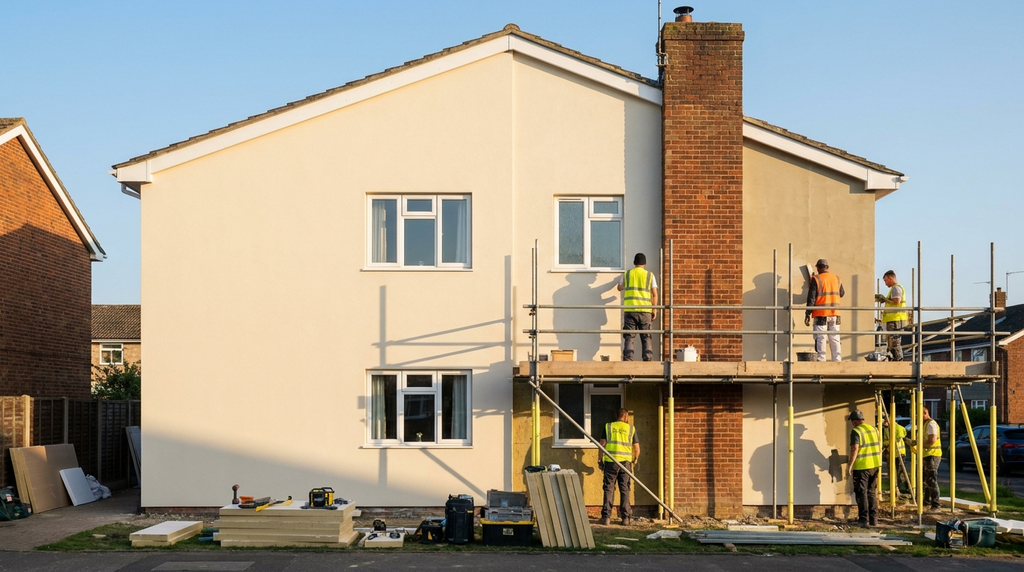
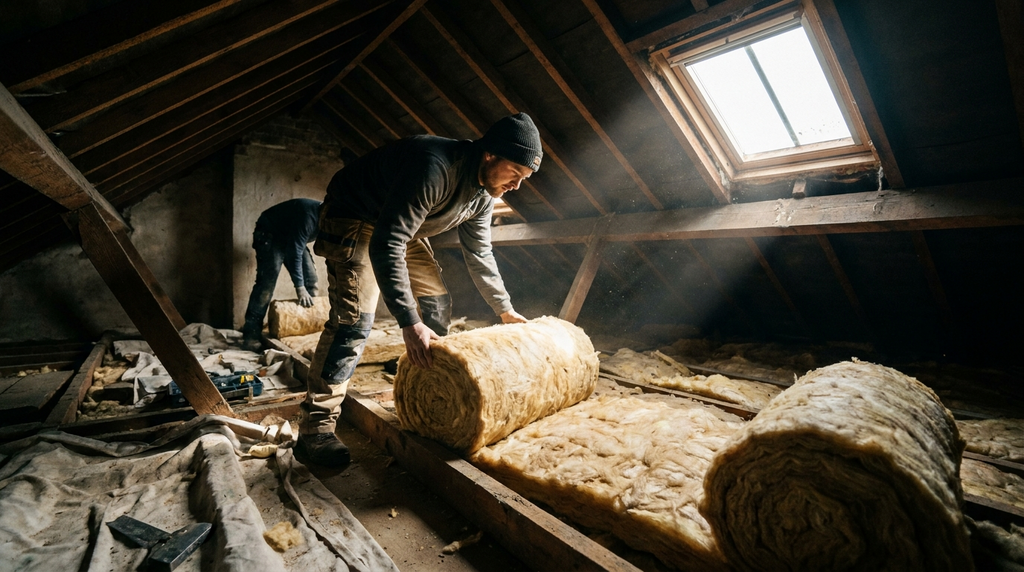
The UK’s solid-brick-wall housing stock means millions of homes lose heat directly through their walls
Around one third of heat loss in an uninsulated solid-wall home occurs through the walls themselves (Energy Saving Trust, 2026). Approximately 7 million UK homes have solid brick walls, which have no cavity to fill, making internal insulation a common retrofit solution. Internal wall insulation can reduce heat loss by up to 45%, but eligibility for grants depends on the property’s energy performance and type of construction (Energy Saving Trust, 2026).
Insulating a brick wall from inside costs £40-£80/m² and cuts heat loss by up to 45%. The Great British Insulation Scheme closed on 31 March 2026. It funded insulation measures only and never covered windows or glazing. Check wall type with your local council before applying.
- Internal insulation reduces heat loss by up to 45% (Energy Saving Trust).
- Solid brick walls over 260mm thick qualify for ECO4 grants.
- Measure wall thickness at a window reveal to check if solid.
- GBIS and ECO4 grants are means-tested for low-income households.
- Cavity walls are ineligible; check with your council first.
- The UK’s solid-brick-wall housing stock means millions of homes lose heat directly through their walls
- Who qualifies for UK grants for internal brick-wall insulation
- How to check if your brick wall is solid or cavity before applying
- Quick numbers – typical costs, U-values, and grant amounts for internal brick-wall insulation
- The direct answer how to insulate a brick wall from inside using stud walls or PIR boards
- Eligibility and certification – how to verify your installer for grant-funded work
- What to do if you are not eligible for a grant – alternative funding and next steps
Who qualifies for UK grants for internal brick-wall insulation
The Great British Insulation Scheme closed on 31 March 2026. It funded insulation measures only and never covered windows or glazing. Eligibility is means-tested: households receiving specific benefits such as Pension Credit, Universal Credit, or with low income may qualify (GOV.UK, 2026). Properties must have an Energy Performance Certificate (EPC) rating of D, E, F, or G, and the wall must be a solid brick wall (not cavity) to be eligible under ECO4 (GOV.UK, 2026). If your home already has cavity wall insulation, you will not qualify for a grant to insulate solid brick walls from inside.
How to check if your brick wall is solid or cavity before applying
A solid brick wall is typically over 260mm thick (including internal plaster) and has no gap between the inner and outer leaves. Homeowners can measure wall thickness at a window or door reveal using a tape measure. A cavity wall will show a gap between brick layers when viewed from the side of an opening (Energy Saving Trust, 2026). The MCS (Microgeneration Certification Scheme) register does not cover wall insulation, but local authority energy advisors can confirm wall type via a visual inspection or thermal imaging. You can contact your council’s energy-efficiency team for a free check.
Quick numbers – typical costs, U-values, and grant amounts for internal brick-wall insulation
| Measure | Value | Source |
|---|---|---|
| Typical cost per m² (materials and labour) | £50–£80 per m² for PIR boards | Energy Saving Trust, 2026 |
| Target U-value after insulation | 0.30 W/m²K | Building Regulations Part L, 2026 |
| Average annual heating bill saving | Up to £345/year for a mid-terrace house | Energy Saving Trust, 2026 |
| Maximum ECO grant contribution | Varies by property; typically covers full cost for low-income households | OFGEM ECO4 supplier guidance, 2026 |
| Payback period (self-funded) | 5–10 years depending on fuel prices | Energy Saving Trust modelling, 2026 |
The direct answer how to insulate a brick wall from inside using stud walls or PIR boards
The two main methods are fixing PIR (polyisocyanurate) insulation boards directly to the wall with a vapour control layer, or building a timber stud frame, filling with mineral wool or rigid boards, and plasterboarding over. For solid walls, internal insulation must be at least 50mm thick to achieve a U-value of 0.30 W/m²K, though thicker insulation (80–100mm) is common for older homes (Building Regulations Approved Document L, 2026). A vapour control layer (VCL) is essential on the warm side of the insulation to prevent interstitial condensation inside the wall (Energy Saving Trust, 2026). This condensation can cause damp and rot if not properly managed. how to avoid condensation when insulating solid walls For DIY installation, ensure you seal all joints in the VCL with tape and overlap at ceilings and floors.
Eligibility and certification – how to verify your installer for grant-funded work
For ECO4 or GBIS grants, the installer must be registered with TrustMark and be a member of a competent person scheme such as FENSA (for windows and doors) or NICEIC and NAPIT for electrical work. For wall insulation specifically, TrustMark is the standard (TrustMark, 2026). Check the installer’s registration on the TrustMark website or via the Energy Saving Trust’s “Find an installer” tool. For private work without a grant, no certification is legally required, but using a TrustMark-registered installer protects your consumer rights if problems arise (GOV.UK, 2026). If your project involves renewable heat (such as a heat pump after insulation), an MCS-certified installer is required for grant eligibility. MCS certification explained for homeowners
What to do if you are not eligible for a grant – alternative funding and next steps
Homeowners above the benefit threshold can still access low-cost loans through the Great British Insulation Scheme’s “pay as you save” option, or through local authority energy-efficiency schemes such as Cosy Homes in Lancashire. The Energy Company Obligation also offers a “flexible eligibility” route for households with a low income but not on benefits, set by local councils (GOV.UK, 2026). Self-funding internal insulation typically costs £2,000–£4,000 for a mid-terrace house, with a payback of 5–10 years depending on fuel prices (Energy Saving Trust, 2026). You could also combine internal insulation with other improvements such as loft insulation or draught-proofing to maximise savings. Contact your local council’s energy-efficiency team to check for area-specific schemes that may cover part of the cost. how to find local energy grants in your area
Frequently Asked Questions
Internal brick wall insulation costs £40 to £80 per square metre installed, according to Energy Saving Trust 2026 figures. A typical 3-bed semi with solid walls costs £4,000 to £8,000 total. Compare quotes from MCS-registered installers for accurate pricing.
The wall must be solid brick, not cavity. Contact your local authority energy team to check eligibility.
Measure the wall thickness at a door or window reveal. Solid brick walls are over 260mm thick, while cavity walls are usually 250-300mm total but have a visible gap. Your council can confirm via thermal imaging (Energy Saving Trust 2026).
PIR foam boards or rigid phenolic boards are most effective, achieving U-values of 0.30 W/m²K or better. Ensure a vapour control layer is installed to prevent condensation. Use a certified installer for best results.
If installed correctly with a vapour barrier, it reduces condensation risk. Without it, moisture can build up behind insulation. The Energy Saving Trust advises professional installation to avoid damp issues.