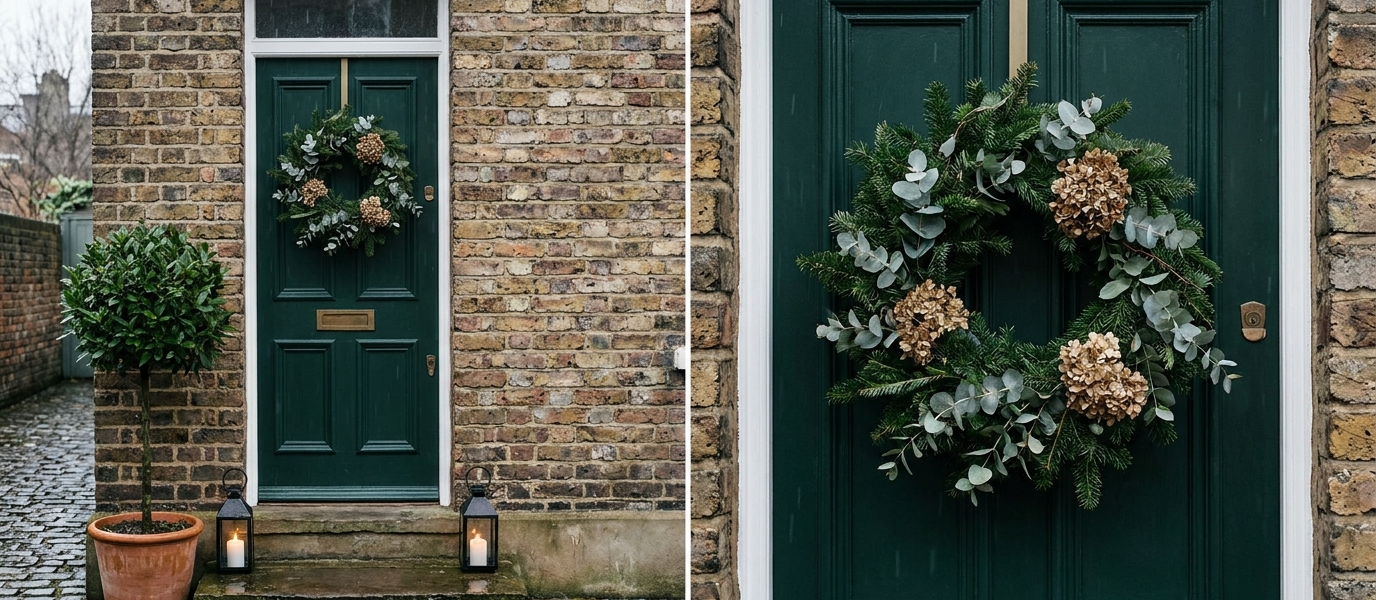
Let your front door do the heavy lifting
On a grey December morning, when the garden has collapsed into mud and the sky sits low and white, your front door is still standing there doing its job. It’s probably the most architectural thing on your facade, the panel geometry, the glazing bars, the fanlight, the letterbox plate. It has rhythm. It has proportion. And most Christmas styling ignores all of it in favour of a tinsel explosion that could belong to any front door on any street.
Before you buy a single decoration, stand on the pavement and study your door. Where are the panels? Is there a central glazed section, or is it solid timber? Are the hinges exposed? Does the handle sit high or low? The best Christmas styling amplifies what’s already there rather than hiding it behind a curtain of plastic greenery. You’ll spend less money and achieve more impact because you’re working with the door’s natural rhythm, not against it.
A Victorian four-panel door, for instance, has a clear vertical spine. A wreath hung at the centre of the top panel respects that line. A 1930s door with a single large glazed section wants something that frames the glass, not covers it. Study first. Decorate second.
Pick a colour that softens with the seasons
There’s a quiet magic in a door colour that shifts its mood depending on what you place against it. Deep bottle green, something like Farrow & Ball’s Studio Green, feels like a dark wood in summer and a winter forest when you hang a wreath of pine and red berries against it. Warm charcoal, such as Railings by the same brand, turns almost silver in low December light, making gold or brass hardware glow. A muted terracotta, think Calke Green’s earthier cousin, gives you a warm backdrop that makes holly and ivy look as though they grew there.
The trick is that a neutral or earthy base allows Christmas greenery, berries, and lighting to pop without competing. A bright red door with a red-berried wreath is just noise. But a deep teal door with a wreath of eucalyptus, dried orange slices, and cream ribbon? That’s a conversation. A well-chosen door colour feels festive all winter, not just for the two weeks of December. It’s the kind of choice that makes you want to light a candle at 3pm and not feel guilty about it.
The wreath as a window into the house
The wreath is the single most important styling element on your front door. It’s a preview of what’s inside, a promise of warmth, scent, and care. But scale is everything. A wreath should be large enough to be seen from the pavement, but not so large it obscures the door’s fanlight or glazing. If your door has a beautiful arched fanlight, a wreath that sits below it, leaving the glass clear, is more elegant than one that fights for attention.
Material contrast is where the magic lives. Bare winter branches, twisted hazel or birch, against painted timber feel sculptural and honest. Dried citrus slices threaded onto wire and tucked into a base of moss catch the light in a way plastic berries never can. A wreath of eucalyptus and white wax flowers against a matte black iron door is understated and utterly sophisticated. The best wreaths don’t shout “Christmas!”, they whisper “someone lives here and they have good taste.”
If you’re making your own, start with a simple metal ring and build outwards. If you’re buying, look for ones that use natural materials and a restrained palette.
Why texture matters more than colour
In low December light, that dim, quiet hour just before dawn, or the blue-grey of a winter afternoon, colour recedes. What does the work is texture. Rough bark against smooth painted timber. Glossy holly leaves next to matte velvet ribbon. The hammered surface of a metal lantern catching the last of the day. Texture keeps the eye moving, keeps the scene feeling alive.
Layer texture on the doorstep too. A coir mat with a geometric pattern grounds the entrance. A basket of logs, birch, with the bark still on, stacked beside the door adds a rough, natural note. A ceramic urn filled with bare twigs or dried hydrangea heads gives height without competing with the door itself. Even a simple pair of wellies, left slightly askew with a sprig of holly tucked into each, adds texture that feels accidental but is carefully composed.
The rule is simple: if it’s all smooth, it’s flat. If it’s all rough, it’s messy. Mix polished and raw, glossy and matte, and the whole thing reads as natural and un-themepark.
Eight ways to soften a tall sash window
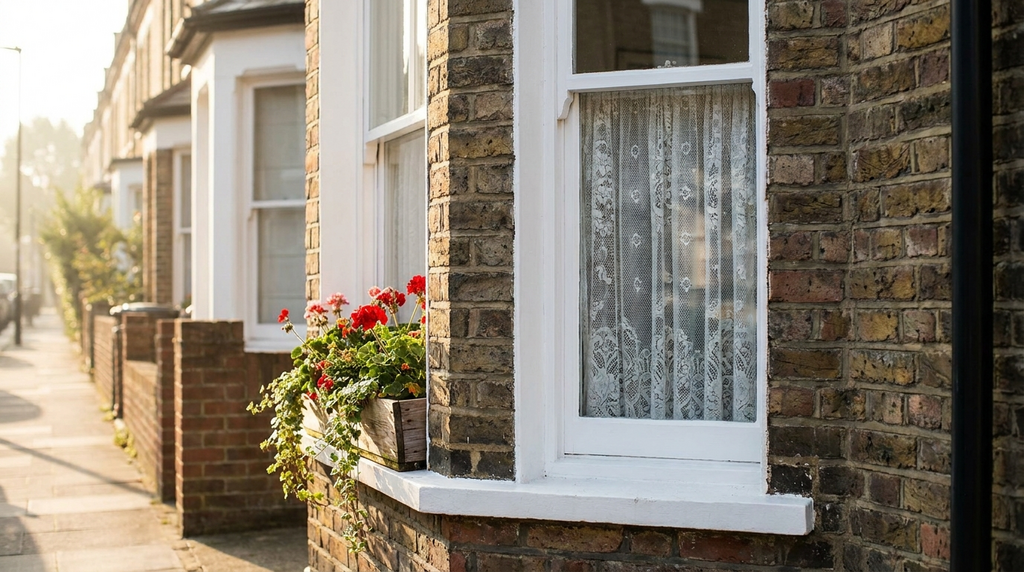
If your front door is flanked by tall sash windows, common in Victorian and Edwardian terraces, those windows are part of the composition. They deserve attention, but not the kind that overwhelms their proportions. Here are eight treatments that respect the window rather than drowning it:
- Single taper candles on the sill. Three or five, varying heights, in plain glass holders. Light them at dusk. The effect is warm, simple, and utterly elegant.
- A garland that follows the architrave. Drape a thin garland of eucalyptus or ivy along the top edge of the window frame, letting it fall slightly at the corners. It frames the glass without blocking it.
- Frosted glass film with a frost pattern. Removable and affordable, this gives you the look of a December morning without the cold. It softens the view into the house while adding a seasonal touch.
- Small potted cyclamen. The deep pink or white flowers last for weeks and sit happily on a windowsill. Group three in terracotta pots for a natural, unforced look.
- Unlit paper stars hung on invisible thread. A single star, or a cluster of three, suspended in the top half of the window. They catch the light during the day and create a soft silhouette at night.
- A single branch of eucalyptus draped over the top sash. Let it hang down a few inches. The grey-green leaves are subtle and fragrant.
- A row of mini terracotta pots with ivy. Line them along the sill. The trailing ivy softens the hard edge of the frame and connects the window to the doorstep below.
- A simple linen curtain pulled halfway. A natural linen panel, hung from a slim rod, drawn to just below the midpoint. It softens the window’s geometry without hiding it.
Each of these treatments respects the window’s proportions. None of them scream “Christmas!”, they whisper it.
Lighting that reads as atmosphere, not amusement
Lighting is the element that makes a passerby slow down rather than look away. The goal is atmosphere, not illumination. Warm, dimmable, directional light, fairy lights tucked inside a glass lantern, a single uplighter placed behind a wreath to cast its shadow onto the door, candles in storm shades grouped on the doorstep.
What you want to avoid is anything that turns your porch into a carnival midway. Strip lights, flashing LEDs, or a string of bulbs that look like they belong on a fairground ride. The same principle applies: work with the architecture, not against it. A lantern that echoes the style of your door, black iron for a Victorian house, brass for a 1930s semi, is a permanent fixture that earns its keep all year. At Christmas, you just add a candle.
If you’re using a string of fairy lights, choose warm white, not cool blue. Drape them loosely, not taut. And always, always put them on a timer so they switch on at dusk and off at midnight. The porch should look magical, not abandoned.
Let the doorstep tell a story
The best Christmas front door styling looks like someone lives there. Not like a stylist visited and left a perfectly curated tableau that will be dismantled on Boxing Day. It looks accidental. It looks as though the holly sprigs fell into the wellies because someone was carrying logs, not because they were placed there with a measuring tape.
Build a vignette that feels lived-in. A pair of wellies, slightly muddied, with sprigs of holly tucked into each. A stack of firewood beside the door, birch or ash, with a single cinnamon stick wedged between the logs. The letterbox has a sprig of rosemary tucked into it, not a plastic Santa. A basket of pinecones sits on the doorstep, spilling slightly onto the mat. None of these things are expensive. None of them require a trip to a Christmas shop. They’re just the things you already have, arranged with a little more intention than usual.
The door itself is the frame. The styling is the story. And the best story is one where the homeowner walks out in their coat, picks up the logs, and the whole thing still looks good. door colour ideas for year-round appeal
That’s the test. If it survives a Tuesday morning in December, it’s right.