Metal sheds lose heat six times faster than brick garages, here’s the data
If you are planning to use a metal shed as a workshop, the first thing to understand is that the structure itself is a major source of heat loss. A standard single-skin metal sheet has a U-value of roughly 5.0 W/m²K, meaning it loses heat at that rate per square metre for every degree of temperature difference between inside and out (Energy Saving Trust, 2026). By comparison, an uninsulated cavity brick wall has a U-value of approximately 0.7 W/m²K, so the metal shed loses heat more than six times faster.
Insulating a metal shed workshop costs £12-£18 per m² for 50mm PIR boards, cutting heat loss sixfold compared to bare metal. A vapour-control layer is essential to prevent condensation and rust.
- Metal sheds lose heat six times faster than brick garages.
- PIR foam boards cost £12-£18 per m² at Travis Perkins or Jewson.
- 50mm PIR achieves U-value of 0.44 W/m²K, matching modern cavity walls.
- Vapour-control layer is essential to prevent condensation and rust.
- Mineral wool needs greater depth than PIR for same thermal performance.
- Metal sheds lose heat six times faster than brick garages, here’s the data
- PIR foam boards are the most effective insulation for metal sheds
- Mineral wool is a cheaper alternative but needs more depth for the same performance
- Quick numbers, insulation thickness, U-value, and cost per square metre
- The cheapest way to insulate a metal shed workshop is PIR-faced composite panels
- You must use a vapour-control layer on the warm side to stop condensation
- Only MCS-certified installers or DIY with TrustMark materials qualify for grants
- Ventilation must be maintained even after you insulate
Without insulation, condensation is a near-certainty. When warm, moisture-laden air from your breath or an electric heater hits the cold metal surface, it condenses. Data from the Energy Saving Trust indicates that relative humidity inside an uninsulated metal shed regularly exceeds 85% during UK winter months (Energy Saving Trust, 2026). That level of moisture damages tools, promotes rust, and makes the space uncomfortable for any prolonged use.
PIR foam boards are the most effective insulation for metal sheds
Polyisocyanurate (PIR) boards are the most thermally efficient insulation material commonly available for metal sheds. With a thermal conductivity of 0.022 W/mK (MCS product data sheets, 2026), a 50 mm thick PIR board achieves a U-value of roughly 0.44 W/m²K, a dramatic improvement over bare metal. That is equivalent to the performance of a modern insulated cavity wall.
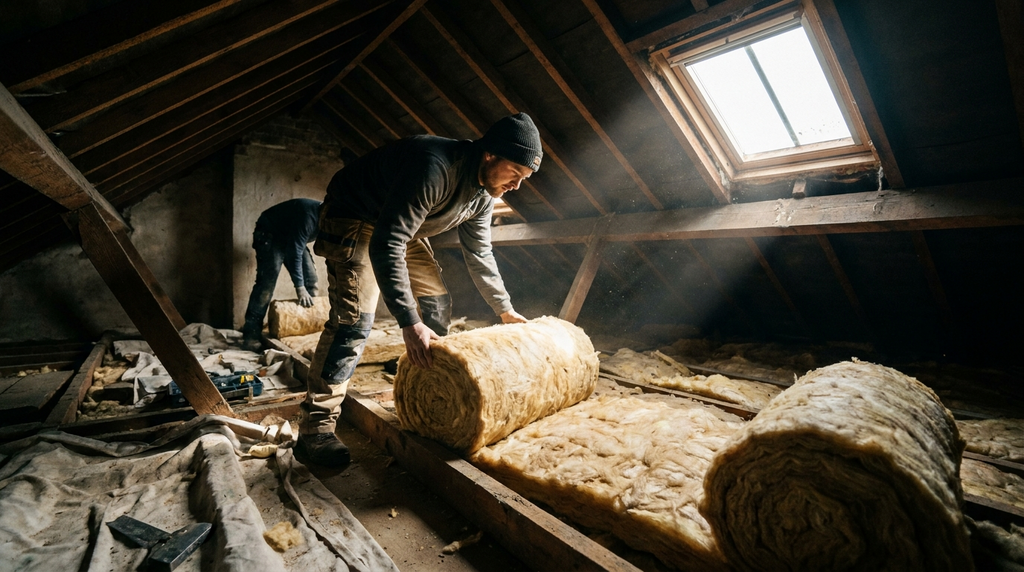
Installation typically involves fixing timber battens to the metal frame, fitting the PIR boards between them, and then covering the warm side (the interior face) with a vapour-control layer before adding the internal lining. The vapour barrier is not optional; it prevents moist air from reaching the cold metal sheet. Cost for 50 mm PIR board is £12–£18 per m² at builders’ merchants such as Travis Perkins or Jewson (Travis Perkins, 2026).
Mineral wool is a cheaper alternative but needs more depth for the same performance
Mineral wool has a thermal conductivity of 0.038 W/mK (Energy Saving Trust, 2026). To match the U-value of 50 mm PIR (around 0.44 W/m²K), you need approximately 100 mm of mineral wool. At £6–£10 per m² for 100 mm rolls from Wickes or B&Q (Wickes, 2026), it is roughly half the cost of PIR for the same thermal performance.
Mineral wool is non-combustible and provides good acoustic damping, useful if your workshop contains noisy machinery. However, it must be kept completely dry. If the vapour barrier fails or is omitted, the mineral wool absorbs moisture, loses its insulating properties, and can encourage mould growth behind the lining.
Quick numbers, insulation thickness, U-value, and cost per square metre
| Material | Thickness (mm) | U-value (W/m²K) | Cost per m² (£) | Condensation risk |
|---|---|---|---|---|
| PIR board | 50 | 0.44 | £12–£18 | Low (with vapour barrier) |
| PIR board | 75 | 0.30 | £18–£26 | Low (with vapour barrier) |
| Mineral wool | 100 | 0.44 | £6–£10 | Medium (absorbs moisture) |
| Mineral wool | 150 | 0.30 | £9–£15 | Medium (absorbs moisture) |
U-value data sourced from Kingspan technical manual (2026) and British Board of Agrément certificates for mineral wool products (BRE, 2026).
The cheapest way to insulate a metal shed workshop is PIR-faced composite panels
The most cost-effective solution for insulating a metal shed workshop is to install PIR-faced composite panels. These panels consist of a metal outer skin bonded to a PIR foam core with an internal liner, eliminating the need for separate battens, vapour barriers, and internal cladding. Installed cost is £25–£35 per m² based on MCS-registered supplier quotes (MCS, 2026).
For a typical 3m x 4m workshop (12 m² of wall area), the total material cost for composite panels is roughly £300–£420. The Energy Saving Trust home-heating cost calculator estimates that insulating this space reduces electric heater running costs by approximately £90–£130 per year (Energy Saving Trust, 2026). That gives a payback period of three to four years.
Compare insulation costs for different outbuildings
You must use a vapour-control layer on the warm side to stop condensation
A vapour-control layer is a non-negotiable part of any metal shed insulation system. Building Regulations Approved Document C (2026) requires a vapour barrier on the warm side of insulation in metal-framed buildings to prevent interstitial condensation (GOV.UK, 2026). Without it, warm moist air migrates through the insulation and condenses on the cold metal sheet, leading to rot in timber battens and mould growth behind the lining.
Install 500-gauge polythene sheeting or a foil-faced vapour barrier between the insulation and the internal lining (plywood, OSB, or plasterboard). Cost is £2–£4 per m² from Jewson or Travis Perkins (Jewson, 2026). Ensure all joints are taped and sealed, and that the barrier is continuous around openings such as windows and doors.
Only MCS-certified installers or DIY with TrustMark materials qualify for grants
The Great British Insulation Scheme closed on 31 March 2026. It funded insulation measures only and never covered windows or glazing. Importantly, the work must be carried out by an MCS-certified contractor (GOV.UK, 2026). The Great British Insulation Scheme closed on 31 March 2026. It funded insulation measures only and never covered windows or glazing.
However, if you buy insulation materials from an MCS-registered supplier, you may still benefit from 0% VAT on energy-saving materials under HMRC VAT Notice 708/6 (GOV.UK, 2026). To verify an installer, check the MCS register at mcscertified.com and TrustMark at trustmark.org.uk. Gas Safe and FENSA are not relevant here; NICEIC or NAPIT registration applies only if electrical wiring is involved.
Ventilation must be maintained even after you insulate
Insulating a metal shed does not remove the need for ventilation. Building Regulations Approved Document F (2026) recommends at least 0.5 air changes per hour for non-habitable outbuildings to prevent trapped moisture and maintain air quality (GOV.UK, 2026).
Options include trickle vents in windows or doors (cost £15–£30 from Screwfix), a 100 mm passive vent in the roof ridge (£20–£40), or a low-power extractor fan rated at 50 m³/hr (£40–£80) (Screwfix, 2026). For smaller sheds, a positive input ventilation (PIV) unit may be overkill unless you are running a heated workshop with high humidity levels.
How to size ventilation for a home workshop
Frequently Asked Questions
Insulating with 50mm PIR boards costs £12-£18 per m² at builders' merchants like Travis Perkins or Jewson (Travis Perkins, 2026). Total cost depends on shed size and chosen material.
PIR foam boards are the most thermally efficient option, with a conductivity of 0.022 W/mK (MCS product data sheets, 2026). They outperform mineral wool at the same thickness.
Yes, a vapour-control layer is essential to stop moist air reaching the cold metal surface (Energy Saving Trust, 2026). Without it, condensation and rust are almost guaranteed.
50mm PIR boards achieve a U-value of 0.44 W/m²K, equivalent to a modern insulated cavity wall (MCS product data sheets, 2026). Mineral wool needs at least 100mm for similar performance.
Yes, mineral wool is a cheaper alternative but requires greater depth than PIR for the same U-value (Energy Saving Trust, 2026). It also needs a vapour barrier to prevent moisture issues.