Bifacial solar panels are they worth the cost in 2026
If you are shopping for solar panels in 2026, you will almost certainly come across bifacial models promoted as the next generation of solar technology. These panels capture sunlight from both sides, promising higher electricity generation than standard monofacial panels that only collect light from the front. The question is whether that extra output justifies the significantly higher price tag for a typical UK home.
Bifacial solar panels are worth the cost in 2026 only on flat roofs, white membranes, or ground mounts. On standard dark pitched roofs, the 5–8% extra generation rarely offsets the 20–30% higher upfront cost, extending payback by 2–5 years.
- Bifacial panels generate 5–30% more electricity depending on roof albedo.
- On dark pitched roofs, payback extends 2–5 years versus standard panels.
- Flat roofs or white membranes can achieve 30% extra generation.
- Bifacial panels cost 20–30% more per watt than monofacial panels.
- Check your roof surface colour before choosing bifacial panels.
- Bifacial solar panels are they worth the cost in 2026
- How bifacial panels work and why the gain depends on your roof
- Cost comparison bifacial versus monofacial panels in 2026
- Quick numbers
- When bifacial panels make financial sense
- MCS certification and the Smart Export Guarantee
- Planning permission and wind loading considerations
- The direct answer bifacial panels are worth it only on flat, white, or ground-mounted roofs
The direct answer is that bifacial solar panels are worth the cost in 2026 only on flat roofs, white membrane roofs, or ground-mounted arrays, not on standard dark-pitched roofs. On a dark-tiled pitched roof, the extra generation is typically 5–8%, which rarely covers the 20–30% higher upfront cost, extending the payback period by 2–5 years compared to standard monofacial panels (Energy Saving Trust, 2026).
How bifacial panels work and why the gain depends on your roof
Bifacial panels are constructed with a transparent backsheet or dual layers of glass. This allows sunlight to reach photovoltaic cells on both the front and rear surfaces. The rear side generates electricity from reflected light, known as albedo, bouncing off the surface below the panel. The amount of reflected light depends almost entirely on the colour and texture of your roof surface.
The actual gain ranges from 5% on a dark slate or concrete tiled roof to 30% on a white gravel or flat roof with a high-albedo surface (BRE National Solar Centre, “Albedo values for UK roofing materials,” 2025 technical note). This is not a fixed efficiency improvement; it is a variable that you must calculate based on your specific roof conditions. If your roof reflects less than 15% of sunlight, the extra generation from bifacial panels is unlikely to make financial sense.
Cost comparison bifacial versus monofacial panels in 2026
Bifacial panels cost roughly 20–30% more per watt than standard monofacial panels. A typical 4 kWp bifacial system costs £8,000–£9,500 installed, compared to £6,500–£7,500 for an equivalent monofacial system, before any grants or incentives (MCS Installer Database, average quoted prices Q1 2026; Solar Energy UK, “Cost trends in residential PV,” January 2026).
The price premium is driven by more complex manufacturing, the need for double-sided glass encapsulation, and specialised mounting systems that raise the panels above the roof surface. While prices have fallen over the past five years, bifacial panels remain a premium product in the residential market.
Quick numbers
| Panel type | Typical efficiency | Cost per watt (installed) | Annual output (4 kWp, south-facing, 40° tilt) | Payback period (typical UK roof) |
|---|---|---|---|---|
| Monofacial | 20–22% | £1.60–£1.85 | 3,800–4,200 kWh | 10–14 years |
| Bifacial (dark roof) | 21–23% (rear adds 5–8%) | £2.00–£2.40 | 4,000–4,500 kWh | 12–17 years |
| Bifacial (light/flat roof) | 21–23% (rear adds 15–30%) | £2.00–£2.40 | 4,400–5,500 kWh | 9–13 years |
Source: DESNZ, “Solar PV cost and performance data 2026”; MCS Register, system performance records 2025–2026.
When bifacial panels make financial sense
Flat roofs with white membrane, gravel, or light-coloured felt reflect 25–40% of sunlight, conditions where bifacial panels can achieve the full 15–30% output gain. Ground-mounted arrays also allow rear-side access to reflected light, making them another strong candidate. In these scenarios, the extra generation justifies the 20–30% price premium, and the payback period is competitive with or better than monofacial systems.
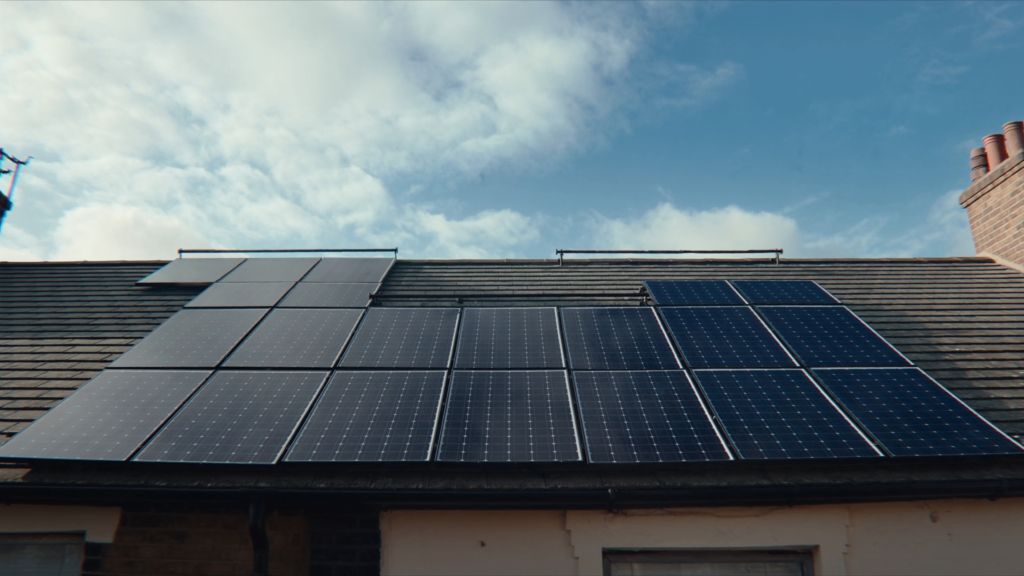
On a dark-pitched roof with slate or concrete tiles, the albedo is typically 5–10%. The extra output of 5–8% rarely covers the higher upfront cost, and the payback period extends to 12–17 years compared to 10–14 years for monofacial panels (Energy Saving Trust, “Bifacial solar panels: when they make financial sense,” March 2026). Over a typical 25-year panel lifespan, the total savings from bifacial on a dark roof are often lower than from a cheaper monofacial system, once the higher initial investment is accounted for.
MCS certification and the Smart Export Guarantee
Every bifacial installation must be certified under the Microgeneration Certification Scheme (MCS) to qualify for the Smart Export Guarantee (SEG). The installer must be MCS-registered and hold TrustMark accreditation. Without this certification, you cannot access SEG payments, which currently range from 5–15p/kWh for exported electricity (Ofgem, “Smart Export Guarantee: eligible installations,” 2026; MCS, “Certification requirements for solar PV,” 2026).
If you are considering a bifacial system, verify that your chosen installer is on the MCS register before signing any contract. The SEG payments can significantly improve the financial case, but only if the installation meets the scheme’s requirements.
Planning permission and wind loading considerations
Bifacial panels require a raised mounting system, typically 10–20 cm gap above the roof surface, to allow light to reach the rear side. This changes the wind loading characteristics compared to flush-mounted monofacial panels. The increased gap can create lift forces that require additional structural reinforcement, particularly on exposed or high-wind sites (BRE, “Wind loading on elevated solar arrays,” 2025).
In England, raised panels may require planning permission if the system protrudes more than 20 cm above the roof plane under Permitted Development rights (Town and Country Planning Act 1990, as amended 2025; Planning Portal, “Solar panels and permitted development,” 2026). If your bifacial panels sit at the upper end of that gap, you may need to submit a planning application. Check with your local planning authority before proceeding.
How to check if you need planning permission for solar panels
The direct answer bifacial panels are worth it only on flat, white, or ground-mounted roofs
Homeowners with dark-pitched roofs should buy standard monofacial panels. Those with flat or light-coloured roofs should consider bifacial for the 15–30% output gain. The higher upfront cost of bifacial only breaks even within a typical 25-year panel lifespan when the albedo exceeds 15% (Energy Saving Trust, “Bifacial vs monofacial: which panel for your roof?” 2026; Solar Energy UK, “Residential solar buying guide 2026”).
Before making a decision, obtain at least three quotes from MCS-registered installers who can provide a site-specific albedo assessment. Ask each installer to model the output for both bifacial and monofacial panels on your specific roof. If the modelled payback for bifacial is within one year of the monofacial option, the choice may come down to personal preference. If the gap is wider, the numbers are clear.
How to compare solar panel quotes and avoid common mistakes
Frequently Asked Questions
Yes, but extra generation is only 5–8% on dark tiles or slates. Energy Saving Trust advises this rarely covers the 20–30% higher cost, extending payback by 2–5 years.
Bifacial panels cost roughly 20–30% more per watt than standard monofacial panels. For a 4 kWp system, that adds £1,200–£1,800 based on 2026 MCS data.
Flat roofs, white membrane roofs, and ground-mounted arrays produce the highest albedo gains. BRE National Solar Centre reports up to 30% extra generation on white gravel surfaces.
Only on high-albedo roofs like flat or white membranes. On standard dark pitched roofs, the 5–8% gain does not justify the 20–30% price premium according to Energy Saving Trust.
Bifacial panels typically have a 30-year performance warranty versus 25 years for standard panels. Their dual-glass construction reduces degradation to around 0.25% per year (GOV.UK, 2026).