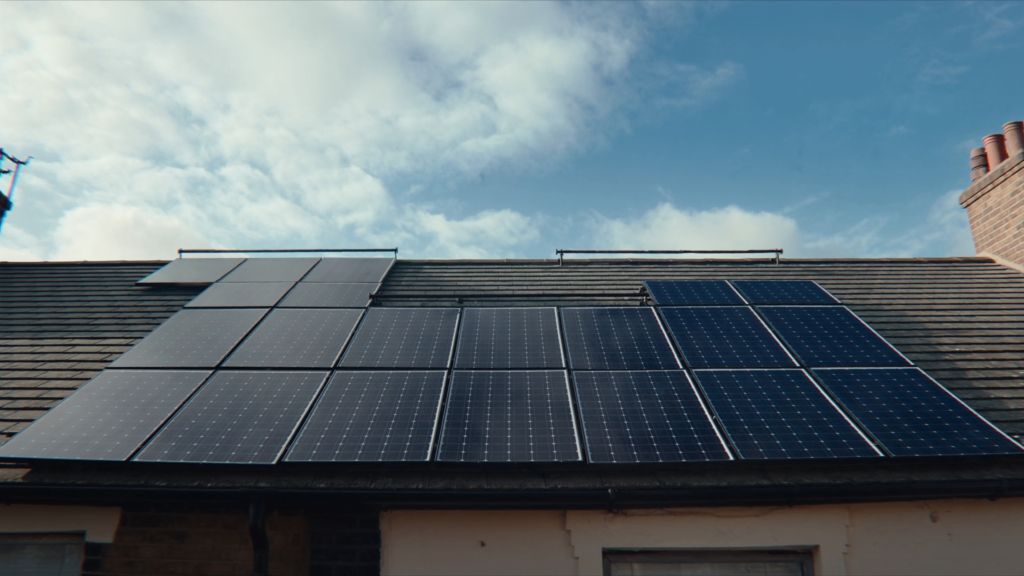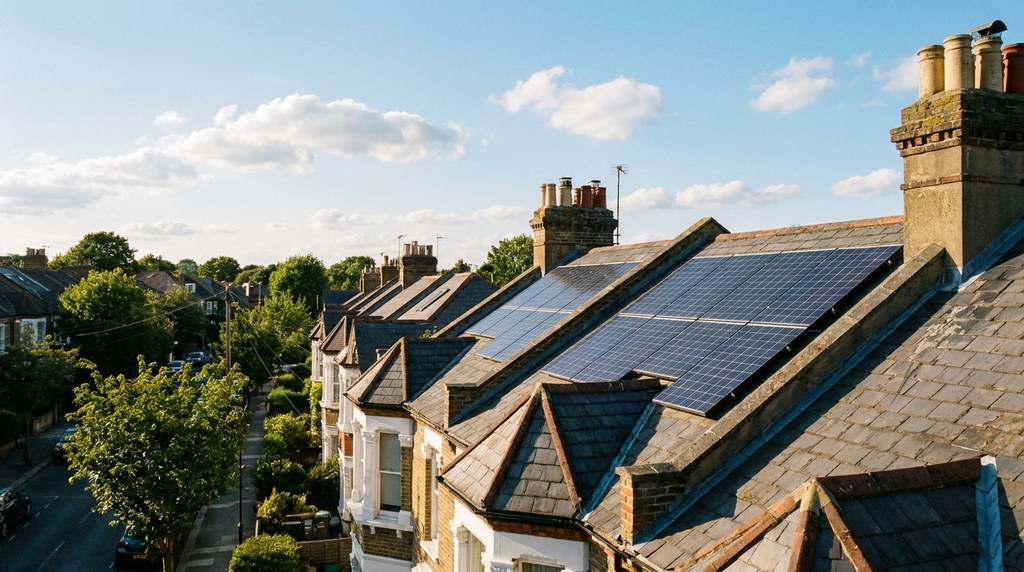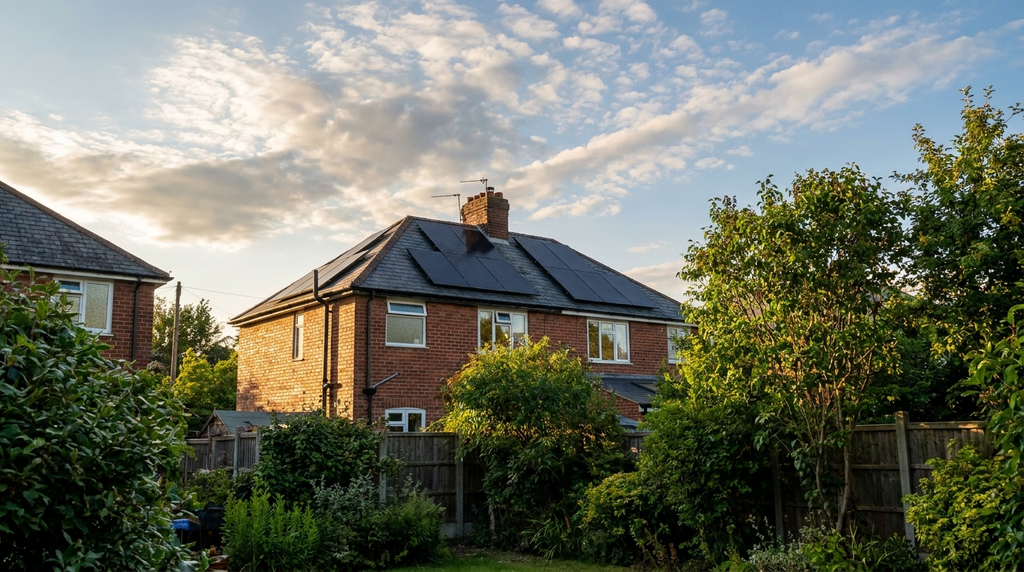
How Solar Panels Work Step by Step
If you are considering solar panels for your home, the basic question is often the first one that needs answering. How do these roof-mounted devices actually turn daylight into usable electricity for your kettle, lights, and washing machine?
Solar panels work in five steps: sunlight hits photovoltaic cells, creating DC electricity. An inverter converts DC to AC for home use. Appliances use it first, and surplus exports earn payment. A typical 4 kWp system costs £5,000–£8,000 and saves £500–£900 annually (DESNZ 2026).
- Five-step process: sunlight to DC, inverter to AC, appliance use, grid export.
- Average 4 kWp system costs £5,000–£8,000 installed (DESNZ 2026).
- Annual savings of £500–£900 based on Ofgem 24.5p/kWh (2026).
- Payback period of 7–14 years depending on self-consumption ratio.
- Photovoltaic effect in monocrystalline silicon cells generates 0.5–0.6V per cell.
The process is a straightforward five-step chain: sunlight hits the panels, creates direct current (DC) electricity, an inverter converts that into alternating current (AC) for your home, your appliances use it first, and any surplus is exported to the grid for which you are paid. The average UK system costs between £5,000 and £8,000 installed and saves between £500 and £900 per year on electricity bills (DESNZ, 2026).
The average UK solar panel system costs £5,000–£8,000 installed and saves £500–£900 per year on electricity bills
Published 2026 data from the Department for Energy Security and Net Zero (DESNZ) shows the median installed cost for a 4 kWp system is £6,200, with a typical range of £5,000 to £8,000 depending on roof type, scaffolding requirements, and installer location (DESNZ Solar PV Cost and Performance Update 2026). Annual savings of £500 to £900 are based on the 2026 Ofgem price cap of 24.5p per kWh and typical generation of 3,500 to 4,500 kWh for a south-facing 4 kWp array (Ofgem Price Cap Q2 2026). The payback period ranges from 7 to 14 years, depending on how much of the generated electricity you use yourself (self-consumption ratio) and the rate you receive for exported electricity under the Smart Export Guarantee.
Step one Sunlight hits the solar panels and creates direct current (DC) electricity
Each solar panel contains photovoltaic cells, typically made from monocrystalline silicon in 2026 models. When sunlight (photons) strikes these cells, it knocks electrons loose from their atoms, generating a flow of electrons known as direct current (DC) electricity. This is the photovoltaic effect (MCS Standard MIS 3002).
Each individual cell produces about 0.5 to 0.6 volts of DC. A standard residential panel contains 60 cells wired together, producing roughly 30 to 36 volts DC per panel. Panels are then connected in series (a string) to achieve a system voltage of 300 to 600 volts DC, which is the typical operating range for a residential string inverter (Energy Saving Trust, 2026).
Step two The inverter converts DC electricity into alternating current (AC) for home use
Your home’s appliances and the UK mains grid run on alternating current (AC), not DC. The inverter is the box (usually located in the loft, garage, or on an external wall) that performs this conversion. Two main types exist. String inverters (costing £800 to £1,200 installed) convert the combined DC output from all panels at once. Microinverters (£200 to £300 each) are fitted to each panel and convert DC individually, which can be beneficial if panels are on different roof orientations or suffer from shading (Energy Saving Trust, 2026).
Typical residential inverter efficiency for 2026 models is 96% to 98%, meaning only 2% to 4% of the generated electricity is lost in conversion. The output matches the UK mains supply of 230 volts at 50 Hz. That makes it ready to power any standard appliance (MCS certified inverter performance data).
Quick numbers Key solar panel performance and cost figures
| Metric | Typical Value | Source |
|---|---|---|
| System size (residential) | 4 kWp (10–12 panels) | MCS Installation Database 2026 |
| Annual generation (south-facing, 4 kWp) | 3,500–4,500 kWh | DESNZ Solar PV Generation Data 2026 |
| Cost per kWp installed | £1,300–£1,600 | DESNZ Cost Update 2026 |
| Annual savings (50% self-consumption) | £500–£900 | Ofgem Price Cap Q2 2026 |
| Export tariff (Smart Export Guarantee) | 5–15p/kWh | Ofgem SEG Register 2026 |
Step three The solar electricity powers your home first; excess flows to the grid
Solar electricity generated during daylight hours is used to power your home’s appliances before any electricity is drawn from the grid. If your panels produce more electricity than your home is using at that moment (for example, on a sunny weekday when the house is empty), the surplus is automatically exported to the national grid (Energy Saving Trust, 2026).
Without a battery, a typical UK household uses 30% to 50% of its solar generation on-site (self-consumption). Adding a battery storage system (costing £2,000 to £4,000 installed) allows you to store surplus daytime generation for use in the evening, raising self-consumption to 60% to 80% (DESNZ Household Electricity Survey 2026).
Step four You are paid for exported electricity under the Smart Export Guarantee (SEG)
The Smart Export Guarantee (SEG) is the UK government scheme that requires all licensed electricity suppliers with 150,000 or more customers to offer an export tariff. As of 2026, typical SEG rates range from 5p to 15p per kWh. Some suppliers offer fixed rates (for example, 12p per kWh), while others offer variable rates linked to wholesale electricity prices (Ofgem SEG Guidance for Generators, 2026).
To qualify for SEG payments, your solar installation must be MCS-certified (see Step five), and you must have a smart meter installed to measure the electricity you export. You are free to switch SEG tariff providers independently of your electricity supply tariff (GOV.UK SEG page).
Step five MCS certification ensures your installer meets technical and consumer protection standards
The Microgeneration Certification Scheme (MCS) is the industry standard that certifies both the solar panels and the installer. It is mandatory for SEG eligibility and is also required for most government-backed grant schemes. Also, TrustMark registration is required for schemes such as the Great British Insulation Scheme (MCS, 2026).
Before paying a deposit or signing a contract, check the installer’s MCS certificate number on the public MCS Register (mcsregister.co.uk). This confirms the installer is accredited and that your system will be eligible for SEG payments and any available grants (GOV.UK Energy Grants and Schemes, 2026). MCS certification and installer checklist
Solar panels work in UK weather even cloudy days generate 10–25% of peak output
A common misconception is that solar panels only work in direct, blazing sunshine. In reality, photovoltaic cells generate electricity from diffuse light on overcast days, typically producing 10% to 25% of their peak rated output. Annual generation is 10% to 15% lower in northern England and Scotland compared to southern England due to lower average light levels (DESNZ UK Solar PV Generation by Region and Season, 2026).
Winter generation is 20% to 30% of the summer peak because of shorter daylight hours and a lower sun angle. Even so, a 4 kWp system still generates 1,000 to 1,500 kWh between November and February, which can offset a significant portion of winter electricity bills (Energy Saving Trust, 2026).
Frequently Asked Questions
Yes, it is a five-step chain. Sunlight hits photovoltaic cells, creating direct current (DC). An inverter converts DC to alternating current (AC) for home use. Appliances use the power first, and surplus is exported to the grid under the Smart Export Guarantee (Ofgem).
The photovoltaic effect is when sunlight photons knock electrons loose from silicon atoms, generating a flow of DC electricity. This is the core principle behind all solar panels, certified under MCS Standard MIS 3002.
A 4 kWp south-facing system in the UK generates 3,500–4,500 kWh per year, or roughly 10–12 kWh per day. Actual output depends on roof orientation, shading, and weather (Energy Saving Trust).
Solar panels produce direct current (DC), which flows in one direction. Home appliances and the grid use alternating current (AC), which reverses direction. An inverter converts DC to AC so the power can be used in your home.
The Smart Export Guarantee (SEG) requires energy suppliers to pay you for surplus solar electricity exported to the grid. Rates vary by supplier, typically 3–15p per kWh, and are set by Ofgem.