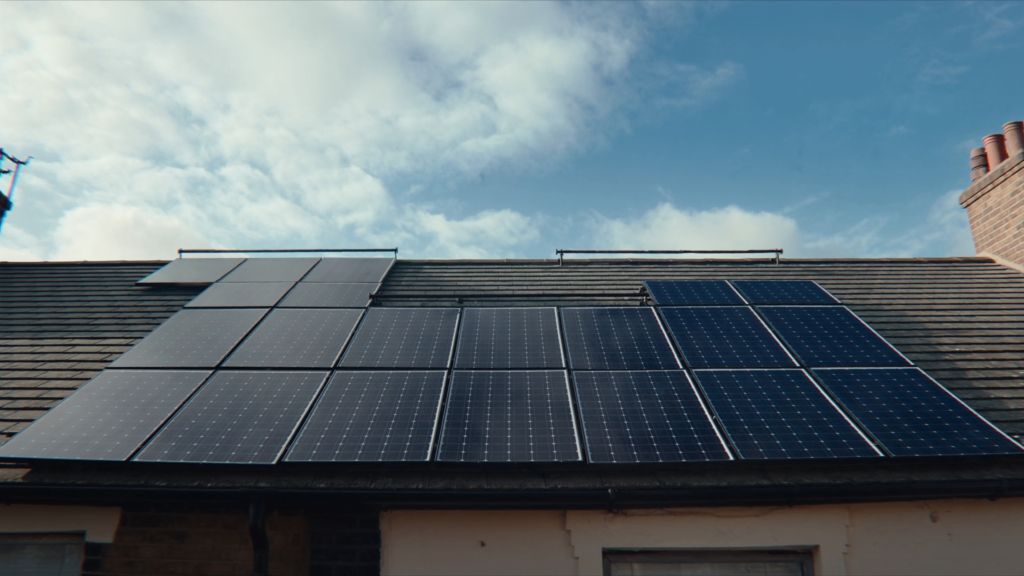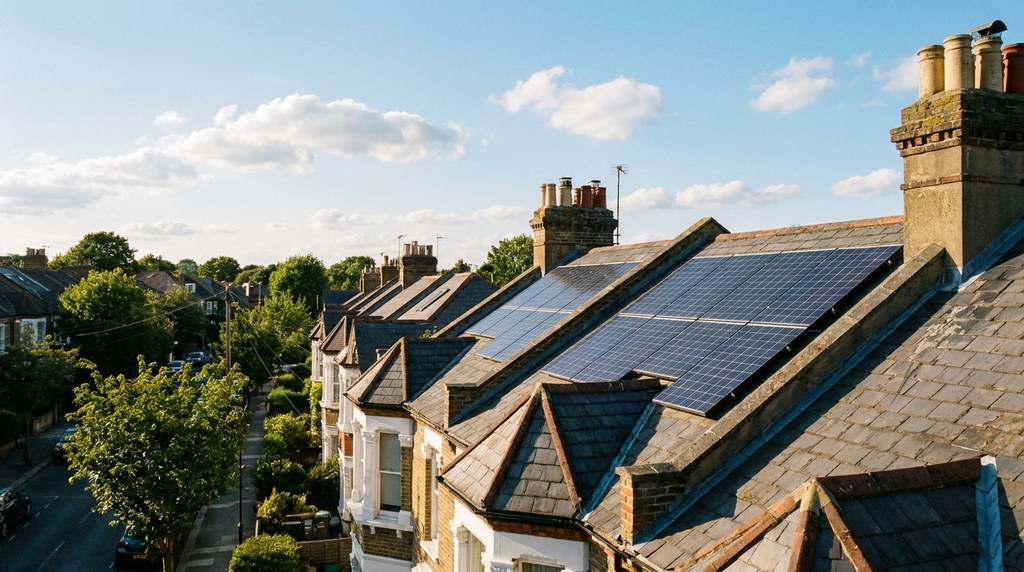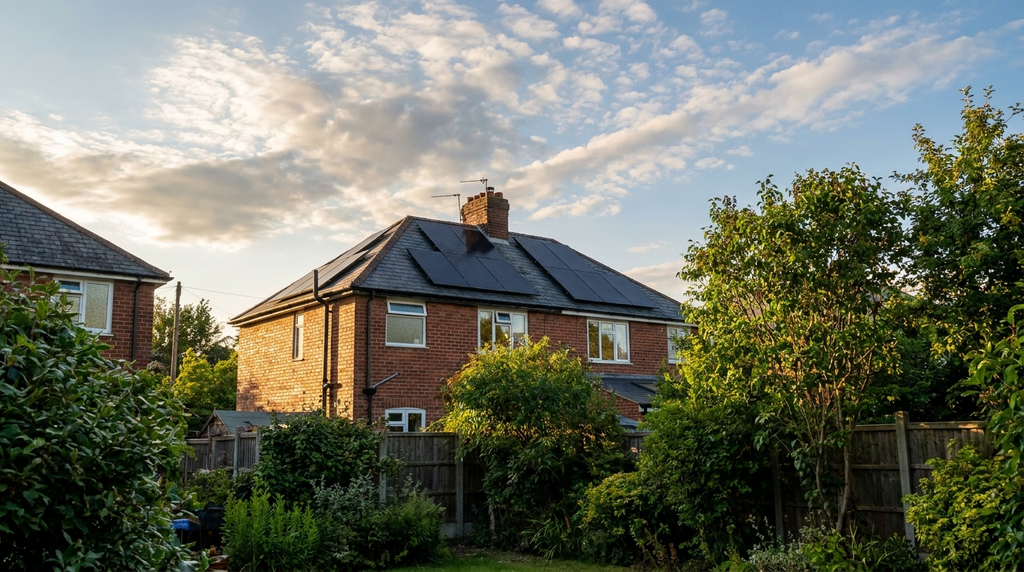
Terraced houses can still generate significant solar savings despite limited roof space
Many homeowners assume terraced houses lack the roof area for a worthwhile solar PV system. That assumption is wrong for the majority of UK terraced properties. A typical terraced house with a south-facing roof and 15–20 m² of usable space can support a 3–5 kWp system, generating roughly 2,550–2,975 kWh per year (Energy Saving Trust, 2026).
Solar panels for a terraced house cost £4,500–£6,500 and save £400–£550 per year on electricity bills. A typical 3–3.5 kWp system fits 15–20 m² of roof space and pays back in 10–14 years.
- A 3–3.5 kWp system fits most terraced roofs with 15–20 m² space.
- Annual savings of £400–£550 on electricity bills at 2026 price cap.
- Payback period is 10–14 years without a battery, shorter with SEG.
- Smart Export Guarantee adds £80–£130 yearly for exported power.
- North-facing roofs still generate 70–80% of south-facing output.
- Terraced houses can still generate significant solar savings despite limited roof space
- Quick numbers, typical costs and savings for a terraced house solar installation
- How much roof space a terraced house actually has and what size system fits
- What the 2026 0% VAT rule means for your terraced house installation
- The single most important factor for terraced house solar payback orientation and shading
- How to verify your installer is certified and your system qualifies for SEG payments
- How to maximise self-consumption in a terraced house without a battery
- What a terraced house solar installation actually costs in 2026, itemised
At 2026 capped electricity rates, that generation saves an average of £400–£550 annually on your electricity bill (Ofgem price cap data, April 2026). Payback periods typically range from 10 to 14 years, depending on orientation, shading, and whether you add a battery (Energy Saving Trust payback guidance, 2026).
The Smart Export Guarantee (SEG) adds another £80–£130 per year for electricity you send back to the grid (Ofgem, 2026). Even north-facing roofs can generate 70–80% of a south-facing system’s output, making solar viable for most terraced houses (Energy Saving Trust, 2026).
Quick numbers, typical costs and savings for a terraced house solar installation
| Item | Typical 2026 figure | Source |
|---|---|---|
| System size | 3–3.5 kWp | MCS installation database |
| Upfront cost (no battery) | £4,500–£6,500 | MCS installer averages |
| Upfront cost (with 5 kWh battery) | £7,000–£9,500 | MCS installer averages |
| Annual generation | 2,550–2,975 kWh | Energy Saving Trust solar calculator |
| Annual bill saving (no battery) | £400–£550 | Ofgem price cap April 2026 |
| Annual SEG income | £80–£130 | Ofgem SEG tariff data |
| Payback period (no battery) | 10–14 years | Energy Saving Trust payback calculator |
| System lifespan | 25–30 years | MCS product warranty standards |
How much roof space a terraced house actually has and what size system fits
A typical UK terraced house has a ridge length of 4–5 metres and a slope length of 5–6 metres, giving a total roof area of 20–30 m². However, usable space is reduced by chimneys, dormer windows, and roof lights, leaving roughly 15–20 m² of clear roof (MCS Solar PV installation guide, 2026).
A 3.5 kWp system needs about 16–18 m² of clear roof, which equates to 16–18 panels at roughly 1.0–1.1 m² each (MCS Solar PV system sizing, 2026). Most terraced houses can fit 8–12 panels on the main roof slope. Adding panels on a rear extension or garage is possible but uncommon in terraced settings due to limited side access and structural considerations.
If a south-facing roof is unavailable, an east-west split system, with half the panels on each side, can fit and generate a similar total daily output (Energy Saving Trust, 2026).
What the 2026 0% VAT rule means for your terraced house installation
Since 2024, domestic solar panel installations have been permanently zero-rated for VAT, not subject to a temporary cut (GOV.UK, 2026). This saves you the full 20% that previously applied. A typical £5,500 system now costs £5,500 instead of £6,600, a saving of £1,100.
The 0% rate also covers batteries installed at the same time as the panels, and any subsequent battery-only installation (HMRC, 2026). There is no upper limit on system size for the VAT relief, it applies to any domestic solar PV installation, regardless of capacity.
The single most important factor for terraced house solar payback orientation and shading
South-facing roofs deliver the highest annual generation, but east-west split arrays can match them in total daily generation because they produce power for more hours of the day (Energy Saving Trust, 2026). Shading from neighbouring terraced houses, chimney stacks, or tall trees is common in terraced streets and can reduce output by 20–50% (Energy Saving Trust, 2026).
Microinverters or power optimisers add £300–£600 to the installation cost but can recover 10–30% of lost generation from shaded panels (MCS microinverter guidance, 2026). A shading survey, often free from MCS-certified installers, is essential before committing. Use the Energy Saving Trust’s Solar Energy Calculator to estimate shading impact.
How to verify your installer is certified and your system qualifies for SEG payments
All installers must be MCS-certified (Microgeneration Certification Scheme) for your system to qualify for Smart Export Guarantee payments. Check the MCS Installer Database at mcs-certified.com (Ofgem, 2026). MCS certification also ensures compliance with building regulations and manufacturer warranties (MCS, 2026).
For electrical work, the installer should also be registered with NICEIC or NAPIT (NICEIC / NAPIT contractor databases). You do not need planning permission for roof-mounted solar panels on a terraced house unless you live in a listed building or conservation area, check with your local planning authority (GOV.UK, 2026).
How to maximise self-consumption in a terraced house without a battery
The simplest way to boost payback is to shift high-energy use (washing machine, dishwasher, tumble dryer) to solar-generating hours (10am–4pm). This can increase self-consumption from 30% to 50% (Energy Saving Trust, 2026). Solar diverters for hot water immersion heaters cost £400–£700 and can use excess generation to heat water, saving an additional £80–£120 per year (Energy Saving Trust, 2026).
Without a battery, expect to export 50–70% of your generation to the grid at SEG rates (Ofgem, 2026). A 5 kWh battery costs £2,500–£3,500 extra but can raise self-consumption to 60–80%, shortening payback by 2–4 years (Energy Saving Trust, 2026).
What a terraced house solar installation actually costs in 2026, itemised
- 3.5 kWp system (10 panels, inverter, scaffolding, labour): £4,500–£6,500
- Microinverters or optimisers (if shading is an issue): add £300–£600
- 5 kWh battery: add £2,500–£3,500
- Solar diverter (hot water): add £400–£700
- Scaffolding for a standard terraced house: £300–£500 (included in most quotes)
- Total with battery and diverter: £7,500–£10,500
- Annual savings (bill + SEG) with battery: £550–£750; without battery: £480–£680
- Payback with battery: 12–16 years; without battery: 10–14 years
All cost figures are sourced from MCS installer price data for 2026. Your actual costs will vary depending on roof complexity, scaffolding access, and local installer rates.
compare solar panel costs for different house types what is the Smart Export Guarantee and how to apply
Frequently Asked Questions
Yes, most UK terraced houses have enough roof space. A typical 3–3.5 kWp system needs 15–20 m² of usable south-facing roof, which fits most mid-terrace and end-terrace properties, according to the Energy Saving Trust.
A 3–3.5 kWp system costs £4,500–£6,500 without a battery or £7,000–£9,500 with a 5 kWh battery, based on MCS installer averages for 2026. Prices vary by installer and roof complexity.
Yes, for most terraced houses with adequate roof space. Annual savings of £400–£550 plus SEG income of £80–£130 provide a payback period of 10–14 years, according to Energy Saving Trust guidance.
Typically 6–10 panels for a 3–3.5 kWp system, depending on panel efficiency and roof dimensions. A standard terraced roof with 4–5 m ridge length and 5–6 m slope fits 8–10 panels, per MCS installation data.
In most cases no, as solar panels are permitted development. However, if your terraced house is in a conservation area or a listed building, you must check with your local planning authority, advises GOV.UK.