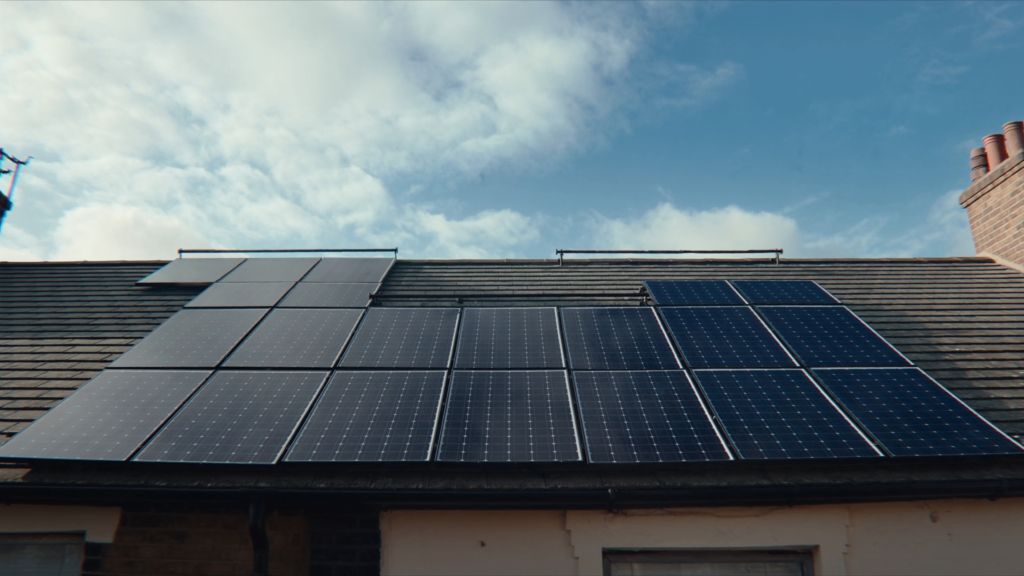
Solar panels convert sunlight into direct current electricity
Photovoltaic (PV) cells inside a solar panel absorb photons from sunlight. The photons knock electrons loose from silicon atoms, creating a flow of electrons. This flow is direct current (DC) electricity. Each cell generates around 0.5 to 0.6 volts, and panels typically combine 60 to 72 cells in series to produce a usable voltage. The process works on cloudy days too, though output drops to roughly 10 to 25 percent of peak capacity (Energy Saving Trust, 2026).
Solar panels create energy by using photovoltaic (PV) cells to absorb photons from sunlight, which knocks electrons loose from silicon atoms to generate direct current (DC) electricity. An inverter then converts the DC into alternating current (AC) at 230 volts for use in your home.
- Photovoltaic cells absorb photons to release electrons, creating DC electricity.
- Each solar cell generates 0.5–0.6 volts; panels combine 60–72 cells.
- An inverter converts DC to AC at 230 volts for household use.
- Cloudy days reduce output to 10–25% of peak capacity.
- Microinverters improve performance on partially shaded roofs.
- Solar panels convert sunlight into direct current electricity
- An inverter transforms DC into usable alternating current
- Quick numbers typical household solar panel output
- Solar panels create energy even in the UK's variable climate
- The direct answer how do solar panels create energy for your home
- MCS certification ensures your installer and system meet UK standards
- A solar PV system includes essential balance-of-system components
- Planning permission and grid connection rules for UK homes
An inverter transforms DC into usable alternating current
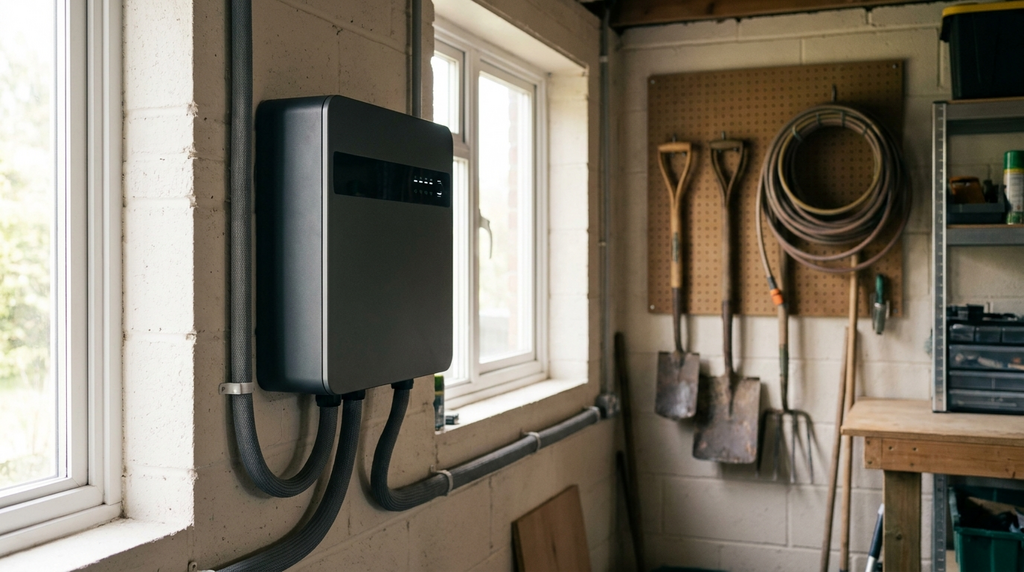
Household appliances and the UK grid run on alternating current (AC) at 230 volts and 50 hertz. A string inverter converts the DC from the entire solar array into AC. This is the most common type of inverter for home systems. Microinverters or power optimisers convert DC to AC at each individual panel, which improves performance when panels are partially shaded by a chimney or tree. Inverter efficiency typically ranges from 95 to 98 percent (MCS, 2026). You need an inverter that matches the size of your solar array to avoid energy losses.
Quick numbers typical household solar panel output
| Measurement | Range | Typical figure | Source |
|---|---|---|---|
| Panel wattage range | 350–450 W per panel | 400 W | DESNZ, Solar PV deployment |
| System size range | 3.5–6 kWp (10–15 panels) | 4 kWp | MCS register average |
| Annual generation (4 kWp south-facing) | 3,400–4,200 kWh | 3,800 kWh | Energy Saving Trust, 2026 |
| Self-consumption rate (without battery) | 25–40% of generated | 30% | DESNZ, Solar PV consumer survey |
| Payback period (2026 electricity prices) | 12–20 years | 15 years | Energy Saving Trust, 2026 |
All figures assume a south-facing roof in southern England with no shading. Output varies by orientation, tilt, and location. A north-facing roof will produce roughly 70 to 80 percent of the output of a south-facing one. How to calculate solar panel output for your home
Solar panels create energy even in the UK’s variable climate
UK annual sunshine hours range from 1,400 in northern Scotland to 1,750 in southeast England. This is enough for viable generation. Panels generate most energy between March and September, when days are longer and the sun is higher. Winter output drops to roughly 15 to 25 percent of the annual total, but still contributes. Modern panels work in diffuse light and do not need direct sunlight (Met Office, 2026). A 4 kWp system in Manchester will generate around 3,200 kWh per year, while the same system in Brighton will generate around 4,000 kWh.
The direct answer how do solar panels create energy for your home
Sunlight hits silicon PV cells, freeing electrons to create DC electricity. The inverter converts DC to AC, which powers your lights, appliances, and heating. Any surplus electricity flows to the grid under the Smart Export Guarantee (SEG). When the sun sets, you draw from the grid unless you have a battery. The SEG pays you for every kilowatt-hour you export, with rates set by your chosen supplier. You must have an MCS-certified installation to qualify for SEG payments. Smart Export Guarantee rates and how to apply
MCS certification ensures your installer and system meet UK standards
The Microgeneration Certification Scheme (MCS) is the UK quality mark for solar PV installers and products. MCS certification is required to claim Smart Export Guarantee payments. Installers must also be registered with TrustMark for consumer protection. Check the MCS online register at mcsdirectory.com to verify an installer’s credentials before signing a contract (MCS, 2026). Without MCS certification, you cannot export electricity to the grid and you lose SEG income.
A solar PV system includes essential balance-of-system components
Beyond the panels and inverter, a solar PV system requires several other components. The mounting system includes roof hooks, rails, and clamps, and must be structural engineer-approved for your roof’s weight load. Cabling and connectors must be UV-resistant and rated for outdoor use. A generation meter records total kWh produced and is required for SEG payments. Optional battery storage, such as a 5 to 10 kWh lithium-ion battery, can increase self-consumption to 60 to 80 percent (Energy Saving Trust, 2026). Without a generation meter, you cannot prove how much electricity you have exported.
Planning permission and grid connection rules for UK homes
Most solar panel installations are permitted development, meaning no planning permission is needed for detached and semi-detached houses. Listed buildings, conservation areas, and flats usually require planning permission. You must notify your Distribution Network Operator (DNO) if your system exceeds 3.68 kilowatts per phase or 16 amps per phase. DNO approval is typically automatic for systems up to 4 kWp on a single-phase supply (GOV.UK, 2026). If you live in a flat or a listed building, contact your local planning authority before ordering equipment.
Frequently Asked Questions
Yes, solar panels still create energy on cloudy days, but output drops to roughly 10–25% of peak capacity (Energy Saving Trust, 2026). Diffuse sunlight still reaches the photovoltaic cells, so generation continues at a reduced level.
A single solar cell produces around 0.5 to 0.6 volts. Panels typically combine 60 to 72 cells in series to produce a usable voltage, usually around 30–40 volts for a residential panel (MCS, 2026).
A solar inverter converts the direct current (DC) electricity from solar panels into alternating current (AC) at 230 volts and 50 hertz, which powers household appliances and the UK grid. Inverter efficiency typically ranges from 95 to 98% (MCS, 2026).
A 4 kWp south-facing solar system generates around 3,800 kWh per year on average in southern England (Energy Saving Trust, 2026). Output varies by orientation, tilt, and location.
No, solar panels do not generate electricity at night because they require sunlight to create energy. A battery storage system can store excess daytime generation for use after dark (Energy Saving Trust, 2026).