The average UK home needs 10–12 solar panels to run a 1.5-ton air conditioner
A 1.5-ton air conditioning unit has a cooling capacity of 5.25 kW, but its electrical power draw is typically 1.8–2.0 kW per hour of operation. In the UK, a standard 400–450 W solar panel produces roughly 1.0–1.2 kWh per day in summer, dropping to 0.3–0.5 kWh in winter (Energy Saving Trust, 2026).
You need 10–12 solar panels (400 W each) to run a 1.5-ton AC for 6 hours in summer. In winter, the same AC needs 25+ panels, making solar-only cooling impractical without battery storage or grid backup.
- A 1.5-ton AC draws 1.8–2.0 kW per hour of operation.
- You need 10–12 panels (400 W each) for 6 hours summer use.
- Winter solar-only AC needs 25+ panels, making it impractical.
- Add a 20–30% buffer for cloudy days and inverter losses.
- Use the EST postcode calculator for precise local panel output.
- The average UK home needs 10–12 solar panels to run a 1.5-ton air conditioner
- The exact calculation to size a solar system for a 1.5-ton AC
- Quick numbers — solar panel count vs AC runtime (table)
- How to verify your installer is certified for solar + AC integration
- Who qualifies for UK solar grants and what they cover
- Why solar panels alone rarely power a 1.5-ton AC in UK winter
- How to check if your roof can support the required number of panels
To cover 6 hours of summer AC use — approximately 12 kWh/day — you need 10–12 panels rated at 400 W each, assuming full summer sun and no battery storage. In winter, the same AC would require 25+ panels, making standalone solar-only AC impractical without grid backup or storage.
The AC power draw figures are based on Ofgem’s typical appliance consumption data, while panel output estimates come from the EST solar calculator (Ofgem, 2026).
The exact calculation to size a solar system for a 1.5-ton AC
Step 1: Determine the AC’s running wattage. A 1.5-ton unit uses 1.8–2.0 kW per hour (DESNZ, 2026). Step 2: Estimate daily AC runtime — for example, 6 hours in summer equals 10.8–12 kWh/day. Step 3: Divide daily kWh by the average daily output of one panel in your region. Use the EST’s postcode-based calculator for precise figures (Energy Saving Trust, 2026). Step 4: Add a 20–30% buffer for cloudy days and inverter losses (MCS, 2026).
Example: 12 kWh ÷ 1.0 kWh per panel (summer) = 12 panels. With a 25% buffer, you would need 14–16 panels. The buffer accounts for the fact that inverter efficiency is typically 95–98%, and UK weather patterns mean full-sun days are rare.
Quick numbers — solar panel count vs AC runtime (table)
| AC runtime per day | Panels needed (400 W, summer) | Panels needed (400 W, winter) |
|---|---|---|
| 4 hours | 7–8 | 16–18 |
| 6 hours | 10–12 | 24–27 |
| 8 hours | 13–15 | 32–36 |
| 10 hours | 16–18 | 40–45 |
Source for panel output: Energy Saving Trust, solar PV performance by season (Energy Saving Trust, 2026). Source for AC wattage: Ofgem, typical appliance consumption (Ofgem, 2026).
How to verify your installer is certified for solar + AC integration
Solar panel installation must be carried out by an MCS-certified installer to qualify for the Smart Export Guarantee (SEG) and any grants (GOV.UK, MCS certification requirements, 2026). AC installation must be done by a FENSA-registered or Gas Safe-registered electrician if hardwired — but for solar-to-AC wiring, an NICEIC or NAPIT registered electrician is recommended (NICEIC, competent person schemes, 2026).
Always check the installer’s MCS number on the MCS register (mcs.uk.com) before signing a contract. For combined solar + heat pump (air conditioning) systems, TrustMark is the government-endorsed quality scheme (TrustMark, DESNZ, 2026). You can also compare MCS-certified installers in your area to ensure you receive a compliant installation.
Who qualifies for UK solar grants and what they cover
The ECO4 scheme provides free or subsidised solar panels to low-income households receiving certain benefits — but it does not cover AC units (GOV.UK, ECO4 guidance, 2026). The Smart Export Guarantee pays you for excess solar electricity exported to the grid — rates vary from 3p–15p per kWh (Ofgem, SEG rate data, 2026).
The Boiler Upgrade Scheme (BUS) covers heat pumps, including reversible AC-style units, up to £7,500 — but not standalone AC (DESNZ, BUS terms, 2026). To qualify for any grant, your home must have an EPC rating of D or below (ECO4) or D–G (BUS). Check your EPC at gov.uk/find-energy-certificate (GOV.UK, 2026).
Why solar panels alone rarely power a 1.5-ton AC in UK winter
UK winter solar generation drops to 20–30% of summer levels — a 4 kW system (10 panels) might produce only 2–3 kWh/day in December (Energy Saving Trust, seasonal performance, 2026). A 1.5-ton AC running for 4 hours in winter would need 7.2 kWh — more than double typical winter solar output.
Without battery storage, you would rely on grid electricity during non-sun hours, making the system less cost-effective. For year-round AC, a grid-tied solar system with a battery (e.g., 10 kWh) is the minimum viable configuration (MCS, system design guidelines, 2026). read our guide to solar battery storage costs and payback periods for more detail on this setup.
How to check if your roof can support the required number of panels
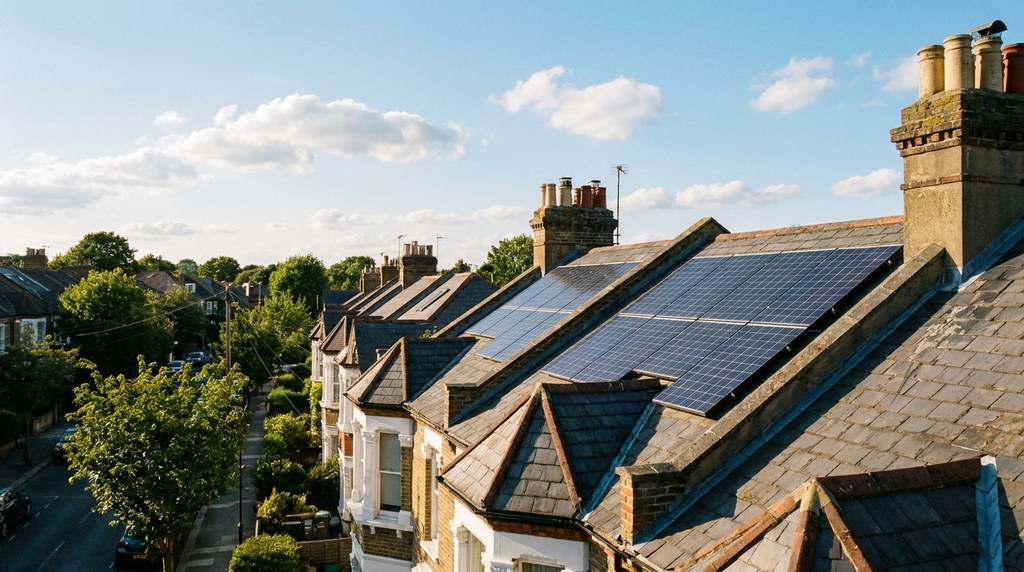
A typical solar panel measures 1.7m x 1.0m — 12 panels require roughly 20–22 m² of roof space (MCS, standard panel dimensions, 2026). Roof orientation matters: south-facing roofs with a 30–40° tilt produce 15–20% more than east or west-facing roofs (EST, solar orientation guide, 2026).
Check for shading from trees, chimneys, or neighbouring buildings — a shaded panel can reduce output by 50% (DESNZ, shading impact data, 2026). Use the GOV.UK solar calculator or EST’s tool to estimate your roof’s suitability before contacting installers (GOV.UK, 2026).
Frequently Asked Questions
You need 10–12 standard 400 W solar panels to run a 1.5-ton AC for 6 hours in summer, based on Energy Saving Trust panel output data.
Yes, in summer with 10–12 panels and no cloud cover, but in winter you would need 25+ panels. The Energy Saving Trust states that solar-only winter AC is impractical without grid backup or battery storage.
You would need 24–27 panels (400 W) for 6 hours of winter AC runtime, according to Energy Saving Trust seasonal output figures.
A 4.0–4.8 kW solar system (10–12 panels) covers 6 hours of summer AC use, per Ofgem appliance data and EST panel output.
A 1.5-ton AC uses 1.8–2.0 kWh per hour, based on Ofgem's typical appliance consumption data.