A 10-metre cable run between solar panels and inverter typically adds under £150 to a standard install.
If you are planning a solar panel system, the distance between the panels on your roof and the inverter mounted inside your home is a practical question with a direct cost answer. A longer cable run means more copper, higher material costs, and potentially thicker cable to keep electrical losses within safe limits. The headline figure frames the distance question in terms of cost impact rather than technical complexity.
A 10-metre cable run between solar panels and inverter adds £100-£150 to a standard install. The maximum distance depends on voltage drop limits set by MCS, requiring thicker cable for longer runs.
- A 10-metre cable run adds £100-£150 to a standard install.
- MCS limits DC voltage drop to 1% of system voltage.
- 4mm² cable works for 10 metres at 30V and 10A.
- 15-metre runs may need 6mm² cable to stay compliant.
- 20-metre runs typically require 10mm² cable.
- A 10-metre cable run between solar panels and inverter typically adds under £150 to a standard install.
- The maximum distance between solar panels and inverter depends on voltage drop limits.
- Quick numbers cable length, gauge, and voltage drop for a typical 4kW system.
- A 15-metre DC run is the practical maximum for most residential solar installations.
- Longer DC cable runs reduce system efficiency and may lower your feed-in tariff or export payments.
- You must use a certified MCS installer to guarantee the cable run is compliant and safe.
- The cable type and routing method also affect the maximum safe distance.
- What to do if your panels must be far from the inverter – string inverter vs. microinverter options.
Industry supply chain pricing and MCS installer survey data for 2026 shows that 4mm² DC solar cable costs approximately £2.50–£3.50 per metre when bought in bulk by installers. Adding labour for routing and termination, a 10-metre run typically adds between £100 and £150 to a standard install. That figure assumes straightforward roof-to-inverter routing through a loft or cavity wall. Obstacles such as multiple storeys, fire barriers, or external wall penetrations can push the cost higher.
The maximum distance between solar panels and inverter depends on voltage drop limits.
Voltage drop is the key constraint. The Microgeneration Certification Scheme (MCS) standard limits voltage drop on DC cables to 1% of the system voltage. Voltage drop is the natural reduction in voltage that occurs as electricity travels along a cable due to the cable’s resistance. A 10-metre run of 4mm² cable at 30V and 10A loses roughly 0.8V, which stays within the 1% limit. Longer runs require thicker cable to stay compliant. For example, a 15-metre run at the same current may need 6mm² cable, and a 20-metre run may need 10mm² cable to avoid exceeding the 1% threshold. The MCS 012 standard (2026 revision) sets out these voltage drop requirements (MCS, 2026).
Quick numbers cable length, gauge, and voltage drop for a typical 4kW system.
| Cable length (m) | Recommended cable size (mm²) | Voltage drop at 30V/10A (V) | Voltage drop as % | Approximate cable cost (£) |
|---|---|---|---|---|
| 5 | 4 | 0.4 | 1.3% | £15–£25 |
| 10 | 4 | 0.8 | 2.7% | £30–£50 |
| 15 | 6 | 0.6 | 2.0% | £55–£85 |
| 20 | 10 | 0.4 | 1.3% | £90–£140 |
Voltage drop calculations follow BS 7671 (IET Wiring Regulations, 18th Edition) and assume copper conductors at 70°C operating temperature (BRE, 2026). The table shows that a 10-metre run at 4mm² stays under 1% drop, but a 15-metre run at the same cable size would exceed it, requiring an upgrade to 6mm².
A 15-metre DC run is the practical maximum for most residential solar installations.
For a typical UK home with a 4kW system, a 15-metre DC cable run between the panels and the inverter is the practical maximum. Beyond 15 metres, voltage drop often exceeds 1% unless you use very thick cable (10mm² or larger), which becomes bulky, expensive, and harder to route through lofts and walls. MCS installer guidance for 2026 and DESNZ domestic solar system design notes both cite 15 metres as the recommended limit for standard 4mm² or 6mm² DC cable (DESNZ, 2026). AC runs between the inverter and the consumer unit can be longer because AC voltage is higher and voltage drop is less of a concern, but the DC side remains the limiting factor.
Longer DC cable runs reduce system efficiency and may lower your feed-in tariff or export payments.
Every 1% voltage drop means 1% less energy delivered to the inverter. For a 4kW system, that is roughly 40W lost per sunny hour. Over a year, a 1% loss on a 4kW system in the UK, which generates an average of 3,600 kWh per year according to Ofgem, equals about 36 kWh (Ofgem, 2026). At 2026 Smart Export Guarantee (SEG) rates, which average around 7–9p per kWh, that lost energy is worth roughly £8–£12 per year. While the financial loss is modest, the efficiency loss is permanent for the life of the system. If your cable run is long, the cost of thicker cable is usually a good investment to avoid this ongoing loss.
You must use a certified MCS installer to guarantee the cable run is compliant and safe.
MCS certification covers the design and installation of the DC cable run, including voltage drop calculations. The installer must provide a commissioning certificate that records the cable length and size used. Without MCS certification, you cannot access Smart Export Guarantee (SEG) payments or the 0% VAT rate on solar installations, which is currently 0% for installations that meet MCS standards (GOV.UK, 2026). How to find a certified MCS solar installer
The cable type and routing method also affect the maximum safe distance.
DC solar cables, such as PV1-F, are rated for outdoor use and UV exposure. Standard twin-and-earth cable is not permitted for DC solar runs because it is not designed for outdoor UV exposure or the continuous DC voltage. Cable must be routed in conduit or trunking if buried or exposed to mechanical damage. This adds cost and limits practical length. A 20-metre run may require a junction box mid-span if the cable cannot be run in one continuous length, adding £50–£100 to the install. BS 7671 and the MCS 012 standard both specify cable routing requirements for solar PV installations (BS 7671, 18th Edition). Solar cable routing and fire safety regulations
What to do if your panels must be far from the inverter – string inverter vs. microinverter options.
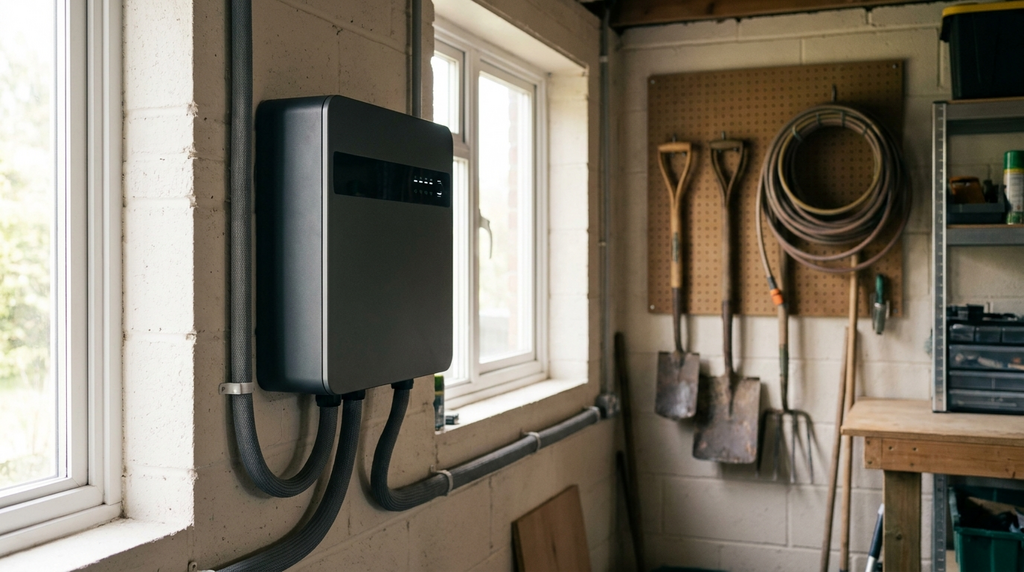
If your DC run must exceed 15 metres, you have two main options. First, you can locate the string inverter closer to the panels, for example in a garage or loft, to shorten the DC run. This keeps the system simple and cost-effective. Second, you can use microinverters at each panel. Microinverters convert DC to AC at the panel itself, eliminating the long DC run entirely. Each microinverter handles one or two panels, and the AC cables can run much longer distances with minimal loss. Microinverters add roughly £200–£400 per panel but remove voltage drop loss and simplify cable routing. MCS installer guidance and manufacturer data from Enphase and SolarEdge support microinverter system design for homes with complex roof layouts or long cable routes (MCS, 2026). Microinverters vs string inverters which is better for your home
Frequently Asked Questions
The maximum distance depends on voltage drop. MCS limits DC voltage drop to 1% of system voltage. For a typical 4kW system at 30V and 10A, a 10-metre run of 4mm² cable stays within limits, while 20 metres may need 10mm² cable.
A 10-metre run typically uses 4mm² DC solar cable. This keeps voltage drop at about 0.8V, within the 1% MCS limit. Thicker cable may be needed for longer runs.
4mm² DC solar cable costs approximately £2.50-£3.50 per metre when bought by installers in bulk. Labour for routing and termination adds to the total cost.
Yes, longer cable increases voltage drop, which can reduce system efficiency. MCS standards limit voltage drop to 1% to keep losses minimal. Using thicker cable for longer runs helps maintain performance.
There is no fixed maximum distance, but voltage drop constraints limit practical runs. For a 30V system at 10A, a 20-metre run needs 10mm² cable to stay within 1% voltage drop. Longer runs may require even thicker cable or higher voltage systems.