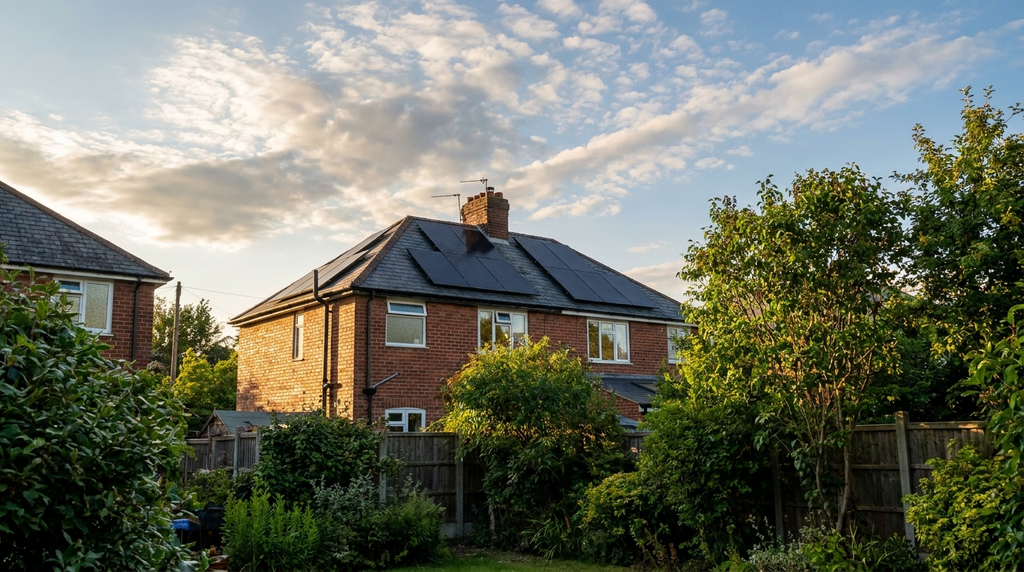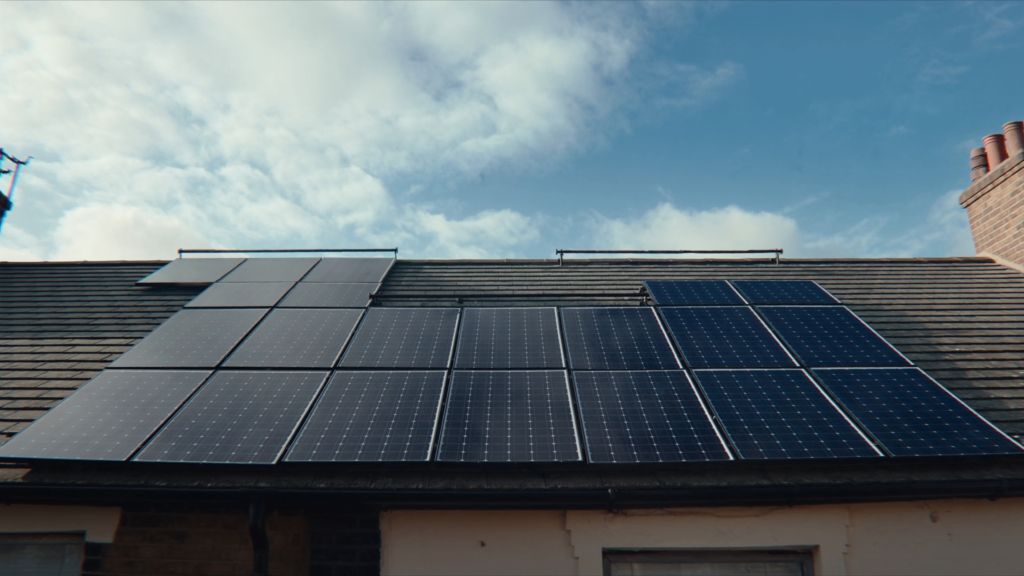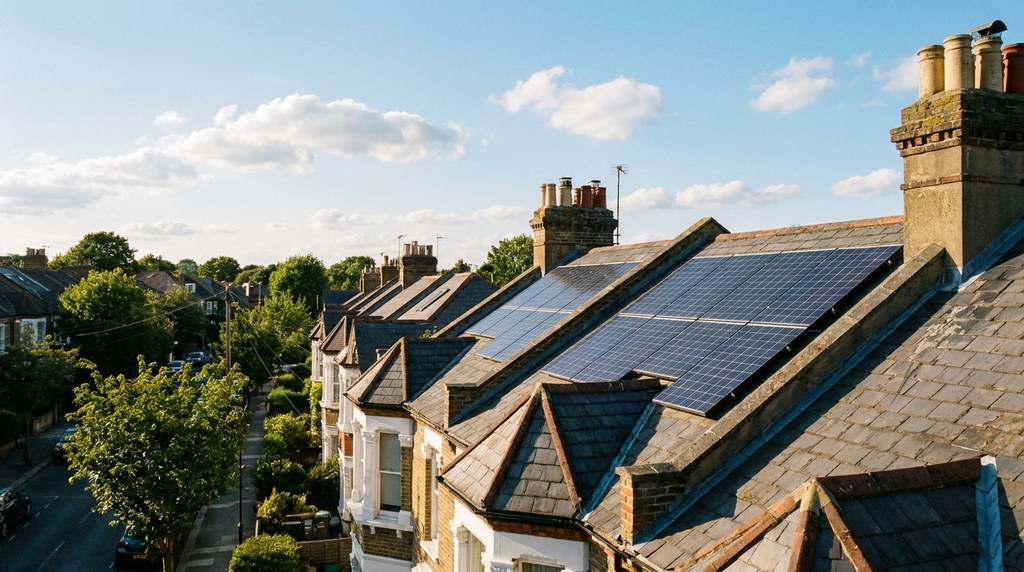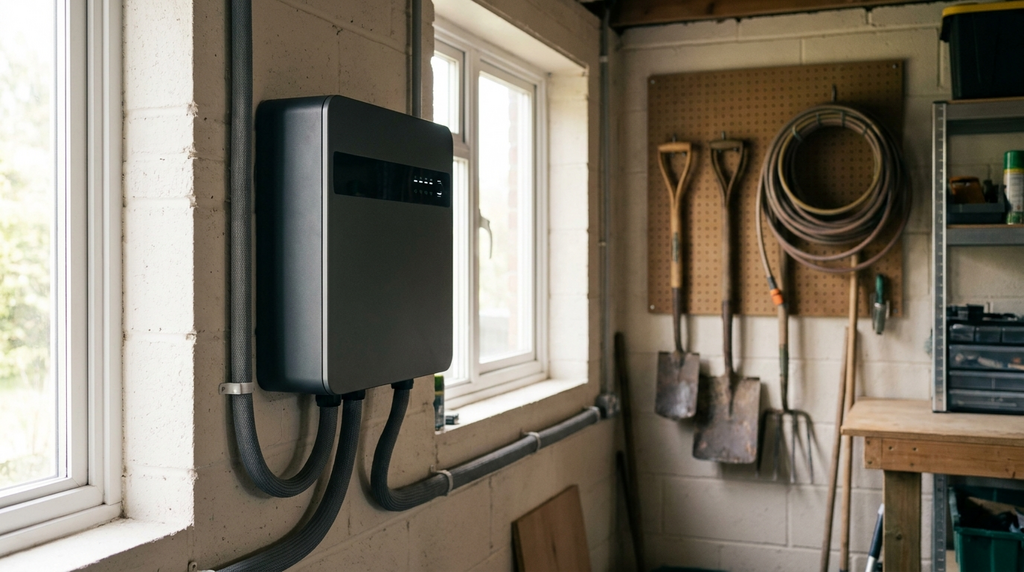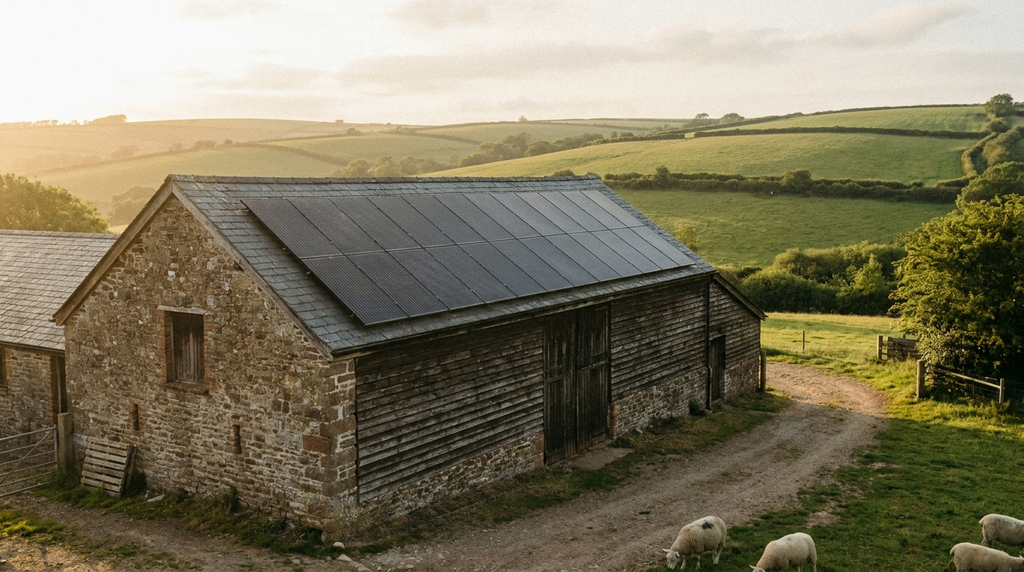
A typical 4 kW solar panel system can cut a UK household electricity bill by roughly £450–£600 a year in 2026, making it one of the few home improvements that pays for itself within a decade.
Many homeowners are asking how solar panels save money on household bills. The answer is straightforward: solar panels generate free electricity from sunlight, reducing the amount you need to buy from your energy supplier. A typical 4 kW system, which is the most common size for UK homes, can save a household between £450 and £600 per year on electricity costs in 2026 (Energy Saving Trust, 2026).
Solar panels save a typical UK household £450–£600 a year on electricity bills in 2026 by generating free daytime power. A 4 kW system reduces the amount you buy from the grid, and the Smart Export Guarantee pays for excess energy exported.
- A 4 kW solar system saves £450–£600 a year on electricity bills.
- Self-consumption of 70% of solar output boosts savings to £600.
- Smart Export Guarantee pays 4p–15p per kWh for exported power.
- Average household uses 2,900 kWh of electricity per year.
- System generates 3,000–4,000 kWh annually depending on location.
- A typical 4 kW solar panel system can cut a UK household electricity bill by roughly £450–£600 a year in 2026, making it one of the few home improvements that pays for itself within a decade.
- Solar panels reduce your electricity bill by generating free daytime power
- The Smart Export Guarantee (SEG) pays you for electricity you send to the grid
- Quick numbers — typical system costs, savings, and payback in 2026
- Solar panels protect you from future electricity price rises
- The direct answer to “how does solar panels save you money” is through three revenue streams
- Eligibility and install certification — what you need to qualify for savings
Solar panels reduce your electricity bill by generating free daytime power
Every kilowatt-hour (kWh) of solar electricity you use in your home is one kWh you do not have to buy from the grid. A kWh is a unit of energy, and the average household uses around 2,900 kWh of electricity per year. The current unit rate under the Ofgem price cap for 2026 is around 24p to 28p per kWh (Ofgem, 2026).
A typical 4 kW solar panel system generates roughly 3,500 to 4,000 kWh annually in southern England, dropping to around 3,000 kWh in Scotland (Energy Saving Trust, 2026). The amount you save depends on how much of this generation you use directly in your home, known as self-consumption. A household using 50% of its solar output saves about £450 to £500 a year. One using 70% saves closer to £600.
The Smart Export Guarantee (SEG) pays you for electricity you send to the grid
Any solar electricity you do not use at home is automatically exported to the national grid. Under the Smart Export Guarantee (SEG) scheme, your energy supplier must pay you for every kWh you export. The SEG replaced the older Feed-in Tariff scheme in 2020 and applies to all new solar installations.
Typical SEG rates in 2026 range from 4p to 15p per kWh, depending on your supplier (Ofgem SEG league table, 2026). For a household that exports 50% of its solar output, SEG payments add roughly £80 to £150 a year to total savings. Some suppliers offer higher rates for customers who also hold a battery storage tariff or a time-of-use electricity plan.
Quick numbers — typical system costs, savings, and payback in 2026
| Metric | Low estimate | High estimate |
|---|---|---|
| System size | 4 kW | 4 kW |
| Typical installed cost (MCS installer average, 2026) | £6,000 | £8,000 |
| Annual bill saving | £450 | £600 |
| Annual SEG income | £80 | £150 |
| Total annual return | £530 | £750 |
| Simple payback period | 8 years | 12 years |
Source: MCS installer cost data, 2026; Energy Saving Trust savings estimates, 2026.
The simple payback period is the time it takes for total savings to equal the upfront cost. For a 4 kW system costing £6,000 to £8,000, payback falls between 8 and 12 years. Solar panels typically last 25 years or more, so the remaining years deliver pure financial gain.
Solar panels protect you from future electricity price rises
Grid electricity prices have risen over 50% since 2021 and are forecast to remain volatile (Ofgem, 2026). A solar system locks in a portion of your energy costs at zero. The electricity you generate is not subject to future price cap increases or wholesale market fluctuations.
Over a 25-year system lifespan, the cumulative savings from avoided price rises can double the simple payback figure. For example, if retail electricity prices increase by 3% to 5% per year on average, a household saving £500 in year one would save over £1,000 per year by year 20 (DESNZ energy price projections, 2026). This makes solar panels a hedge against energy inflation.
The direct answer to “how does solar panels save you money” is through three revenue streams
Solar panels save you money through three distinct revenue streams. First, savings on purchased electricity: every kWh of solar used at home replaces a kWh bought at the full retail rate of 24p to 28p. Second, SEG payments: every kWh exported to the grid earns a guaranteed payment from your supplier, typically 4p to 15p per kWh. Third, reduced standing charge reliance: while the standing charge remains fixed, your usage charge drops significantly, lowering your total bill (Ofgem SEG scheme rules, 2026; Energy Saving Trust, 2026; MCS, 2026).
These three streams combine to produce the total annual return shown in the table above. The exact split between savings and SEG income depends on your household’s daytime electricity use and your chosen supplier’s export tariff.
How to choose the best SEG tariff for your home
Eligibility and install certification — what you need to qualify for savings
To receive SEG payments, your system must be installed by an MCS-certified (Microgeneration Certification Scheme) installer. The installer must also be registered with TrustMark for consumer protection (MCS installer register, 2026; TrustMark, 2026).
Your property must have a suitable roof. The ideal roof faces south or within 90 degrees of south, has minimal shading from trees or buildings, and has a pitch between 10 and 60 degrees. The roof structure must be sound enough to support the weight of the panels. Most domestic solar panel installations in England, Scotland, and Wales do not require planning permission, unless your home is listed or located in a conservation area (GOV.UK planning guidance, 2026).
If you are considering solar panels, check your roof orientation and shading first. A south-facing roof with no shading will generate the most electricity and deliver the highest savings. How to check if your roof is suitable for solar panels
Frequently Asked Questions
Solar panels generate free electricity from sunlight, reducing the amount you buy from the grid. According to the Energy Saving Trust, a typical 4 kW system can save £450–£600 a year in 2026.
A typical UK household with a 4 kW solar system saves between £450 and £600 per year on electricity costs, based on data from the Energy Saving Trust. Actual savings depend on how much solar power you use directly.
The Smart Export Guarantee (SEG) requires energy suppliers to pay you for solar electricity you export to the grid. Rates in 2026 range from 4p to 15p per kWh, according to Ofgem's SEG league table.
Yes, but savings are lower because days are shorter and sunlight is weaker. A 4 kW system still generates around 10–15% of its annual output in winter, reducing your winter electricity bill.
A typical 4 kW solar system pays for itself within 10 to 12 years in 2026, based on annual savings of £450–£600 plus SEG payments. This estimate comes from the Energy Saving Trust.