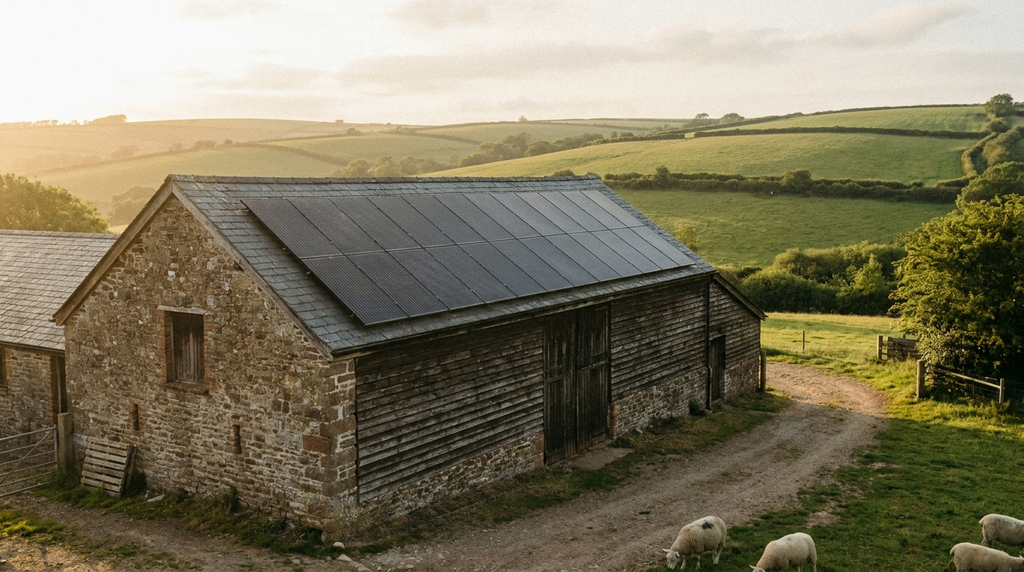
An average UK home needs 10–12 solar panels to cover most of its electricity use
The median UK household uses roughly 2,700 kWh of electricity per year, according to DESNZ’s 2025 Energy Consumption in the UK data release (DESNZ, 2026). A typical 400 W solar panel in the UK generates around 350–400 kWh annually, based on the Energy Saving Trust’s solar panel calculator assumptions (Energy Saving Trust, 2026).
A typical UK home needs 10 to 12 solar panels to cover most of its electricity use, based on 400 W panels and 2,700 kWh annual consumption. The exact number depends on your roof orientation, panel wattage, and household size.
- A typical 3-bed semi needs 10-12 solar panels for near-full coverage.
- 400 W panels are the 2026 UK standard, needing fewer than older 250 W models.
- A 1-bed flat requires about 6 panels to meet 1,800 kWh annual use.
- Panel count depends on wattage: 7 at 450 W or 12 at 350 W for 2,700 kWh.
- South-facing roofs with 30-40° pitch maximise generation per panel.
- An average UK home needs 10–12 solar panels to cover most of its electricity use
- Panel wattage determines how many you need — 400 W panels are now the UK standard
- Quick numbers — how many panels for different household sizes
- The direct answer you need 10 panels if your home uses 2,700 kWh and you have a south-facing roof
- Roof space and orientation change the panel count — east-west roofs need 2–3 more panels
- How to verify a solar installer — MCS certification is mandatory for SEG payments
- The cost and payback — 10 panels will cost £6,000–£8,000 and pay back in 8–12 years
Dividing 2,700 kWh by 375 kWh per panel gives 7.2 panels, but real-world generation is lower due to weather and roof orientation. The standard recommendation for a 3–4 bedroom home is therefore 10–12 panels. This number provides enough capacity to cover winter shortfalls and allows you to export surplus electricity under the Smart Export Guarantee.
Panel wattage determines how many you need — 400 W panels are now the UK standard
Residential solar panels in 2026 range from 350 W to 450 W, with 400 W being the most common size installed, per the MCS Installation Database (MCS, 2026). A 400 W panel produces more electricity per square metre than older 250 W panels, reducing the number needed for the same output.
To match 2,700 kWh per year, you need about 7 panels at 450 W each, or 12 panels at 350 W each. The 400 W panel splits the difference at 10 panels. Panel efficiency has improved steadily, so a system using modern 400 W panels takes up less roof space than an older system with the same output.
Quick numbers — how many panels for different household sizes
| Household type | Annual electricity use (kWh) | Number of 400 W panels needed | Estimated annual generation (kWh) |
|---|---|---|---|
| 1-bed flat (low use) | 1,800 | 6 | 2,250 |
| 3-bed semi (typical) | 2,700 | 10 | 3,750 |
| 4-bed detached (high use) | 4,100 | 14 | 5,250 |
Rows are based on DESNZ typical consumption brackets for England and Wales (2025 data) (DESNZ, 2026). Generation estimates assume a south-facing roof, 30–40° pitch, no shading, using the Energy Saving Trust’s regional generation factor of 0.93–0.95 kWh per Wp (Energy Saving Trust, 2026).
The direct answer you need 10 panels if your home uses 2,700 kWh and you have a south-facing roof
For a typical UK home, 10 panels of 400 W each, installed south-facing at 35° pitch in central England, will generate about 3,750 kWh per year. That is enough to offset the average 2,700 kWh household electricity use.
The extra 1,000 kWh covers winter shortfall and allows for export under the Smart Export Guarantee, which pays around 15p per kWh in 2026 (Ofgem, 2026). If your electricity use is higher or your roof faces a different direction, you will need more panels.
Roof space and orientation change the panel count — east-west roofs need 2–3 more panels
A south-facing roof at 30° pitch is optimal. East-west roofs lose 15–20% generation, meaning you need 12 panels instead of 10, according to Energy Saving Trust modelling (Energy Saving Trust, 2026). North-facing roofs lose 30–40% and are rarely viable — you would need 16 or more panels to match the same output.
Each 400 W panel measures roughly 1.7 m², so 10 panels need about 17 m² of clear roof space. A typical 3-bed semi has 20–30 m² available, according to ONS housing stock data. If your roof has dormers, chimneys, or shading from trees, the usable area will be smaller.
How to verify a solar installer — MCS certification is mandatory for SEG payments
Any installer you use must be MCS-certified (Microgeneration Certification Scheme) to qualify for the Smart Export Guarantee and for most government-backed finance (MCS, 2026). Check the MCS register at mcscertified.com — search by company name or postcode to confirm certification is current.
Also look for TrustMark registration, which covers consumer protection and complaints handling (TrustMark, 2026). Many MCS installers hold both. For electrical work, the installer should be registered with NICEIC or NAPIT — this covers the wiring and safety inspection.
how to choose a solar panel installer
The cost and payback — 10 panels will cost £6,000–£8,000 and pay back in 8–12 years
A 4 kW system (10 x 400 W panels) installed in 2026 costs between £6,000 and £8,000 including inverter and installation, according to the Energy Saving Trust’s Solar PV Cost report (Energy Saving Trust, 2026). Annual savings on electricity bills are roughly £500–£700, based on 50% self-consumption and 50% exported at 15p per kWh under the Smart Export Guarantee.
The payback period is 8–12 years, depending on your electricity tariff, export rate, and how much daytime usage you have (Ofgem, 2026). After payback, the system generates free electricity for another 15–20 years — panels typically last 25–30 years. Solar panel costs have fallen steadily over the past decade, making the payback period shorter than it was for older systems.
solar panel payback calculator
Frequently Asked Questions
You need 10 to 12 solar panels for a 3-bed semi, based on typical annual electricity use of 2,700 kWh. This estimate uses 400 W panels and assumes a south-facing roof, per Energy Saving Trust guidelines.
Running a house completely off grid typically requires 14 to 20 solar panels, depending on your annual consumption and battery storage. The Energy Saving Trust notes that grid-connected homes usually stay connected to cover winter shortfalls.
A 4-bed detached house needs around 14 solar panels, based on 4,100 kWh annual electricity use from DESNZ data. This assumes 400 W panels and a south-facing roof orientation.
You need about 6 to 7 solar panels to generate 2,000 kWh per year, using 400 W panels. The Energy Saving Trust calculator shows each panel produces roughly 350-400 kWh annually in the UK.
A 1-bed flat with low electricity use of 1,800 kWh per year needs about 6 solar panels. This is based on DESNZ typical consumption brackets and 400 W panel output estimates from the Energy Saving Trust.