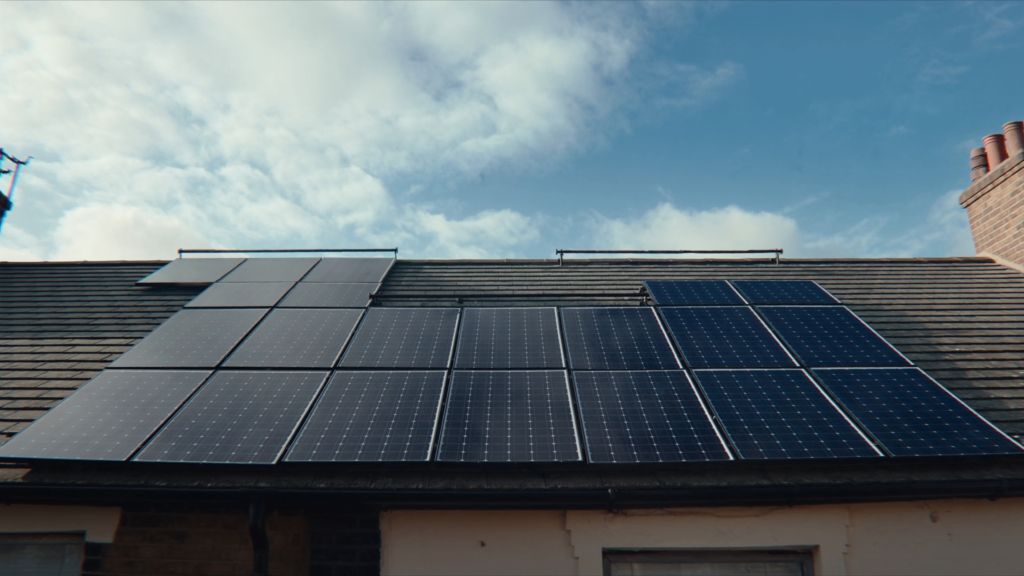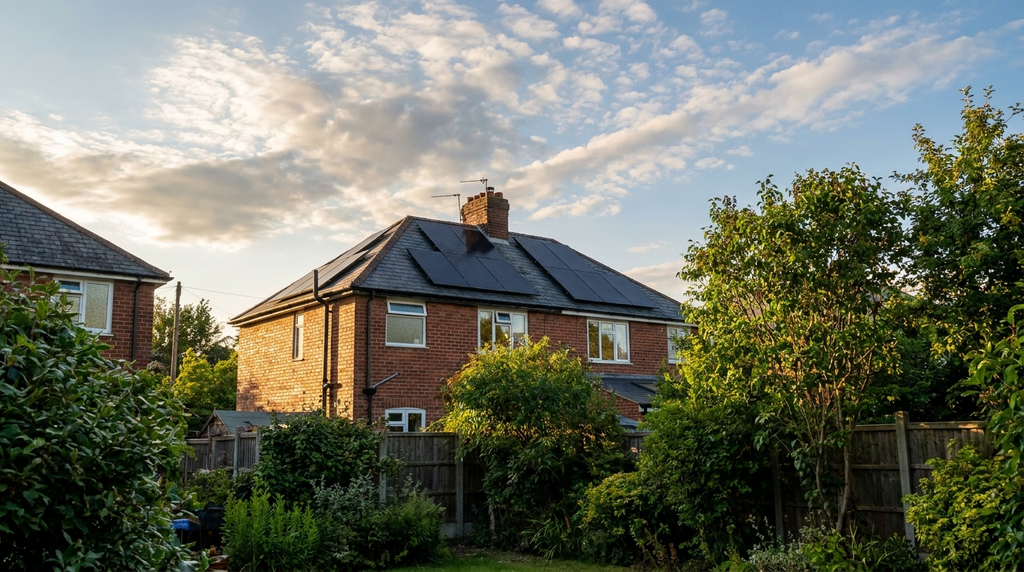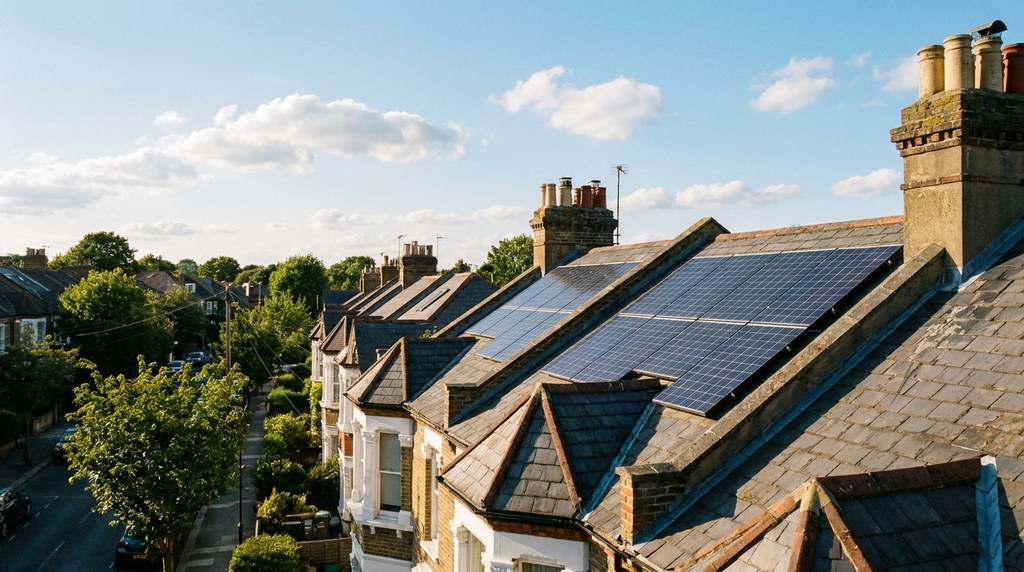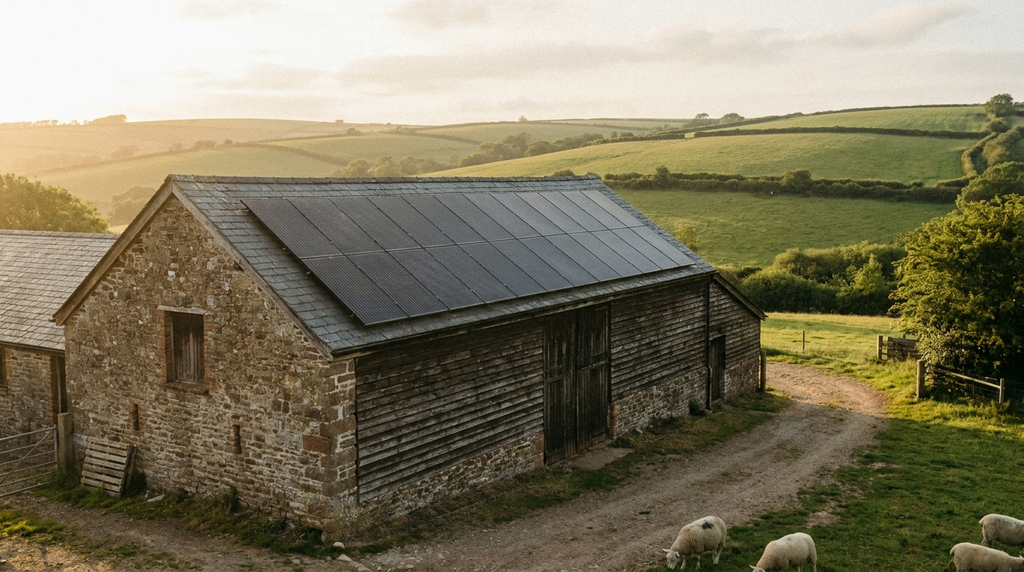
A north-facing roof in the UK can still be a viable location for solar panels, but the energy output will be lower than a south-facing system.
The single most important fact: a north-facing roof in the UK receives roughly 50-60% less annual sunlight than a south-facing roof, directly reducing total electricity generation. This lower output means the financial payback period will be longer, but the system can still offset a portion of household electricity bills. The viability depends on the roof pitch, local shading, and the household’s electricity consumption patterns (Energy Saving Trust, 2026).
Solar panels on a north-facing roof in the UK generate 50-60% less energy than south-facing, saving £560-£700 per year for a 4kWp system. The payback period stretches to 12-15 years, but the system still qualifies for the Smart Export Guarantee.
- North-facing roofs receive 50-60% less annual sunlight than south-facing.
- A 4kWp north-facing system saves £560-£700 per year (2026 prices).
- Payback period for north-facing panels is 12-15 years.
- North-facing roofs still qualify for the Smart Export Guarantee (SEG).
- Check roof pitch, shading, and household usage before installing.
- A north-facing roof in the UK can still be a viable location for solar panels, but the energy output will be lower than a south-facing system.
- Quick numbers estimated annual generation and payback for a north-facing system
- The key eligibility criterion a north-facing roof is not automatically excluded from the Smart Export Guarantee (SEG)
- How to verify your installer is certified for a north-facing roof installation
- The direct answer can you get a government grant for solar panels on a north-facing roof?
- How to confirm your north-facing roof’s suitability before buying
- What the installer must check roof pitch and shading are more critical than orientation
- The financial reality lower returns, but still a valid investment for some households
Quick numbers estimated annual generation and payback for a north-facing system
The table below compares a north-facing roof against other common orientations for a typical 4kWp system in the UK, based on 2026 electricity prices of 28p per kWh (DESNZ 2026 projections). Generation figures are averages from the Energy Saving Trust’s solar PV calculator for UK conditions (Energy Saving Trust, 2026).
| Orientation | Typical annual generation per kWp (kWh) | Estimated payback period (years) for a 4kWp system | Approximate annual saving (£) |
|---|---|---|---|
| North | 500-625 | 12-15 | £560-£700 |
| East | 750-875 | 9-12 | £840-£980 |
| West | 750-875 | 9-12 | £840-£980 |
| South | 875-1,000 | 8-10 | £980-£1,120 |
These figures assume a roof pitch of 30°, minimal shading, and a 4kWp system. Your actual numbers will vary based on your specific roof and local conditions.
The key eligibility criterion a north-facing roof is not automatically excluded from the Smart Export Guarantee (SEG)
The SEG does not penalise roof orientation; any eligible solar PV installation (up to 5MW) can receive payments for exported electricity. However, the lower generation from a north-facing roof means the total export revenue will be smaller. To qualify for SEG, the system must be installed by an MCS-certified installer and use MCS-certified equipment (Ofgem, Smart Export Guarantee (SEG) scheme rules; MCS certification requirements).
How to verify your installer is certified for a north-facing roof installation
The installer must hold MCS certification for solar PV (microgeneration) and be registered with TrustMark for consumer protection. Check the MCS Installer Database to confirm the installer is listed and has not been suspended (MCS Installer Database). The installer should provide a detailed site survey that includes a shading analysis and an estimated annual generation figure specific to your north-facing roof (TrustMark, 2026).
The direct answer can you get a government grant for solar panels on a north-facing roof?
Yes, you can apply for the ECO4 scheme or the Great British Insulation Scheme, as eligibility is based on household income and energy efficiency, not roof orientation. The ECO4 scheme may fund solar panels for eligible low-income households, but only if the property has a suitable roof (north-facing is not a disqualifier, but the installer must confirm it can generate a minimum annual output). The Home Upgrade Grant (HUG) also does not exclude north-facing roofs, but the installer’s assessment must show the system is cost-effective (GOV.UK, ECO4 scheme eligibility guidance; GOV.UK, HUG scheme guidance).
How to confirm your north-facing roof’s suitability before buying
Use the Energy Saving Trust’s online solar PV calculator to input your exact roof orientation and pitch for a bespoke generation estimate (Energy Saving Trust solar PV calculator). Request a free, no-obligation survey from three MCS-certified installers who will assess shading, roof pitch, and structural integrity. Compare the estimated annual generation from the installers against your household’s annual electricity consumption to see the percentage of self-supply (MCS installer database).
What the installer must check roof pitch and shading are more critical than orientation
The optimal roof pitch for a north-facing roof in the UK is between 10° and 30°; steeper pitches above 40° will significantly reduce output. Shading from trees, chimneys, or neighbouring buildings is more damaging on a north-facing roof because the sun is lower in the sky, so a full shading analysis is essential. The installer should use a solar pathfinder or similar tool to measure the percentage of annual sunlight blocked (MCS installation standards, MIS 3002; Energy Saving Trust guidance on shading and roof pitch).
The financial reality lower returns, but still a valid investment for some households
A typical 4kWp north-facing system in the UK might generate around 2,000-2,500 kWh per year, compared to 3,500-4,000 kWh for a south-facing system (Energy Saving Trust, 2026). At 2026 electricity prices of 28p per kWh, this could save approximately £560-£700 annually on bills, versus £980-£1,120 for south-facing (DESNZ 2026 projections). The payback period could be 12-15 years, compared to 8-10 years for south-facing, but the system still reduces grid reliance and carbon emissions.
Read our guide on solar panel payback periods for different roof orientations
Frequently Asked Questions
Yes, solar panels work on a north-facing roof in the UK, but they generate 50-60% less electricity than a south-facing system. The Energy Saving Trust confirms that a 4kWp north-facing system can still save £560-£700 per year.
A north-facing roof in the UK typically produces 500-625 kWh per kWp per year. That's significantly less than south-facing panels, which generate 875-1,000 kWh per kWp, according to the Energy Saving Trust's 2026 data.
Yes, the Smart Export Guarantee (SEG) does not penalise roof orientation. Ofgem confirms that any eligible solar PV system, including north-facing ones, can receive payments for exported electricity, as long as it's installed by an MCS-certified installer.
It can be worth it if your roof has a steep pitch and minimal shading. The payback period is 12-15 years, compared to 8-10 years for south-facing, but you can still offset a portion of your electricity bills.
A steeper roof pitch, ideally 30-45°, helps maximise sunlight capture on a north-facing roof. The Energy Saving Trust notes that flatter pitches reduce generation further, making the system less viable.